Thursday, September 27, 2012


The 35th Academy Awards ceremony, honoring the films of 1962, took place at Santa Monica's Civic Auditorium on April 8th, 1963. Frank Sinatra, who nearly missed the event because he forgot his parking pass, hosted the festivities. The big winner that evening was David Lean’s epic production of Lawrence of Arabia, winner of seven golden
statuettes - for:
  • Best Picture
  • Best Director
  • Art Direction/color
  • Cinematography/color
  • Film Editing
  • Music Score
  • Sound

The film also garnered nominations for Peter O’Toole in the Best Actor category, Omar Sharif as Best Supporting Actor and for its screenplay.

1962 was not a mediocre movie year - among other notable films that season were The Birdman of Alcatraz, Cape Fear, Days of Wine and Roses, Dr. No (the first James Bond film), Gypsy, How the West Was Won (one of only two dramatic feature films made using the three-strip Cinerama process), Jules and Jim, To Kill a Mockingbird, Knife in the Water, Lolita, The Longest Day, The Man Who Shot Liberty Valance, The Manchurian Candidate, The Miracle Worker, The Music Man and Ride the High Country. Lean’s sweeping tale, filmed in Super Panavision 70 and based on the legendary experiences of British Army lieutenant T.E. Lawrence in Arabia during World War I, became a legend in its own right and is today listed as #7 on the AFI’s “100 Greatest Movies of All Time.”

Now, in celebration of the 50th anniversary of the film's release, Sony Pictures and Fathom Events presents Lawrence of Arabia 50th Anniversary Event: Digitally Restored in theaters on Thursday, October 4. The 50th anniversary restoration of the Director’s Cut was conducted with the latest digital imaging technology and went through a painstaking color grading and re-mastering process. This special event presentation features an introduction by Omar Sharif, newsreel footage of the film’s New York premiere as well as an interview with director and film preservation/restoration champion Martin Scorsese who talks about the film and its enduring influence.
Update: Congratulations to Lorraine in Illinois, winner of the ticket giveaway!

On Sunday, September 30, I’ll conduct a random drawing for a pair of tickets to the one-day-only screening. Please send your entry, including your name, mailing address (no P.O. boxes, please) and theater selection (for a list of participating theaters, click here) to ladyevesidwich@gmail.com. The winner will be notified immediately and tickets will be sent directly from Pure Brand Communications. This special presentation of Lawrence of Arabia screens at 7pm local time on October 4 in theaters nationwide.

Saturday, September 22, 2012


Mickey Rooney, who celebrates his 92nd birthday on September 23, has spent 90+ of those years in show business. Born into a family of vaudevillians, he came closer to actually being "born in a trunk" in the back of a theater than even his frequent MGM co-star and pal Judy Garland. His stage debut came before he was 18 months old.


Mickey's mom always thought her boy had star quality and hustled him to Hollywood in the mid-'20s in hopes that he might be selected for the "Our Gang" series. Though he auditioned, it didn't work out and he later ended up making his big screen debut in a short titled Not to be Trusted cast as a midget.


"Mickey McGuire"
Mickey has not always been Mickey. Originally Joe Yule, Jr., he took the name by which he became known for nearly nine decades from his first breakthrough movie role. In 1927 he was cast as comic strip character Mickey McGuire and starred in the part for a series of 78 comedy shorts from 1927 - 1934. He briefly changed his name to Mickey McGuire but for legal reasons was forced to drop the surname. It was then that he became Mickey Rooney.

The two 'Blackies'
One day in 1934 producer David O. Selznick happened upon young Rooney competing in a ping pong match - and putting on quite a show for the crowd. Taken with the boy's showmanship and charisma, Selznick arranged for him to be cast as "Blackie as a boy" in the MGM hit Manhattan Melodrama (1934), starring William Powell, Myrna Loy and Clark Gable (who portrayed "Blackie" as a man). Soon Mickey was signed to a long-term contract with the studio. In 1935 he was given a small part in the Jean Harlow vehicle, Reckless, appeared as "Puck" in the star-studded Warner Bros. production of A Midsummer Night's Dream and was cast in the MGM adaptation of Eugene O'Neill's Ah, Wilderness! as Lionel Barrymore's mischievous youngest son, Tommy.

Roles in the Jean Harlow hit Riffraff and the Freddie Bartholomew vehicle Little Lord Fauntleroy would follow in 1936, and in 1937 he would once more portray Lionel Barrymore's son - this time in A Family Affair, as Andy Hardy to Barrymore's Judge Hardy. The film was so successful that it begat 15 sequels. 

Beloved as the Hardy series was from the late '30s to mid-'40s, there was more to Mickey Rooney's filmography during this period than Andy Hardy. Among the other popular films that fueled his ascension to #1 box office star in America from 1939 - 1941 were Captains Courageous (1937), Boys Town (1938), The Adventures of Huckleberry Finn (1939), Babes in Arms (1939) -  for which he received a Best Actor Oscar nomination, Strike Up the Band (1940) and Babes on Broadway (1941). In 1938, the Academy of Motion Picture Arts & Sciences honored him with a "Juvenile" Oscar. From 1942 until he went into World War II service in early 1944, Rooney cranked out three more Andy Hardy sequels, received his second Best Actor nomination for his starring performance in the film adaptation of William Sorayan's The Human Comedy (1943) and co-starred with Elizabeth Taylor in National Velvet (1944). During the war he entertained troops in the U.S. as well as in combat zones and worked for American Forces Network radio. 


  The Human Comedy
(1943)

Like the other top male stars who left movies for the the war, Mickey Rooney returned to a changed Hollywood.  Many of the most successful films of the post-war era were markedly dark and serious -  The Best Years of Our Lives, The Treasure of the Sierra Madre, All the King's Men, Sunset Blvd., A Streetcar Named Desire. And TV was on the near horizon, portending more change to come. Rooney's first film following his war service was Love Laughs at Andy Hardy (1946), with Bonita Granville. But audiences had moved on from that particular brand of Americana and he would struggle to keep his career afloat. He would do admirable if overlooked work in early '50s noir (Quicksand, The Strip, Drive a Crooked Road), and earn a Best Supporting Actor nod for his portrayal of an American soldier serving in Italy in The Bold and the Brave (1956). He ventured into live television, appearing on various anthology series of the time, and garnered an Emmy nomination for his performance in "The Comedians," a Playhouse 90 drama, in 1957.

Jeanne Cagney and Mickey Rooney in Quicksand  (1950)
Rooney would work primarily in TV through the '60s, but would also turn in a gritty performance in the 1962 film adaptation of Rod Serling's teleplay Requiem for a Heavyweight, a searing drama co-starring Jackie Gleason and Anthony Quinn. He also appeared, along with a boatload of great comedians (Sid Caesar, Milton Berle, Phil Silvers and Jonathan Winters), one Broadway diva (Ethel Merman) and a revered dramatic actor (Spencer Tracy) in the classic 1963 comedy It's a Mad, Mad, Mad, Mad World.  And he had a supporting role in a premier romantic comedy of the early '60s, Breakfast at Tiffany's (1961). Unfortunately, his over-the-top turn as Audrey Hepburn's Japanese-American neighbor, though performed exactly as director Black Edwards requested, did not age well; eventually Edwards apologized for the characterization.

Jackie Gleason and Mickey Rooney in Requiem for a Heavyweight  (1962)
Though the glory years at the top of the movie star pile were over, Mickey Rooney continued on as a journeyman character actor. In Carroll Ballard's stunningly beautiful The Black Stallion (1979), Rooney portrayed aging horse trainer Henry Dailey, a role for which he received his second Best Supporting Actor Oscar nomination. Both the film and his character recalled National Velvet, and footage of Rooney as jockey Mi Taylor in the earlier film was used in The Black Stallion to depict the trainer's previous career as a rider.

for "50 years of versatility in a variety of memorable film performances"
In October 1979, Mickey Rooney took to the stage with Ann Miller in the Broadway production Sugar Babies. For his performance he earned a Tony nomination and won the 1980 Theatre World Special Award. In 1981 he was cast in the title role of Bill, a TV-movie based on the true story of a mentally handicapped man, and won a Best Actor Emmy for his performance. He was Emmy-nominated for his portrayal in the 1983 sequel, Bill: On His Own, and was awarded a 1983 Academy Award in honor of his 50 year film career. Born to entertain, he says he fell in love with the spotlight before he could walk or talk, when he first crawled from the wings to center stage. He was a natural for movies and grew up in front of a camera. A whirlwind of energy onscreen, he could dance and sing and put on a one-man show. And he proved to be a fearless dramatic actor with a gift for naturally disappearing into character.

He has never stopped working - whether TV, voice or film work  - and has enjoyed the pleasure another hit movie, famously appearing with Dick Van Dyke and Bill Cobbs as one of a trio of aged and larcenous security guards in Night at the Museum (2006). He was interviewed by Turner Classic Movies' Robert Osborne for an early (1997) "Private Screenings" segment and appears at TCM-sponsored events (he'll be a special guest on TCM's 2013 Classic Cruise to Grand Cayman and Cozumel). He has also been outspoken on the subject of elder abuse and in 2011 testified before the Senate Special Committee on Aging.

What more can be said about a living legend? I'll leave the last word to Cary Grant, who described Mickey Rooney as "the most talented actor in Hollywood."

When James Montgomery Flagg finished this charcoal sketch of Mickey Rooney in October 1941, he showed it to his subject and cracked, "There's the brat!" Rooney grinned and agreed, "Yessir -- one hundred percent brat!"

Sources (click on title for link):

The Official Mickey Rooney website
"Fate Slaps Down Andy Hardy: Mickey Rooney After MGM" by Jake Hinkson

Monday, September 17, 2012


Every now and then a delightful surprise arrives in the ladyevesidwich@gmail.com emailbox.

A few months ago I was contacted by British scholar Dr. Susan Smith, Senior Lecturer in Film Studies at the University of Sunderland in England and author of Hitchcock: Suspense, Humour and Tone, published by the British Film Institute. Dr. Smith was interested in getting in touch with Edna May Wonacott who portrayed young Ann Newton in Hitchcock’s 1942 masterwork Shadow of a Doubt for a paper she was working on. I’d originally gotten to know Edna in 2010 and an interview I conducted with her was published online, in the local newspaper of the Arizona city where Edna now lives -and in Films of the Golden Age. Dr. Smith had came upon my interview (and those that followed) with Edna online and asked if I’d put her in touch with the now 80-year-old former child actress. I did, and Dr. Smith later interviewed Edna for her paper.
The King and I (1956)

More recently – i.e., last week -  I received an email from Brooke Wheeler, son of legendary art director/production designer/set decorator Lyle Wheeler, winner of five Academy Awards (for Gone with the Wind, Anna and the King of Siam, The Robe, The King and I, The Diary of Anne Frank). Last year, in July, I’d published a piece by a young woman, Constance/aka/”Captain Gregg,” who was then primarily blogging at Turner Classic Movies’ Classic Film Union. The piece was entitled “Lyle Wheeler – Setting the Scene.”

For those unfamiliar with Lyle Wheeler, he not only won five Oscars but was nominated for an additional 24 - for his work on films including Rebecca, Laura, Leave Her to Heaven, All About Eve, Viva Zapata!, My Cousin Rachel, Love is a Many-Splendored Thing, Daddy Long Legs and Journey to the Center of the Earth. He also contributed as art director and/or production designer and/or set decorator on well over 300 additional films that weren’t (though many should have been) Oscar nominated – films like A Star is Born (1937), Nightmare Alley, The Snake Pit, A Letter to Three Wives, Niagara, Pickup on South Street, How to Marry a Millionaire, The Seven Year Itch, Carousel, The Man in the Gray Flannel Suit, No Down Payment, The Fly, South Pacific, The Long, Hot Summer, The Best of Everything and In Harm’s Way. Wheeler worked in movies during every decade from the 1930s through the 1970s, that’s five decades, and was inducted into the Art Directors Guild Hall of Fame (est. 2005) in 2008 (other illustrious inductees include Anton Grot, William Cameron Menzies, Van Nest Polglase, Hans Dreier, Cedric Gibbons, Henry Bumstead, Robert F. Boyle and Alfred Junge). Wheeler also worked in TV, most notably on the the noirish and iconic Perry Mason series.


Here is what Lyle’s son Brooke Wheeler wrote:

After doing some recent research on my father Lyle, I came across your excellent and well informed article…

I'm sure Lyle would have been appreciative of all the kind comments, as I am. Just an FYI, Lyle's career continued into the mid 1970's, renewing his relationship with Otto Preminger on IN HARMS WAY (1965) post 20th Century Fox, then with features through Columbia Pictures like MAROONED (1969) and his final feature, POSSE (1975) (with Kirk Douglas starring and directing). It is wonderful to hear younger audiences enjoying all the Classic "Golden Age of Hollywood" films…. Many Thanks,

W. Brooke Wheeler

To read the superb piece on his father that prompted Brooke Wheeler's email, click here.

Leave Her to Heaven (1945)

Thursday, September 13, 2012


The much-anticipated Turner Classic Movies/NCM Fathom Events presentation of Alfred Hitchcock's The Birds screens in theaters nationwide next Wednesday night, September 19, and I'm happy to announce a random drawing for a pair of tickets to the event will be held here at Eve's Reel Life this Sunday, September 16.


Please send your entry, including your name, mailing address (no P.O. boxes, please), and theater selection (I need all three) to ladyevesidwich@gmail.com. The winner will be contacted immediately and tickets will be sent directly from a representative of  NCM Fathom. Click here for a list of participating theaters. Update: On Sept. 16, a winner was selected by random drawing - congratulations to Rebecca in Indiana (and thanks to everyone else who entered the drawing)!

This presentation of Hitchcock's 1963 classic thriller, Oscar-nominated for its special effects, will screen at 7pm local time. Special features include an introduction by TCM's Robert Osborne as well as his interview with the film's leading lady, Tippi Hedren. Co-stars Rod Taylor and Suzanne Pleshette will also share on-the-set stories via archival TCM footage. The film itself has been newly restored by Universal in celebration of its 100th anniversary.

Saturday, September 8, 2012


Turner Classic Movies honors jazz-dance pioneer Jack Cole on Monday night, September 10, with a five-movie tribute to his film work. The choreographer, credited with playing a key role in defining the onscreen personas of Rita Hayworth and Marilyn Monroe, has been the subject of several articles by noted Los Angeles Times dance writer and critic, Debra Levine, who co-hosts TCM’s tribute with Robert Osborne.

If Jack Cole’s name doesn't ring a bell, here are a few examples of his choreography…

From Gilda (1946):


From Gentlemen Prefer Blondes (1953): 


From There’s No Business Like Show Business (1954):


From Designing Woman (1957):


From Les Girls (1957):


In all, Jack Cole worked on two dozen films from the ‘40s to the ‘60s. He had been in great demand from the beginning - Betty Grable and Rita Hayworth sought him - and, after she worked with him on Gentlemen Prefer Blondes, Marilyn Monroe insisted on his participation for every film she made that included a musical routine.

Cole also worked in TV, in clubs and on Broadway and was nominated for a Tony Award in 1966 for Man of La Mancha(1965 – 1971).

Jack Cole and Marilyn Monroe rehearsing "Diamonds are a Girl's Best Friend"

Choreography by Jack Cole on TCM Monday, September 10
(all times Eastern/Pacific)

8pm/5pm - Tonight and Every Night (1945) starring Rita Hayworth
10pm/7pm - On the Riviera (1951) starring Danny Kaye and Gene Tierney
11:45pm/8:45pm - Gentlemen Prefer Blondes (1953) starring Marilyn Monroe and Jane Russell
1:30am/10:30pm - Les Girls (1957) starring Gene Kelly, Mitzi Gaynor and Kay Kendall
3:30am/12:30am - River of No Return (1954) starring Marilyn Monroe and Robert Mitchum

Debra Levine has written several detailed pieces on the life and work of Jack Cole. Click on titles for links:

Jack Cole Made Marilyn Monroe Move

Jack Cole (1911 - 1974)

American Master Choreographer Jack Cole Feted at Jacob's Pillow

"Amada Mio" from Gilda

Monday, September 3, 2012


Turner Classic Movies and Fathom Events are about to begin a film series in celebration of Universal's 100th anniversary with special movie theater presentations of four newly restored Universal classics.


On Wednesday, September 19, "The Birds is coming" - again - and Alfred Hitchcock's 1963 thriller will screen in select theaters around the country at 7pm local time. Oscar-nominated for special effects, the film is arguably Hitchcock's last great classic. TCM's Robert Osborne will provide an introduction and present an interview with the film's leading lady, Tippi Hedren, who shares her memories of working with Hitchcock and filming The Birds (1963). Archival TCM footage of Hedren's co-stars Rod Taylor and Suzanne Pleshette are also included.


Next up, in a spectacular lead-in to Halloween, is a double feature on Wednesday, October 24, of two James Whale horror classics, Frankenstein (1931) and The Bride of Frankenstein (1935). Again, TCM's Robert Osborne will introduce the films and will also present interviews from the 2012 TCM Classic Film Festival with Boris Karloff's daughter, Sara, Bela Lugosi's son, Bela, Jr., and Oscar-winning make-up artist Rick Baker. Show time is 7pm local time.

  
On Thursday, November 15, TCM, Fathom and Universal will celebrate the 50th anniversary of the heartwarming and thought-provoking To Kill a Mockingbird (1962), a powerful drama nominated for eight Academy Awards and winner of three. Directed by Robert Mulligan and based on Harper Lee's Pulitzer Prize winning novel, the film stars Gregory Peck in an iconic Oscar-winning performance and features future Oscar-winner Robert Duvall in his first credited screen role. Included in the presentation is an introduction by TCM's Ben Mankiewicz who will share archival interviews with many who took part in the production. Screening of To Kill a Mockingbird begins at 7pm local time.


In addition, Fathom Events is partnering with Sony Pictures Entertainment to bring Lawrence of Arabia 50th Anniversary Event: Digitally Restored to the big screen on Thursday, October 4. Nominated for ten Academy Awards and winner of seven including Best Picture, the film was directed by David Lean and stars Peter O'Toole and Omar Sharif. Special features include introduction of the film by the Oscar-nominated Sharif, newsreel footage of the film's original New York premiere and a discussion of the film by Oscar-winning director and film restoration champion, Martin Scorsese. Show time is 7pm local time.


Peter O'Toole and Omar Sharif in Lawrence of Arabia (1962)
Tickets for all four events are on sale now. Click here for more information on each special screening and links to state-by-state listings of participating theaters.

And now, a word on The Birds from Alfred Hitchcock...

Saturday, August 25, 2012


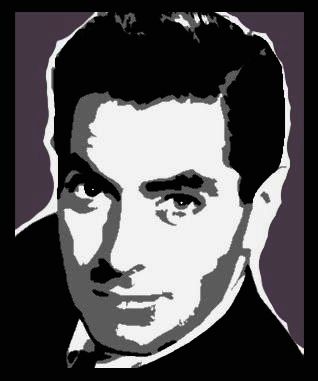
“There he was, dark-looking with black hair and eyebrows, and no man had a right to be that handsome.” So aviator Bob Buck remembered first meeting Tyrone Power. Buck, enlisted by his boss Howard Hughes, the owner of TWA, to pilot Power on a tour of South America, Africa and Europe, would spend three months with the actor and a small retinue on a trip that was set to begin in September 1947. The group would travel in Power’s plane, The Geek, named after a character in his latest film, Nightmare Alley.  At the time, at age 33, Tyrone Power was one of the biggest stars in Hollywood, an adored “matinee idol,” but his straightforward, unassuming manner instantly disarmed the skeptical Buck.

Tyrone Power, father and son
Born in Cincinnati in 1914, Tyrone Power descended from a long line of performing artists. His father, born Frederick Tyrone Power in England and billed as Tyrone Power, was a Shakespearean actor and hisfather was concert pianist Harold Power, son of celebrated Irish actor Tyrone Power. Tyrone Edmund Power was born May 5, 1914 to his 45-year-old father and his second wife, Emma (known as Patia Power). Young Tyrone and his sister, Anne, were the esteemed actor’s only children. Power, Sr., and Patia, who had shared the stage with him from time to time, divorced in 1920. The actor soon remarried and continued his stage and movie career while his ex-wife cared for the children and worked as a voice and drama coach.

It was at age 17 when he was just out of high school that the younger Tyrone Power was able to spend some months with his father. Encouraged by his parents, he had begun acting early in life and that summer of 1931 his father took him to Chicago where he was appearing in a production of The Merchant of Venice. Young Tyrone was given a small part in the play. The two later returned to Hollywood where the elder Power began work on a film. Several weeks into production he suffered a massive heart attack at the Hollywood Athletic Club and there he died in the arms of his son.

Tyrone Power on stage in St. Joan, 1936
By 1935, Tyrone Power, Jr., as he was then known, had made his way to Broadway and been taken under the wing of stage icon Katharine Cornell. He had a small role in Flowers in the Forest (1935), a play the actress produced, and Romeo and Juliet (1935 – 1936), in which Cornell and Maurice Evans starred. When he appeared in a supporting role in St. Joan (1936), starring Cornell, Power was approached by talent scouts from 20th Century Fox and offered a screen test; Katharine Cornell told the young actor he was ready for Hollywood.

She was right. Power’s brief appearance in his first film for Fox, Girls' Dormitory (1936) prompted a deluge of fan letters. Legend has it that powerful Hollywood columnist Hedda Hopper stayed to watch a second showing of the film just to check the credits for the name of the handsome young actor she’d spied in a brief role toward the end of the film.

It was with his third outing for Fox in 1936 that Tyrone Power became a star. Child actor Freddie Bartholomew, who played protagonist Jonathan Blake as a youth, was top-billed in Lloyd's of London. Fourth-billed Tyrone Power, who had far more screen time than anyone in the film, portrayed Blake as an adult. Only 22 at the time, but handsome, charismatic and self-possessed, Power walked away with the film. He would share top billing on his next assignment, In Old Chicago (1937), with Alice Faye and Don Ameche. Following the film’s great popular success, Fox would re-team him with Faye and Ameche in Alexander’s Ragtime Band (1938). Later in 1938, on loan to MGM, he appeared opposite Norma Shearer in the costume melodrama Marie Antoinette. Tyrone Power was now a firmly established leading man.

Tyrone Power on the set of Marie Antoinette (1938) with Norma Shearer
1939 would prove to be a watershed year for the 25 year old actor. He would portray the outlaw Jesse Jamesin one of only two Technicolor pictures Fox produced that year, and he would star in the studio’s spectacular The Rains Came. Nominated for six Academy Awards, it would win, in that year of the Gone with the Wind sweep, only one, for Best Effects, Special Effects. Power’s leading lady Myrna Loy remembered him as one of the nicest human beings she’d ever known. She would recall much later, “I’m sorry to report that we weren’t lovers, but close to it. I loved him, but he was married to that damn Frenchwoman.” That Frenchwoman was Annabella, the actress Power met a year earlier on Suez (1938) and married in 1939. Also in 1939, in an annual nationwide newspaper poll, Tyrone Power was voted “King of Hollywood.”

Tyrone Power, 1939's "King of Hollywood," with Ed Sullivan and "Queen" Jeanette MacDonald

Power next appeared as what has to have been one of the most attractive criminals in Hollywood history in Johnny Apollo (1940) opposite Dorothy Lamour. His first swashbuckler would follow, The Mark of Zorro (1940). Among his best known films, it features one of his most memorable performances. Tyrone Power and Basil Rathbone had reputations as two of the best fencers in film and they would dramatically cross swords in The Mark of Zorro:

Dec. 2012 update: sadly, this (colorized) YouTube clip was recently blocked

Before joining the U.S. Marines and departing for World War II, Power would star in one of his favorites, the vivid Technicolor Blood and Sand (1941). Directed by Rouben Mamoulian, it is the story of a brilliant bullfighter undone by temptation and jealousy. Power was apparently entranced by co-star Rita Hayworth, one of his two leading ladies (the other was Linda Darnell), and his stand-in reportedly noticed that the actor could not take his eyes from her throughout filming.

Rita Hayworth and Tyrone Power in Blood and Sand (1941)
Also prior to entering the service, Power completedA Yank in the R.A.F. (1941), a war-time romance that paired him with Fox’s other superstar, Betty Grable. He also appeared in The Black Swan (1942), a Technicolor swashbuckler in which Maureen O’Hara, as an aristocratic young beauty, plays hard-to-get with Power’s character, a dashing reformed pirate.

Tyrone Power, U.S. Marine Corps
Tyrone Power was about to turn 28 when he joined the USMC. He had developed an interest in flying through director Henry King and flew in the Pacific during the war, carrying supplies into Iwo Jima and flying the injured out, often under heavy enemy fire. When he returned to Hollywood just a few years later, he seemed to have aged. Though still very handsome, he appeared weary.

Power returned to the screen in the Edmund Goulding-directed production of Somerset Maugham’s The Razor’s Edge in 1946. Myrna Loy later remarked on the spiritual quality she saw in Power’s eyes. As Larry Darrell, a war veteran on a quest for enlightenment and meaning in The Razor’s Edge, she believed he was perfectly cast, “That was Ty,” she said.

Nightmare Alley (1947)
Nightmare Alley (1947) was a film Power battled with Fox chief Darryl Zanuck to make. Zanuck, protective of Power as a valuable studio asset, feared that casting him as a dark character in a downbeat film would damage his box office appeal. But Power was frustrated with the endless string of heroes he invariably played and longed to break type. As sleazy carnival huckster Stan Carlisle, Power is fascinating - and convincing. But Zanuck had no confidence in the film and it was given little promotion. Though it quickly faded from view it developed a solid reputation and following over the years. Captain from Castile (1947), Power’s first post-war swashbuckler, would not be his last. At the time the picture was filming in Mexico, he was in the midst of a high-profile romance with Lana Turner. She flew south of the border to be with him on Christmas 1946 and would remember their New Year’s Eve together as the happiest night of her life. Her daughter Cheryl Crane recalled that one of her own earliest memories was of sitting on Power’s lap in the family den. “I was only about three years old, but I remember his face.” Lana would forever refer to Power as the love of her life and recall, “No man except possibly Tyrone Power took the time to find out that I was a human being, not just a pretty, shapely little thing.”

1946: Lana Turner and Tyrone Power in Mexico
It was while involved with Lana and following the completion of his first three post-war films that Power readied for his trip across the Atlantic with pilot Bob Buck and crew. As the group prepared to depart on September 1, 1947, Turner took Buck aside and told him, “I love that guy, be sure you bring him back to me.”

Though Buck was originally drafted to pilot The Geek, Power confided early on that he would like to do most of the flying himself. Buck quickly learned that the actor “flew like an old pro” and relaxed into backing him up as co-pilot. Wherever The Geek landed, they were mobbed and sometimes pursued. Even landing in a jungle in Liberia and greeted by only two natives, one of the two pointed to Tyrone Power and said, “I know him.” When they arrived in Johannesburg, South Africa, Power’s group was welcomed by a crowd so large and enthusiastic that their driver commented, “they didn’t do this for the king and queen.” According to Buck, Power believed that people weren’t reacting to him but to the characters he played and their own romantic fantasies. Buck felt this perspective “kept his head size normal.” Buck formed a life-long friendship with Power and saw in him an all-American guy and natural athlete who could also talk religion, philosophy, art and literature. He had a photographic memory – which Buck witnessed first-hand when he watched the actor scan a script and then discuss it in great detail.

Once The Geek made its way to Europe, the group spent some time in Rome. It was there that Power encountered Linda Christian, a young starlet he would marry the following year. They would have two daughters before divorcing in the mid-‘50s.

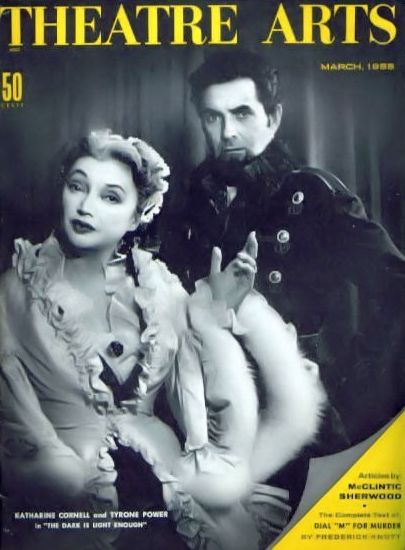
The Dark is Light Enough on Broadway, 1955
Back in Hollywood, Power’s career would continue with a mix of swashbucklers, adventures, light fare and big budget A-films.

In 1951 Power went on the London stage for a six month engagement of a Joshua Logan-directed production of Mr. Roberts. It was a sold-out run and Variety characterized his performance in the title role as a “warm, colorful and meaningful interpretation.” He toured the U.S. very successfully in John Brown’s Body and took it to Broadway in 1953 with Raymond Massey and Judith Anderson. He returned to Broadway in 1955 with The Dark is Light Enough, starring with Katharine Cornell (a young Christopher Plummer would win a Theatre World Award for his supporting performance in the play). Power’s final Broadway appearance came in Back to Methuselah in 1958 with Faye Emerson.

His last finished film would be Billy Wilder’s Witness for the Prosecution (1957) with Charles Laughton and Marlene Dietrich. In it, Power, cast against type as an accused killer, delivers one of his most acclaimed performances. Billy Wilder reported that co-star Marlene Dietrich developed an enormous crush on Power during filming and remarked, “Everybody had a crush on Ty…it was impossible to be impervious to that kind of charm.”

Tyrone Power, Marlene Dietrich, Witness for the Prosecution (1957)
In 1958, 44-year-old Tyrone Power married 26-year-old Debbie Minardos. They traveled to Spain in September where he was to film the King Vidor epic Solomon and Sheba. On November 15, Power collapsed on the set during an arduous swordfight scene with George Sanders and suffered a massive heart attack; he died on the way to the hospital. It had been ice-cold on the set that day and he was a heavy smoker. Power’s wife gave birth to their son, Tyrone Power IV, in January 1959.

“His voice was beautiful to listen to, deep, clear and strong,” Bob Buck wrote; his dark, long-lashed eyes radiated warmth and a soulful quality. He performed with sensitivity and conviction and he brought to the screen a certain nobility and tempered reserve. He was Fox’s top leading man for more than 15 years and though his late career had its ups and downs, his last films were some of his greatest successes. He has been called “illegally handsome” and perhaps his looks, coupled with a powerful onscreen charisma, blinded both studio and audience to his actual talent and capacity to be something more than a leading man.

Today, August 25, Turner Classic Movies honors Tyrone Power with a full 24 hours of his films as part of its annual Summer Under the Stars celebration in August. Click here for the schedule of films.  Click here for more on Michael and Jill’s Summer Under the Stars blogathon.

Portrait of Tyrone Power by Claire Trevor, 1958

Notes:
North Star Over My Shoulder: A Flying Life by Bob Buck, Simon & Schuster (2002)
Being and Becomingby Myrna Loy and James Kotsilibas-Davis, Alfred A. Knopf (1987)
On Sunset Boulevard: The Life and Times of Billy Wilder by Ed Sikov, Hyperion (1998)
Lana: the Memories, the Myths, the Movies by Cheryl Crane, Running Press (2008)