Showing posts with label Tyrone Power. Show all posts

Thursday, October 10, 2013

Nightmare Alley to Make Its TCM Premiere

Nightmare Alley

Tyrone Power was one of the biggest stars in Hollywood from the late 1930s through the late 1950s and he was 20th Century Fox's most famous star until Marilyn Monroe came along. Turner Classic Movies hasn't traditionally aired as many films of Fox's great stars as those from other studios - this has been about film rights more than anything else. Since TCM entered into an exclusive licensing deal with Fox, though, that has begun to change.


In August 2012, Tyrone Power was honored for the first time with a day filled with his films as part of TCM's annual Summer Under the Stars event. Soon after, more of Power's films began appearing on the channel than in the past, but Wednesday evening, October 16, marks the first time since then that TCM's primetime schedule and late night hours are being devoted to his movies.  Among the films to be aired are two that will be making their TCM debuts: Rawhide (1951), a Western, and Nightmare Alley (1947), a film noir that contains what most consider Power's best dramatic performance.

The Schedule (all times Eastern/Pacific):

8:00pm/5:00pm  Rawhide (1951), co-starring Susan Hayward, directed by Henry Hathaway

9:45pm/6:45pm  Nightmare Alley (1947), co-starring Joan Blondell, directed by Edmund Goulding

11:45pm/8:45pm  The Mark of Zorro (1940), co-starring Basil Rathbone and Linda Darnell, directed by Rouben Mamoulian

1:30am/10:30pm  The Black Swan (1942), co-starring Maureen O'Hara, George Sanders, Thomas Mitchell and Anthony Quinn, directed by Henry King

3:00am/midnight  Marie Antoinette (1938), co-starring Norma Shearer, directed by W.S. Van Dyke 


The Black Swan

Sunday, May 5, 2013

artwork by Rob Kelly

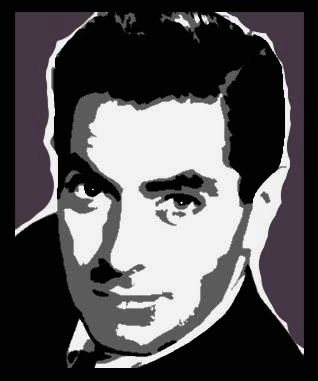
99 years ago Tyrone Edmund Power was born in Cincinnati, Ohio. 22 years after that he became a movie star and would remain one for the rest of his life – another 22 years. The biggest male star at 20thCentury Fox during the ‘30s and ‘40s, Power is remembered by most today as a charismatic leading man of extraordinary looks and resonant voice. He was also a talented and ambitious actor.
Rose of Washington Square
Today, on the 99th anniversary of Power’s birth and the 98th anniversary of Alice Faye’s, Turner Classic Movies will air one of their hits from the 1930s, Rose of Washington Square (1939). The film, the third and last pairing of Power and Faye, was a barely veiled fiction based on Fanny Brice’s rise to fame and her tumultuous relationship with her second husband, professional gambler Nicky Arnstein (Brice was incensed and sued Fox for defamation of character - the case was settled out of court). TCM and the Fox Movie Channel are airing a broad range of Power’s films this month – click here for a schedule.

Tyrone Power’s centenary will be celebrated in 2014 with film retrospectives in his hometown as well as in New York and Los Angeles. Click here for more information. To learn more about his life and career, click here.

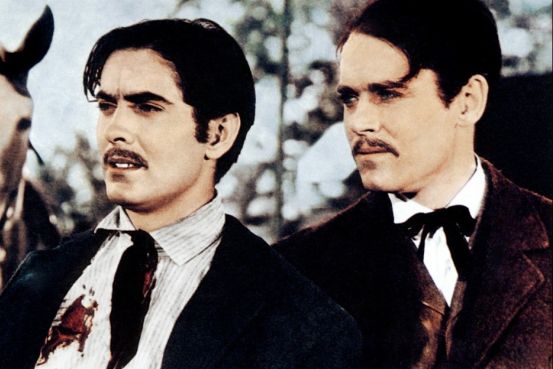
Tyrone Power and Henry Fonda in Jesse James (1939)...airs on TCM May 19

Wednesday, February 20, 2013

Woodcut print by Guy Budziak
Coney Island's first so-called "freak show" opened in 1880, but the heyday of its sideshow attractions began nearly 25 years later when Samuel W. Gumpertz opened "Lilliputia" at Dreamland, one of the site's three major amusement parks. Wildly popular with tourists, "Lilliputia" was a miniature city scaled to accommodate its 300 midget and dwarf residents. When Dreamland burned in 1911, Gumpertz built the Dreamland Circus Sideshow and traveled the world constantly seeking "freaks" (usually those with congenital anomalies) and people from exotic lands (Filipino blowgun shooters, actual "wild men" from Borneo, Ubangi women with plated lips) for his shows. In no time Gumpertz would have competition from The World Circus Freak Show, Wonderland Circus Sideshow and other copy-cat venues large and small.

Geek show, Nightmare Alley
During Coney Island's peak, its bizarre sideshow attractions drew great crowds. Naturally, young people were especially awed by the incredible "human oddities" on display. One boy, whose family had recently moved to Brooklyn, became enthralled with these freak attractions. He haunted the sideshows and reportedly held a job on the midway for a while. His name was William Lindsay Gresham and he was born in Baltimore in 1909. His family had moved from Baltimore to Massachusetts in 1916 before coming to New York and, for most of his life, Gresham would live in New York. He worked as a reporter after high school and for a time made a living in Greenwich Village as a folk singer. In the late '30s he served in the Spanish Civil War, fighting the good fight against Franco. While in Spain he met a fellow American who regaled him with memories of life on the carnival circuit. It was through this man, 'Doc' Halliday, that William Lindsay Gresham learned all about 'carny culture' and first heard of the sideshow act known as 'the geek.' Halliday's description of this creature, a man who crawled around in filth and bit the heads from live chickens and snakes for booze money, revolted and intrigued Gresham. He could not get the image out of his head and later said, "to get rid of it, I had to write it out."
 
William Lindsay Gresham
After he returned to the states, Gresham found employment editing and contributing to pulp magazines. With a steady income providing some financial stability, he was able to begin work on his first novel. Nightmare Alley appeared in 1946. The novel was a soul blistering tour of third-rate Depression-era carnival life and the "spook racket." 'Protagonist' Stan Carlisle is a handsome young man in a low-level carny job who is driven at first by lust and then by the burning ambition to make it big. Coolly conning nearly everyone who crosses his path, Stan makes his way up, up, up as a bogus clairvoyant and on to the heights as a religious charlatan. But he meets his match in a high-end grifter even more cold-blooded than he is. Stan's fall is fast and far and horrific.

Author Gresham, a tormented man in search of peace of mind, had, by the time he was writing Nightmare Alley, already dabbled in Marxism and psychoanalysis and was now studying the Tarot (each chapter of the book is named for a Major Arcana card). He would go on to delve into and abandon Christianity, Zen Buddhism and Alcoholics Anonymous. None of these pursuits would alleviate his struggle with personal demons. The expanse of Gresham's own sense of desperation was revealed in his all-too-real depiction of human despair in Nightmare Alley; later in life he would claim in a letter, "Stan is the author."

Nightmare Alley was a success and the film rights were quickly snapped up by Tyrone Power, who'd read the book and saw in Stan Carlisle the role of a lifetime. He pressed his boss, 20th Century Fox head Darryl F. Zanuck, to produce the adaptation and allow him to star. The film Power badgered Zanuck to make would be directed by Edmund Goulding and co-star Joan Blondell, Helen Walker and Coleen Gray. It was released in 1947.

Tyrone Power makeup test for Nightmare Alley

If William Lindsay Gresham was a troubled misfit, Tyrone Power would seem his very opposite. Born into a legendary theatrical family and graced with good looks, onscreen charisma and talent, Power was a movie star by age 22 - a decade or more younger than most leading men of the late '30s. But, as the years passed, Power became frustrated with the too-often shallow roles Fox offered him and had begun to have misgivings about his career. He told a girlfriend, "Someday I'll show the @!&%!*s who say I was a success just because of my pretty face..." and famously commented on charismatic appeal, "The secret of charm is bullshit." By the time Nightmare Alley came along, Tyrone Power was ready to play Stan Carlisle.

Helen Walker as Dr. Lilith Ritter
A 1947 film adaptation of Nightmare Alley could never have been entirely faithful to the novel - the book was just too raw, sexual and disturbing. So the story was streamlined and cleaned up. Noir veteran Jules Furthman's screenplay could only imply or allude to what was far more perverse and explicit in the novel. Furthman did manage to incorporate a good dose of Gresham's rich and authentic huckster jargon into the script and Goulding evokes, as much as he was allowed, the novel's underlying savagery. An A-budget noir, Nightmare Alley's ink-black look came courtesy of Lee Garmes, one of the developers of "Rembrandt lighting," with art direction by Lyle Wheeler, effects by Fred Sersen and makeup by Ben Nye. Joan Blondell is a natural cast as blowzy, pillowy Zeena, the mentalist, and Helen Walker as Dr. Lilith Ritter is razor-blade deadly. But it is Tyrone Power's portrayal of Stan Carlisle that is the eye-opener. Power's Stan evolves from opportunistic naif to oily hustler, slick headliner, relentless schemer, jumpy man-on-the-run and, finally, vulnerable rum-dum. The transformation is shattering.

It's no secret that Darryl Zanuck disliked Nightmare Alley. Power was his box office bonanza of a leading man and Zanuck hadn't wanted to risk casting him in so dark a film. But was it a risk? The post-war era brought stars like Joan Crawford (Mildred Pierce), Ray Milland (The Lost Weekend), Lana Turner (The Postman Always Rings Twice), Ronald Coleman (A Double Life) and others new success - and sometimes an Oscar - for less than sympathetic character portrayals in downbeat films. On release, Nightmare Alley received mixed reviews (a New York Times reviewer complained, "this film traverses distasteful dramatic ground") but Power's performance was widely acclaimed. That was not enough to reassure an already nervous studio and the film's run in theaters was brief. It was a commercial failure.

 Pete (Ian Keith) reads Stan (Tyrone Power)

Zanuck's reluctance to back Nightmare Alley is often blamed for its failure. But his caution makes sense given the times and his understanding of Tyrone Power's place in movie goers' hearts. Audiences could handle the handsome star as a skirt-chasing carnival Lothario sporting a cocky attitude and a tight tee-shirt. But once Stan's seamy nature begins to creep to the surface - a wad of chewing gum always in his cheek, a cigarette behind his ear, a spiel ever on his lips - the audience might start to get jittery. When he slips a bottle of hooch to Pete (Ian Keith), a carny alcoholic who is an obstacle to his dreams, there's no denying Stan's ruthlessness. It becomes clear soon enough that Stan is a nastier more cynical sort than Dion O'Leary, a romanticized Jesse James or Clive Briggs. By film's end, when an unhinged Stan runs through the midway, wild-eyed and vacant, swinging a club at anyone who comes near, Power's multitude of fans might well have stared in disbelief. How could Tyrone Power (Zorro, that Yank who joined the RAF, Jamie Waring!?!) possibly be the pathetic, disfigured wretch on the screen? They may not have realized or cared that they had just witnessed the performance of his career. Darryl Zanuck must have breathed a deep sigh of relief when Captain from Castile, a Technicolor swashbuckler Power finished just before Nightmare Alley, was released a few months later to blockbuster business.

Tyrone Power as Stan Carlisle
The publication and reception of Nightmare Alley was the one great success of William Lindsay Gresham's career. His second and final novel was a commercial flop. He went back to writing for pulp magazines and published only three more books, all non-fiction. With his health failing and low on cash, Gresham took his own life in a cheap New York hotel in September 1962. He is best remembered by some as a footnote in the life of C.S. Lewis; Gresham's second wife, Joy Davidman, married Lewis after her split from Gresham. Shadowlands, a TV movie, play and film, was based on the Lewis/Davidman relationship.  Others place Gresham in the pantheon of writers like Nathaniel West, James M. Cain and Jim Thompson. Nightmare Alley's reputation has grown steadily through the years and in 2010 New York Review Books published a new, uncensored edition. This publication boasts an introduction by Nick Tosches, who is at work on a Gresham biography. The NYRB edition of Nightmare Alley was hailed by critics; reviews were filled with glowing adjectives - and one constant noun: masterpiece.

Tyrone Power would never have another film role quite equal to Stan Carlisle, but his last onscreen performance, in Billy Wilder's Witness for the Prosecution (1957), was as a character not unlike Stan. Once more he received critical praise, something he'd nearly given up on ("They still don't take me seriously," he complained a year or so earlier). Power had spent the intervening years making movies of varying quality, working successfully in the theater, traveling the world - and going through a succession of women and a lot of money. His death at age 44 occurred in Spain where he was filming Solomon and Sheba. Perhaps fate thought it better to spare him that biblical swashbuckler. Of all the films he made, Nightmare Alley would remain Power's favorite, the one he screened at home for friends.


Nightmare Alley developed a cult following that continued to grow over the decades. Because of legal wrangling between the estate of its producer, George Jessel, and 20th Century Fox, it was kept out of the home video market for years. Finally released on DVD in 2005, the film was greeted with a new wave of enthusiasm from critics, film buffs and film noir fans. Once overlooked and undervalued, Nightmare Alley is now considered a noir classic, one of the bleakest films in a bleak genre, singular for its carny setting and absence of thugs-with-guns and outright murder.


This piece is my contribution to the Classic Movie Blog Association's Fabulous Films of the 1940s Blogathon. Click here for links to all participating blogs.

Notes:
Nightmare Alley by William Lindsay Gresham, Introduction by Nick Tosches, New York Review Books (2010)
Noir Fiction: Dark Highways by Paul Duncan, Oldcastle Books (2000)
Dark City: The Lost World of Film Noir by Eddie Muller, St. Martin's Press (1998)
All Those Tomorrows by Mai Zetterling, Grove Press (1985)
The Films of Tyrone Power by Dennis Belafonte with Alvin H. Marill, Citadel Press (1979)


Thursday, February 7, 2013


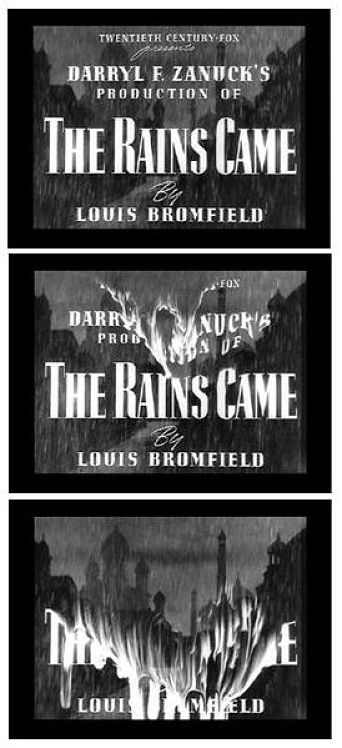
There is no mistaking that drama on a grand scale is about to take place even before the first scene of The Rains Came (1939) begins. Alfred Newman's commanding score pounds, the title sequence rolls over the dark image of a rain drenched ancient city, and as each hand-lettered title appears it is soon washed from the screen as if swept away in a downpour.


The film opens on a more languid note. A group of Indian musicians plays a song, hypnotic and dreamy, beneath a tree filled with chattering monkeys. A white man, taking shade from the heat, observes from the broad veranda where he lounges. This lighter tone persists as the man, British expatriate Tom Ransome (George Brent) is visited by his good friend, Major Rama Safti (Tyrone Power), and then by an American missionary's wife bearing a party invitation. Later on, lovely and wayward Lady Edwina Esketh (Myrna Loy) arrives in India and the mood begins to shift with her troublesome presence.

George Brent and Myrna Loy, alone in a darkened room somewhere in the palace
Halfway into this lavish forbidden love/disaster epic, a massive earthquake strikes and triggers a catastrophic flood. As the plot's steamy intrigues have stirred the emotions, so the cinematic vision of quake and flood overwhelms the senses. For these thrilling sequences the very first Oscar for Best Special Effects was awarded to Fred Sersen (visual effects) and E.H. Hansen (sound effects). The Rains Came, produced by Darryl F. Zanuck and directed by Clarence Brown for 20th Century Fox, was nominated for another five Academy Awards.

It's believed that the first in-camera special effect was part of a short film sequence titled The Execution of Mary Queen of Scots (1895). The effect of a be-heading was achieved with the use of a dummy and a shot known as a substitution shot or a stop trick. A few years later pioneering George Melies produced his 14 minute effects-laden La voyage dans la lune/A Trip to the Moon (1902) and by 1923 Cecil B. DeMille was able to simulate the parting of the Red Sea for the first time with his original version of The Ten Commandments. When the first Academy Awards were presented for 1928 a plaque for Best Engineering Effects was given to Roy Pomeroy for Wings, but the category did not continue. An honorary award was presented to Gordon Jennings (and shared with others) for effects created on 1938's Spawn of the North; the following year the Best Special Effects category was established. 1939, that banner year of legendary Hollywood films, was  Gone with the Wind's year when it came to record-breaking Academy Award wins (eight). Among the five it did not win was the special effects award taken by The Rains Came; a total of seven films had been nominated in the category including The Wizard of Oz.
Myrna Loy and Tyrone Power at the Maharani's music school

The Rains Came was based on Louis Bromfield's best-selling 1937 novel, The Rains Came: A Novel of Modern India. Set in the fictional Indian state of Ranchipur during the last years of the British Raj, the story follows three principal characters. Tom Ransome (Brent) is a charming sot of a British 'younger son' (aristocrat) who arrived Ranchipur seven years earlier to paint a still unfinished portrait. Lady Edwina Esketh (Loy) is the jaded and promiscuous trophy wife of the much older and unrelentingly boorish Lord Esketh (Nigel Bruce). Major Rama Safti (Power) is a high-caste Indian doctor who trained in the U.S. and returned to Ranchipur, bringing with him the modern practice of medicine and enlightened social values. Early on, Ransome and Lady Esketh, former lovers, meet at a party in the royal palace. After the two slip away from the festivities for a bit of private passion, they return and Lady Esketh's roving eye falls upon the handsome 'pale copper Apollo,' Major Safti. To Ransome's displeasure, Edwina makes it clear she plans to seduce the young doctor. Meanwhile, Ranchipur looks forward to the end of its dry season and all anxiously await the coming of the rain. When it comes, it arrives in an unending torrent. Soon a powerful earthquake hits and the swollen local dam collapses. The ensuing calamity disrupts the best laid plans, virtuous and scandalous alike, of everyone in Ranchipur.


Fred Sersen's drawing for flood scene
Flood scene
According to The Hollywood Reporter, the film was budgeted at $2,500,000 with $500,000 for sets and $500,000 for the flood and earthquake scenes. A tank holding 50,000 gallons of water was constructed on a Fox sound stage to create the effects for the flood scenes. 350 grips, carpenters and others worked on these sequences for more than a month.

It was author Bromfield's philosophy that "the story must grow out of the characters, their environment and background" rather than "be imposed on a plot."  The natural disaster of the earthquake, along with the flood, fires and cholera that follow, profoundly alters each main character. Tom Ransome and Lady Esketh, both molded in the world of the British aristocracy, are transformed. Ransome, whose expat life in exotic Ranchipur had grown dissolute and stale, is restored, finding new purpose in the aftermath through service to the Maharani and in discovering new love. Edwina Esketh, once the incarnation of chilly self-indulgence, volunteers at Major Safti's hospital. Having fallen in love with the doctor and no longer in predatory pursuit of him, she wishes to be useful and helpful in his work. Noble Major Safti, who has been a model of duty and devotion to his country as well as a symbol of "the new India," realizes that he cannot - and will not - reason away what has awakened in his heart. These characters and a narrative of illicit love set in a colonial outpost are what make The Rains Came connect as something more than a beautifully filmed and scored special effects extravaganza.

Cast against type (something that rarely happened once she became MGM's "ideal wife"), Myrna Loy is entirely believable as man-eating Edwin Esketh, a spoiled woman who is humbled and changed by love and circumstance. Sparks fly when Loy shares the screen with Tyrone Power. One of Power's strengths is his ability to underplay in intimate scenes. His resonant voice softens and takes on a hint of velvet as he communicates emotion through his eyes. The effect is heart-melting warmth.

Loy and Power share one especially tender scene that takes place in the early morning on a hospital ward. That scene is included at the end of the following clip which also contains a classic sequence in which the very tired Lady Esketh makes and then realizes that she's made a horrific mistake (listen for the sustained-string musical cue): 6/3/13 update: the YouTube clip originally included below was recently deleted from the site.

    
George Brent, who received third billing, is the actual male lead and he, like Loy, believably conveys his character's transformation, in Ransome's case from roue to responsible citizen.  Ransome's involvement with infatuated young Fern Simon (Brenda Joyce) is the film's other dangerous romance.  She is very young, he is decades older and has a reputation. This was Joyce's film debut and it shows. She is a beautiful girl but green and awkward onscreen. Zanuck had initially considered Lana Turner for the role but, unfortunately, settled on the Fox starlet instead. Solid in supporting roles are Nigel Bruce (Lord Esketh), Maria Ouspenskaya (Maharani), H.B. Warner (Maharajah) and Mary Nash (Miss McDaid). As was the custom then, all the key Indian characters are portrayed by Caucasian actors: Power, Ouspenskaya, Warner and Joseph Schildkraut (Mr. Bannerjee).

Alfred Newman's stunning score for The Rains Came is a favorite of mine.  Dramatic (the main theme) and romantic (he uses the sweet and haunting "Hindoo Love Song" as Lady Esketh and Major Safti's love theme), it is also chilling (the music cues that signal danger, as in the scene shown above). Newman received an Oscar nomination for his score (as well as for three other films he scored that year: Wuthering Heights, The Hunchback of Notre Dame and They Shall Have Music). In all, Alfred Newman was nominated for 45 Oscars, won 9 (a record) and is considered one of the "three godfathers" of film music along with Max Steiner and Dmitri Tiomkin.

The Rains Came does not masquerade as a realistic depiction of India in the 1930s (there is no mention of Gandhi or British oppression), it is a visually dazzling romantic epic - a true Hollywood Movie - and irresistible.

~

The Rains Came airs Friday morning, February 8, at 9:30am Eastern/6:30am Pacific on Turner Classic Movies as part of its annual "31 Days of Oscar" celebration.

~

Oscar Nominations
Special Effects  - Fred Sersen, E.H. Hansen (winner)
Music/Original Score - Alfred Newman
Cinematography - Arthur C. Miller
Art Direction - William S. Darling, George Dudley
Film Editing - Barbara McLean
Sound Recording - E. H. Hansen

~

This post is my entry in the 31 Days of Oscar Blogathon hosted by Once Upon a Screen, Outspoken & Freckled and Paula's Cinema Club. Click here for a link to a listing of participating blogs.


Sunday, January 27, 2013


I wasn’t sure, exactly, what the word meant and was curious, so I went to the Internet in search of an answer. There I found the verb swashbuckle defined as “to engage in daring and romantic adventures with ostentatious bravado or flamboyance.” According to Merriam Webster, the word is a “back-formation” from the noun swashbuckler that came into use in around 1897. The Online Etymology Dictionary revealed more on the history of swashbuckler: 

1550’s “fighting, swaggering fighting man” (earlier simply swash, 1540s), from swash “fall of a blow”…plus buckler “shield.” The original sense seems to have been “one who makes menacing noises by striking his or an opponent’s shield.”

Fascinating. Well, it is if you love words as I do.


On Monday, January 28, Turner Classic Movies treats viewers to many hours of swashbuckling with an evening devoted to “Sword Play.” Two of the genre’s great stars, Tyrone Power and Errol Flynn, will be in the spotlight, along with Oscar winner Jose Ferrer and a pair of 20th Century Fox’s lesser leading men, John Payne and Cornel Wilde.

The first film in the line-up (8pm Eastern/5pm Pacific) is the best of the night’s offerings. It is 20th Century Fox’s rollicking remake of a 1920 Douglas Fairbanks  classic, The Mark of Zorro (1940) starring Tyrone Power in the title role, with Linda Darnell, Basil Rathbone, Gale Sondergaard and Eugene Pallette. Directed by Rouben Mamoulian, who would re-team with Power again for 1941’s Blood and Sand, the film was a blockbuster in its time that set the standard for the multitude of big and small screen remakes and sequels to come. Power’s performance as the fey-by-day/heroic-by-night Don Diego/Zorro is one of his signature roles - and The Mark of Zorro contains one of the all-time great swordfights on film. New York Times critic Bosley Crowther cited the “jim-dandy duel between Mr. Power and the villainous Basil Rathbone, which ends about as juicily as anyone could wish.” Rathbone, a skilled fencer, would recall, “Power was the most agile man with a sword I’ve ever faced before a camera. Tyrone could have fenced Errol Flynn into a cocked hat.” Rathbone, who dueled with both men onscreen, would surely have known. Alfred Newman’s memorable score was nominated for an Oscar and, more recently - in 2009, The Mark of Zorro was selected by the National Film Preservation Board to be added to the National Film Registry’s list of “culturally, historically or aesthetically significant” films.


Next up on TCM’s Monday night schedule (10pm Eastern/7pm Pacific) is Adventures of Don Juan from Warner Bros. in 1948 starring the credibly cast Errol Flynn in one of his later swashbuckling efforts. John Barrymore had starred with Mary Astor in a silent 1927 rendering of the infamous lover’s legend. In the Warner’s production, directed by Vincent Sherman, the great ‘swordsman’ is compelled to provide assistance to his queen (Viveca Lindfors) and country. With this film Flynn was returning to a familiar genre following the so-so reception of his most recent post-war films. Though Adventures of Don Juan was not a great box office success, it won an Oscar for costume design and a nomination for art and set design.

Jose Ferrer won an Oscar for his portrayal of Cyrano
Cyrano de Bergerac (1950) from Stanley Kramer Productions, is set to air at midnight Eastern/9pm Pacific. Jose Ferrer won a Best Actor Oscar for his colorful portrayal of the poetic swordsman with the preposterous proboscis. Mala Powers co-stars as the beloved Roxane.

Later (2am Eastern/11am Pacific), John Payne rides the waves in Raiders of the Seven Seas (1953) and finally (3:45am Eastern/12:45am Pacific), Cornel Wilde stars in At Sword’s Point (1951) as the offspring of one of the Three Musketeers. Maureen O’Hara co-stars. 

The Mark of Zorro is a favorite of mine and I barely remember Adventures of Don Juan so, because I'm going to be out Monday night, I'll be recording both. Monday marks my first sojourn this year to San Francisco’s Noir City festival. The night's program is a “Pre-Code Proto-Noir Triple Bill” – William Wyler’s A House Divided (1931) starring Walter Huston, The Kiss Before the Mirror (1933) directed by James Whale starring Nancy Carroll, Frank Morgan and Gloria Stuart, and Laughter in Hell (1933), a film thought to be lost but recently rediscovered, starring Pat O’Brien. I’ll be back to the noir fest on Wednesday night for “San Francisco Noir,” a double-bill we couldn’t resist featuring Edward Dmytryk’s The Sniper (1952) and Experiment in Terror (1962), directed by Blake Edwards and starring Glenn Ford and Lee Remick.

It seems, when it comes to movie-watching, my life has become the definition of the adjective busy...


Saturday, August 25, 2012


“There he was, dark-looking with black hair and eyebrows, and no man had a right to be that handsome.” So aviator Bob Buck remembered first meeting Tyrone Power. Buck, enlisted by his boss Howard Hughes, the owner of TWA, to pilot Power on a tour of South America, Africa and Europe, would spend three months with the actor and a small retinue on a trip that was set to begin in September 1947. The group would travel in Power’s plane, The Geek, named after a character in his latest film, Nightmare Alley.  At the time, at age 33, Tyrone Power was one of the biggest stars in Hollywood, an adored “matinee idol,” but his straightforward, unassuming manner instantly disarmed the skeptical Buck.

Tyrone Power, father and son
Born in Cincinnati in 1914, Tyrone Power descended from a long line of performing artists. His father, born Frederick Tyrone Power in England and billed as Tyrone Power, was a Shakespearean actor and hisfather was concert pianist Harold Power, son of celebrated Irish actor Tyrone Power. Tyrone Edmund Power was born May 5, 1914 to his 45-year-old father and his second wife, Emma (known as Patia Power). Young Tyrone and his sister, Anne, were the esteemed actor’s only children. Power, Sr., and Patia, who had shared the stage with him from time to time, divorced in 1920. The actor soon remarried and continued his stage and movie career while his ex-wife cared for the children and worked as a voice and drama coach.

It was at age 17 when he was just out of high school that the younger Tyrone Power was able to spend some months with his father. Encouraged by his parents, he had begun acting early in life and that summer of 1931 his father took him to Chicago where he was appearing in a production of The Merchant of Venice. Young Tyrone was given a small part in the play. The two later returned to Hollywood where the elder Power began work on a film. Several weeks into production he suffered a massive heart attack at the Hollywood Athletic Club and there he died in the arms of his son.

Tyrone Power on stage in St. Joan, 1936
By 1935, Tyrone Power, Jr., as he was then known, had made his way to Broadway and been taken under the wing of stage icon Katharine Cornell. He had a small role in Flowers in the Forest (1935), a play the actress produced, and Romeo and Juliet (1935 – 1936), in which Cornell and Maurice Evans starred. When he appeared in a supporting role in St. Joan (1936), starring Cornell, Power was approached by talent scouts from 20th Century Fox and offered a screen test; Katharine Cornell told the young actor he was ready for Hollywood.

She was right. Power’s brief appearance in his first film for Fox, Girls' Dormitory (1936) prompted a deluge of fan letters. Legend has it that powerful Hollywood columnist Hedda Hopper stayed to watch a second showing of the film just to check the credits for the name of the handsome young actor she’d spied in a brief role toward the end of the film.

It was with his third outing for Fox in 1936 that Tyrone Power became a star. Child actor Freddie Bartholomew, who played protagonist Jonathan Blake as a youth, was top-billed in Lloyd's of London. Fourth-billed Tyrone Power, who had far more screen time than anyone in the film, portrayed Blake as an adult. Only 22 at the time, but handsome, charismatic and self-possessed, Power walked away with the film. He would share top billing on his next assignment, In Old Chicago (1937), with Alice Faye and Don Ameche. Following the film’s great popular success, Fox would re-team him with Faye and Ameche in Alexander’s Ragtime Band (1938). Later in 1938, on loan to MGM, he appeared opposite Norma Shearer in the costume melodrama Marie Antoinette. Tyrone Power was now a firmly established leading man.

Tyrone Power on the set of Marie Antoinette (1938) with Norma Shearer
1939 would prove to be a watershed year for the 25 year old actor. He would portray the outlaw Jesse Jamesin one of only two Technicolor pictures Fox produced that year, and he would star in the studio’s spectacular The Rains Came. Nominated for six Academy Awards, it would win, in that year of the Gone with the Wind sweep, only one, for Best Effects, Special Effects. Power’s leading lady Myrna Loy remembered him as one of the nicest human beings she’d ever known. She would recall much later, “I’m sorry to report that we weren’t lovers, but close to it. I loved him, but he was married to that damn Frenchwoman.” That Frenchwoman was Annabella, the actress Power met a year earlier on Suez (1938) and married in 1939. Also in 1939, in an annual nationwide newspaper poll, Tyrone Power was voted “King of Hollywood.”

Tyrone Power, 1939's "King of Hollywood," with Ed Sullivan and "Queen" Jeanette MacDonald

Power next appeared as what has to have been one of the most attractive criminals in Hollywood history in Johnny Apollo (1940) opposite Dorothy Lamour. His first swashbuckler would follow, The Mark of Zorro (1940). Among his best known films, it features one of his most memorable performances. Tyrone Power and Basil Rathbone had reputations as two of the best fencers in film and they would dramatically cross swords in The Mark of Zorro:

Dec. 2012 update: sadly, this (colorized) YouTube clip was recently blocked

Before joining the U.S. Marines and departing for World War II, Power would star in one of his favorites, the vivid Technicolor Blood and Sand (1941). Directed by Rouben Mamoulian, it is the story of a brilliant bullfighter undone by temptation and jealousy. Power was apparently entranced by co-star Rita Hayworth, one of his two leading ladies (the other was Linda Darnell), and his stand-in reportedly noticed that the actor could not take his eyes from her throughout filming.

Rita Hayworth and Tyrone Power in Blood and Sand (1941)
Also prior to entering the service, Power completedA Yank in the R.A.F. (1941), a war-time romance that paired him with Fox’s other superstar, Betty Grable. He also appeared in The Black Swan (1942), a Technicolor swashbuckler in which Maureen O’Hara, as an aristocratic young beauty, plays hard-to-get with Power’s character, a dashing reformed pirate.

Tyrone Power, U.S. Marine Corps
Tyrone Power was about to turn 28 when he joined the USMC. He had developed an interest in flying through director Henry King and flew in the Pacific during the war, carrying supplies into Iwo Jima and flying the injured out, often under heavy enemy fire. When he returned to Hollywood just a few years later, he seemed to have aged. Though still very handsome, he appeared weary.

Power returned to the screen in the Edmund Goulding-directed production of Somerset Maugham’s The Razor’s Edge in 1946. Myrna Loy later remarked on the spiritual quality she saw in Power’s eyes. As Larry Darrell, a war veteran on a quest for enlightenment and meaning in The Razor’s Edge, she believed he was perfectly cast, “That was Ty,” she said.

Nightmare Alley (1947)
Nightmare Alley (1947) was a film Power battled with Fox chief Darryl Zanuck to make. Zanuck, protective of Power as a valuable studio asset, feared that casting him as a dark character in a downbeat film would damage his box office appeal. But Power was frustrated with the endless string of heroes he invariably played and longed to break type. As sleazy carnival huckster Stan Carlisle, Power is fascinating - and convincing. But Zanuck had no confidence in the film and it was given little promotion. Though it quickly faded from view it developed a solid reputation and following over the years. Captain from Castile (1947), Power’s first post-war swashbuckler, would not be his last. At the time the picture was filming in Mexico, he was in the midst of a high-profile romance with Lana Turner. She flew south of the border to be with him on Christmas 1946 and would remember their New Year’s Eve together as the happiest night of her life. Her daughter Cheryl Crane recalled that one of her own earliest memories was of sitting on Power’s lap in the family den. “I was only about three years old, but I remember his face.” Lana would forever refer to Power as the love of her life and recall, “No man except possibly Tyrone Power took the time to find out that I was a human being, not just a pretty, shapely little thing.”

1946: Lana Turner and Tyrone Power in Mexico
It was while involved with Lana and following the completion of his first three post-war films that Power readied for his trip across the Atlantic with pilot Bob Buck and crew. As the group prepared to depart on September 1, 1947, Turner took Buck aside and told him, “I love that guy, be sure you bring him back to me.”

Though Buck was originally drafted to pilot The Geek, Power confided early on that he would like to do most of the flying himself. Buck quickly learned that the actor “flew like an old pro” and relaxed into backing him up as co-pilot. Wherever The Geek landed, they were mobbed and sometimes pursued. Even landing in a jungle in Liberia and greeted by only two natives, one of the two pointed to Tyrone Power and said, “I know him.” When they arrived in Johannesburg, South Africa, Power’s group was welcomed by a crowd so large and enthusiastic that their driver commented, “they didn’t do this for the king and queen.” According to Buck, Power believed that people weren’t reacting to him but to the characters he played and their own romantic fantasies. Buck felt this perspective “kept his head size normal.” Buck formed a life-long friendship with Power and saw in him an all-American guy and natural athlete who could also talk religion, philosophy, art and literature. He had a photographic memory – which Buck witnessed first-hand when he watched the actor scan a script and then discuss it in great detail.

Once The Geek made its way to Europe, the group spent some time in Rome. It was there that Power encountered Linda Christian, a young starlet he would marry the following year. They would have two daughters before divorcing in the mid-‘50s.

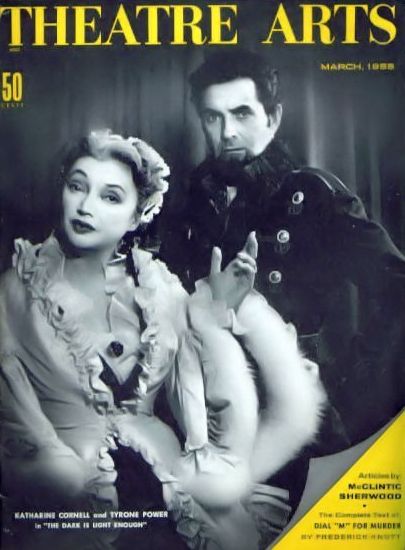
The Dark is Light Enough on Broadway, 1955
Back in Hollywood, Power’s career would continue with a mix of swashbucklers, adventures, light fare and big budget A-films.

In 1951 Power went on the London stage for a six month engagement of a Joshua Logan-directed production of Mr. Roberts. It was a sold-out run and Variety characterized his performance in the title role as a “warm, colorful and meaningful interpretation.” He toured the U.S. very successfully in John Brown’s Body and took it to Broadway in 1953 with Raymond Massey and Judith Anderson. He returned to Broadway in 1955 with The Dark is Light Enough, starring with Katharine Cornell (a young Christopher Plummer would win a Theatre World Award for his supporting performance in the play). Power’s final Broadway appearance came in Back to Methuselah in 1958 with Faye Emerson.

His last finished film would be Billy Wilder’s Witness for the Prosecution (1957) with Charles Laughton and Marlene Dietrich. In it, Power, cast against type as an accused killer, delivers one of his most acclaimed performances. Billy Wilder reported that co-star Marlene Dietrich developed an enormous crush on Power during filming and remarked, “Everybody had a crush on Ty…it was impossible to be impervious to that kind of charm.”

Tyrone Power, Marlene Dietrich, Witness for the Prosecution (1957)
In 1958, 44-year-old Tyrone Power married 26-year-old Debbie Minardos. They traveled to Spain in September where he was to film the King Vidor epic Solomon and Sheba. On November 15, Power collapsed on the set during an arduous swordfight scene with George Sanders and suffered a massive heart attack; he died on the way to the hospital. It had been ice-cold on the set that day and he was a heavy smoker. Power’s wife gave birth to their son, Tyrone Power IV, in January 1959.

“His voice was beautiful to listen to, deep, clear and strong,” Bob Buck wrote; his dark, long-lashed eyes radiated warmth and a soulful quality. He performed with sensitivity and conviction and he brought to the screen a certain nobility and tempered reserve. He was Fox’s top leading man for more than 15 years and though his late career had its ups and downs, his last films were some of his greatest successes. He has been called “illegally handsome” and perhaps his looks, coupled with a powerful onscreen charisma, blinded both studio and audience to his actual talent and capacity to be something more than a leading man.

Today, August 25, Turner Classic Movies honors Tyrone Power with a full 24 hours of his films as part of its annual Summer Under the Stars celebration in August. Click here for the schedule of films.  Click here for more on Michael and Jill’s Summer Under the Stars blogathon.

Portrait of Tyrone Power by Claire Trevor, 1958

Notes:
North Star Over My Shoulder: A Flying Life by Bob Buck, Simon & Schuster (2002)
Being and Becomingby Myrna Loy and James Kotsilibas-Davis, Alfred A. Knopf (1987)
On Sunset Boulevard: The Life and Times of Billy Wilder by Ed Sikov, Hyperion (1998)
Lana: the Memories, the Myths, the Movies by Cheryl Crane, Running Press (2008)