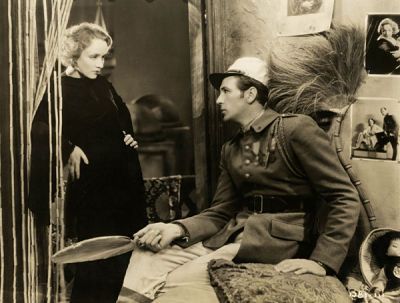
Showing posts with label Josef von Sternberg. Show all posts

Friday, December 27, 2013

Marlene Dietrich, photograph by Edward Steichen
Marie Magdalene Dietrich was born 112 years ago today in Schöneberg, Germany. She died well into her 90th year, in Paris, in 1992, and was by then known the world over as Marlene Dietrich, archetypal superstar of the silver screen as well as the cabaret and concert stage.

As a child, Dietrich contracted her first name, added her nickname (pronounced Layna) and became "Marlene"
I've long been fascinated by the Dietrich persona and have extravagantly enjoyed and admired the seven films she made with Josef von Sternberg, the first for UFA in Germany, the rest for Paramount in the U.S.: The Blue Angel (1930), Morocco (1930), Dishonored (1931), Shanghai Express (1932), Blonde Venus (1932), The Scarlet Empress (1934) and The Devil is a Woman (1935). She has been the subject of several blog entries here.

The Devil is a Woman (1935)
My earliest Dietrich posts for Reel Life were published in a series on the von Sternberg/Dietrich partnership - Light, Shadow and Synergy, Part I, Part II and Part III - a reflection on the films they made together and the nature of their collaboration. I am regularly tempted to revise the whole thing but fear that if I do the series might grow to four, five or even six parts. Recently, though, I came upon this piece by Anne Helen Peterson, a wise, witty and wicked assessment of the fabulous star, and decided to leave well enough alone.


Dietrich in Travis Banton, from her personal wardrobe
"I dress for the image. Not for myself, not for the public, not for fashion, not for men."
- Marlene Dietrich

Marlene Dietrich by David Downton

Friday, March 29, 2013

Clive Brook and Marlene Dietrich

Between 1930 and 1935, Josef von Sternberg filmed six wondrous and surreal flights of imagination for Paramount starring Marlene Dietrich with costumes by Travis Banton. The director and Dietrich had already made their first film together, The Blue Angel (1930), for UFA in Germany and, on the heels of that film's sensational premiere in Berlin, departed for Hollywood. Von Sternberg, who was born in Austria but mostly raised in America, had worked previously with Banton in the U.S. on Underworld (1927), a groundbreaking silent crime drama.


Evelyn Brent as Feathers McCoy in Underworld
The first of the six Paramount productions was Morocco (1930), the film that made a star of Dietrich. It brought Academy Award nominations to von Sternberg, cinematographer Lee Garmes, art director Hans Dreier - and for Marlene Dietrich her one and only Best Actress nod. Morocco also introduced elements and themes that would recur in Josef von Sternberg's future Dietrich films: an enigmatic siren, besotted men, distant locales, misleading appearances, frustrated passion and the redemptive power of love.

Marlene Dietrich and Gary Cooper, Morocco

Shanghai Express (1932), the third of the collaborations with Dietrich and Banton, was, according to its director, "loosely based on a single page by Harry Hervey." Hervey actually provided more pages than that and from those pages Jules Furthman crafted a clever script. Von Sternberg constructed a China made of "papier-mache" and, borrowing a locomotive and railway cars from the Santa Fe Railroad, set the scene for the tale of a train hijacked en route from Peking to Shanghai by Chinese revolutionaries.

imagining China, Shanghai Express

Crowded on board with a clutter of cargo is a disparate group of passengers, several of whom harbor secrets. Among these travelers is dry-as-dust British military officer Donald ‘Doc’ Harvey (Clive Brook). Early in the journey he encounters the great lost love of his life, Magdalen, now known as “Shanghai Lily” and an infamous ‘coaster’ living by her wiles – played to the hilt by Marlene Dietrich at her most ravishing. As the trip unfolds and the train makes its way down the exotic and dangerous coast of China, Doc and Lily wrestle with reignited desire for each other. The hijacking triggers a crisis in their reunion.

Dietrich first appears onscreen more blonde than ever before, veiled and swathed in crepe and feathers, wearing crystal beads and kid gloves, carrying an Art Deco handbag. She is the quintessential femme fatale. Sleek and mysterious, Lily’s cynicism and insolence are tempered by her profound femininity. Dietrich skirts the edges of parody as the soft-spoken, worldly-wise heartbreaker. Brook is mostly sulky and long-suffering in his role; what attracts such a sensual woman to the repressed doctor is neither easy nor difficult to fathom.

veil, feathers, crystal, kidskin

This ensemble was concocted, according to Dietrich’s daughter Maria Riva, by her mother and Travis Banton. She writes of Dietrich going to the studio and running into Banton’s private office shouting, “Feathers! Travis - feathers! What do you think…Black feathers! Now, what bird has black feathers that will photograph?” The black-green tail feathers of Mexican fighting cocks were eventually chosen. Selecting the proper veil fabric took as long. Riva reports that when Dietrich finally held up a swatch of “black 41” with its horizontal lines, “Travis let out a wild whoop.” Finally, von Sternberg came to take a look at the completed outfit. There had been concern about his reaction – the elaborate costume would be very difficult to photograph. In German he said to Dietrich, “If you believe I am skilled enough to know how to photograph this, then all I can offer you is – to do the impossible.” In English he said to Banton, “A superb execution of an impossible design, I congratulate you all.”  After the director left, Banton broke out a bottle of champagne.

fur, feathers and lace

David Chierichetti has written that Travis Banton worked to give Dietrich, with her perfect posture and slender figure, a softened quality. "Her clothes would usually be fussier than any others he designed, with drapings of fabric and much use of fur and velvet that would be unflattering to a heavier figure." Banton understood that few but Dietrich could successfully wear a busy mix of textures and patterns.
 
feathers and lace

~
Cinematic virtuoso and visionary Josef von Sternberg didn't hesitate to claim that he not only directed his films but was also responsible for every facet of every one of them, from lighting and photography to set design, costuming and, sometimes, music. Though the director freely admitted that Lee Garmes excelled behind the camera, he also maintained that Garmes did exactly as he was told, "to the extent that I would always be beside the camera. No picture of mine has been independently photographed." Dietrich, for her part, supported these assertions. As for costumes, von Sternberg's involvement in designing Dietrich's wardrobe was, as David Chierichetti has noted, "as hard a question to answer as how much he photographed the films." What is evident in the films von Sternberg made for Paramount with Dietrich and Banton is that costume was as much an element of narrative and theme as every other meticulously designed visual and aural detail.

Shanghai Lily's introduction - her attire and bearing suggest different possibilities: seasoned seductress, dark angel and more.
Lily is regally bundled in fur when she toys with her former lover. Teasing, she puts his military cap on her own head - at a jaunty angle. This is a woman who knows how to take command.

By the time Dietrich utters the line, "Shanghai Lily has reformed," Magdalen has begun to resurface.
In the final scene, Dietrich is again bedecked in Shanghai Lily's black-feathered vamp ensemble - but Magdalen can be seen and heard in her expression, her voice and her words. Doc, who she now calls by his given name, Donald, surrenders to her completely. She tosses away his riding crop and glove as they embrace.

Josef von Sternberg, in a 1966 interview with Oscar-winning film preservationist Kevin Brownlow, acknowledged that he had no interest in ‘authenticity’, “…on the contrary, the illusion of reality is what I look for, not reality itself.” Of the six von Sternberg/Dietrich/Banton films, film critic/historian David Thomson has written, “They are sublime, radiant and utterly undated, where earnestness, noble intentions, showing real life with pained sincerity (all plausible in the difficult times of the 1930s), have perished by the wayside.”

Shanghai Express was the most financially successful of the six Paramount productions, though its critical reception was mixed. Von Sternberg was flattered when novelist/philosopher Ayn Rand told him that the film had impressed her as other films rarely had. Naturally he asked what it was that captivated her so. He remembered, with some irony, that she told him it was “the way the wind blows through the fur-piece around Marlene’s shoulder when she sits on the back platform of the train.”


Shanghai Express was Oscar-nominated for Best Picture, Josef von Sternberg was nominated for Best Director and Lee Garmes won the Academy Award for Best Cinematography.

~

Travis Banton was Paramount's Chief Designer from 1929 until 1938. Before coming to Hollywood to design Leatrice Joy’s costumes for The Dressmaker of Paris (1924), he worked at various design houses including his own in New York. His reputation got a major boost in 1920 when he designed Mary Pickford’s wedding dress for her marriage to Douglas Fairbanks.

Mary Pickford in wedding gown, 1920
Banton’s designs were known for their fashionable cuts (generally on the bias, his specialty), luxurious fabrics, and beads, feathers, lace, fur and other ornamentation. His designs embodied the “Paramount Look” of the 1930s. He never took home a costume design Oscar; there's no question this was because the award did not exist until 1948, after the better part of his film career was over. Leaving Paramount, Banton went on to work for Fox on films like The Mark of Zorro (1940), Blood and Sand (1941) and A Yank in the R.A.F. (1941). He designed gowns on Columbia’s Cover Girl (1944) and for Universal’s Smash-Up: The Story of a Woman (1947). One of his late film assignments was designing gowns for Joan Fontaine in the haunting Max Ophuls drama Letter from an Unknown Woman (1948). The designer is also credited with mentoring his Paramount assistant Edith Head, who became the best known and most Oscar-winning costume designer in Hollywood history.


Rita Hayworth, Cover Girl (1944)
 

Banton’s eventual decline has been attributed to overwork and overindulgence. Evelyn Brent, the first actress to star in a von Sternberg/Banton film, recalled Banton's work ethic: “He was the kind of designer who read the script and would find out who was going to play the part, and worked out the clothes that way.” The feather and velvet hat he designed for her in Underworld started a fashion trend. “He was a genius and, boy, did he drink! That’s what ruined him…” said Louise Brooks, a woman who knew firsthand about drinking and ruination. 

Maria Riva knew Banton when he designed for the Dietrich/von Sternberg films. Of him she said that he “had the Ronald Colman look long before Ronald Colman had a look” – cashmere blazer, white flannels, paisley ascot and silk shirt with French cuffs. Dietrich’s long-time photographer John Engstead recalled that the actress didn’t listen to many but would always take advice from von Sternberg and Banton. David Chierichetti has written that it was his work for Dietrich that made Banton’s designs immortal. And costume designer Walter Plunkett (Gone with the Wind, An American in Paris) remembered, “The rest of us always watched Banton because he was always ahead of the fashion trend.” In fact, Banton's use of the strapless bodice pre-dated by four years Christian Dior's celebrated use of it as part of his "New Look" of the late 1940s.
 
Travis Banton and Marlene Dietrich

~

Marlene Dietrich forever attributed her initial success in film to Josef von Sternberg, insisting "I was nothing but pliable material on the infinitely rich palette of his ideas and imaginative faculties." She learned everything about filmmaking, most especially lighting and photography, from him. The director would be unusually modest when it came to taking credit for 'inventing' Marlene Dietrich. "I did not endow her with a personality that was not her own...I gave her nothing she did not already have. What I did was to dramatize her attributes and make them visible for all to see."

The Paramount films Dietrich made with von Sternberg and Travis Banton were Morocco, Dishonored (1931), Shanghai Express, Blonde Venus (1932), The Scarlet Empress (1934) and The Devil is a Woman (1935). She and von Sternberg parted ways afterward. When her career foundered he advised her to make Destry Rides Again with James Stewart for Universal in 1939; it was a hit and revived her reputation. She went on to reinvent herself again and again.

Dietrich would work with Travis Banton on two more Paramount films, Frank Borzage's Desire (1936) and Ernst Lubitsch's Angel (1937). With or without von Sternberg's input, Banton's gowns for the great star were breathtaking.

Marlene Dietrich in scenes from all six films directed by Josef von Sternberg with costume design by Travis Banton


This post is my entry in The Hollywood Revue's Fashion in Film Blogathon...click here for more information and links to participating blogs.

 Notes:
Fun in a Chinese Laundry by Josef von Sternberg, MacMillan Co. (1965)
Marlene Dietrich by Maria Riva, Alfred A. Knopf (1993)
Hollywood Costume Design by David Chierichetti, Harmony Books (1976)
The Parade's Gone By by Kevin Brownlow, Bonanza Books (1968)
People Will Talk by John Kobal, Alfred A. Knopf (1985)
The Big Screen: The History of Hollywood by David Thomson, Farrar Strauss and Giroux (2012)    

Thursday, April 26, 2012

Josef von Sternberg, Merle Oberon and Charles Laughton
In 1934, British scholar/writer Robert Graves published his best known and most successful work, the sweeping historical novel I, Claudius, written in the form of an autobiography by the Roman Emperor Claudius (10 B.C. - 54 A.D.). 40 years later this classic work would receive plaudits and a new audience in an entirely different medium.

The golden age of the television miniseries began in the mid-'70s - Rich Man, Poor Man was a sensation in 1976 and Roots made history in 1977. Classics like Shogun (1980), Brideshead Revisited (1981) and Winds of War (1983) soon followed. In 1976 the BBC's Masterpiece Theatre adapted Graves's historical fiction into a 12-episode landmark starring Derek Jacobi (Claudius), John Hurt (Caligula), Sian Phillips (Livia) and Patrick Stewart (Sejanus). An Emmy and BAFTA winner, I, Claudius debuted in the U.S. in 1977 and was, among other things, later acknowledged as inspiration for the blockbuster prime-time soap, Dynasty (1981 - 1989).


This year, in March, Acorn Media released a new boxed set edition celebrating the 35th anniversary of I, Claudius. Among the bonus features are extended original versions of episodes one and two, a behind-the-scenes documentary entitled I,Claudius: A Television Epic, an interview with Derek Jacobi and...a 70+ minute BBC documentary from 1965, The Epic That Never Was, about the unfinished Alexander Korda production of a Josef von Sternberg-directed film. This first version of the Graves novel starred Charles Laughton (Claudius), Merle Oberon (Messalina), Flora Robson (Livia) and Emlyn Williams (Caligula).

A sketch by Art Director/Production Designer Vincent Korda for I, Claudius

In 1937 Korda, who would later marry Oberon, set out to produce a grand epic. In 1933 he had produced and directed The Private Life of Henry VIII, the popular film that brought Charles Laughton a Best Actor Oscar, and produced another great success in 1934 with The Scarlet Pimpernel starring Leslie Howard. Hungarian-born but based in Great Britain, Korda's dream was to make pictures in England that rivaled those coming out of Hollywood. With Henry VIII and The Scarlet Pimpernel, he'd begun to realize his dream but wanted to reach further. With Charles Laughton still under contract to him in 1937, Korda's ambition was to create a film greater than either Henry VIII or their most recent collaboration, Rembrandt (1936). Korda bought the rights from Robert Graves for the recently published I, Claudius, hired Josef von Sternberg to direct, and the project moved forward.

Charles Laughton as Claudius

The Epic That Never Was is hosted by actor Dirk Bogarde, who recalls in his narration that as a teenager he ventured with friends to Korda's Denham Studios to watch the filming of I, Claudius. The documentary features interviews with many who worked on the film: Merle Oberon, Josef von Sternberg, Robert Graves, Emlyn Williams and Flora Robson, as well as Korda's longtime script girl and others. Only Korda and Laughton, no longer alive in 1965, are absent.

Merle Oberon as Messalina
According to Merle Oberon, Korda wanted his friend von Sternberg to direct hoping that the filmmaker who masterminded Marlene Dietrich's ascent to stardom would handle Oberon with the same care and artistry so that she, too, might become a great star. The actress recalled vividly once filming began, "something odd happened," suddenly Charles Laughton "couldn't find his character." Laughton began to break down and the script girl remembered him despairing, "I can't find the man!" Josef von Sternberg recalled the actor "had some difficulty getting into his part" but felt, all in all, that Laughton's performance was "magnificent" and that his problems would pass.  Eventually Laughton determined that Claudius was Edward VIII and began listening to the former king's abdication speech to help sustain his motivation.

Flora Robson as Livia
Flora Robson remembered that Josef von Sternberg was very much the flamboyant director and that he came to the set dressed in riding boots and other regalia. The script girl recalled that the director was also a first-rate editor and noted that he seemed to "edit in his head" before he shot a scene. Her remarks bring to mind critic Andrew Sarris's observation that von Sternberg "entered the cinema through the camera rather than the cutting room" and Marlene Dietrich's flat statement that "he was the greatest cameraman the world has ever seen..."

About 30 minutes of the 1937 production footage survives and is included in The Epic That Never Was; it is fascinating. Emlyn Williams is vile and reptilian as Caligula and Laughton's inspired Claudius foreshadows Jacobi's brilliant interpretation. As always, von Sternberg composed visually stunning, painterly scenes drenched in atmosphere.

Just a month into shooting, Oberon suffered a car accident in which she was thrown into the windshield. She was badly injured and filming was permanently halted. Emlyn Williams considered this "a godsend;" according to him, producer, director and star were not happy. Author Robert Graves, who had written an unused script for the project, assigned credit for the film's demise to Claudius himself - from beyond the grave...

The Masterpiece Theatre drama met a far better fate than Korda's promising but ill-starred venture. Along with awards won and influence extended, TV's I, Claudius earned an enduring reputation and remains today among the top-ranked miniseries of all time. Any speculation by Robert Graves, who lived until 1985 and the age of 90, on the late Emperor's reaction to the BBC series is unknown...

John Hurt as Caligula, Derek Jacobi as Claudius, Sian Phillips as Livia

Tuesday, April 26, 2011


Prolific biographer Charlotte Chandler has written on the life of a different film legend every year for the past 6 years, beginning with It's Only a Movie: Alfred Hitchcock in 2005. Her latest, Marlene, has just been published by Simon & Schuster.

Chandler's biographies are based on personal interviews. She includes filmography and career details, but her style is to convey the story of a life in the first-person as much as possible, using the subject's own words. This conversational approach gives the reader a sense of being in the room, listening in, as the story of a remarkable life unfolds.


Groucho Marx
The author's career as a biographer began with Hello, I Must Be Going: Groucho and His Friends in 1978. Written during Marx's lifetime but published not long after his death, it became a bestseller. Chandler returned to the genre years later with her 1995 Fellini biography, I, Fellini. But it was with her first book for Simon & Schuster in 2002, Nobody's Perfect: Billy Wilder, that Charlotte Chandler’s biographies became frequent and consistently titled, each with the annotation "A Personal Biography."

Who is Charlotte Chandler? Her Simon & Schuster bio is sketchy - we are told that she has written many bios, lives in New York and is on the board of the Film Society of Lincoln Center. The back cover of Hello, I Must Be Going includes a picture of Chandler with Groucho who sits at a piano. Her biography of Alfred Hitchcock contains photos of Chandler with the director as well as his daughter, Pat. The dust jackets of Chandler’s biographies are strewn with the praise of film world luminaries: Isabella Rossellini, Michael Caine, Jack Nicholson, Pat Hitchcock, director Michelangelo Antonioni, producer David Brown and others. Vanity Fair, which has published excerpts of many of her books, proclaims that Chandler “sets the gold standard for celeb bios.”

In a recent interview with Kirkus Reviews, Chandler was asked how she managed to gain access to so many of the most famous, and often famously difficult, stars of Hollywood’s Golden Age. About Groucho Marx she recalled that someone had given her his phone number, she called and, though Groucho refused to be interviewed, he invited Chandler to dinner. Then, over dinner, Groucho asked why she hadn't been taking notes on their conversation. It was Groucho who later introduced her to Billy Wilder.  Henri Langlois, film archivist and founder of the Cinématheque Française, introduced Chandler to Hitchcock, Mary Meerson, also of the Cinématheque Française, introduced her to Dietrich, director George Cukor introduced her to Katharine Hepburn…and Bette Davis, ever the formidable outlier, called Chandler herself, the only one of the author's subjects to do so. 
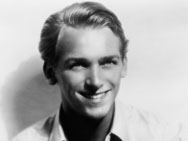
Douglas Fairbanks, Jr.
Connections abound between Chandler's subjects, most of whom knew and worked with each other, and occasionally one story will overlap into another. For example, Marlene Dietrich and Douglas Fairbanks, Jr. had an affair that lasted for years, and the gentleman had many memories of her. He told Chandler about a series of miniature nudes he sculpted of Marlene and how he eventually decapitated all of them to protect her reputation in the event of his demise. This anecdote is told in detail in the Dietrich biography. It is also woven into the Hitchcock biography, in abridged form, in a section on Stage Fright.

Fairbanks was the friend of many film legends and a substantial resource for Chandler; he is quoted in each of the biographies of hers that I’ve read (Bette Davis, Dietrich, Katharine Hepburn, Hitchcock). Equally well-connected and forthcoming was George Cukor, who is quoted in the Davis, Hepburn and Hitchcock books. What I wouldn’t give to have access to the stack of notes and tapes Chandler must have made over the years…

Charlotte Chandler met Marlene Dietrich in 1977, when the legendary star was 76 years old and living in Paris. Dietrich’s greeting to her future biographer was, “I don’t mind meeting you because you didn’t know me before, when I was young and very beautiful.” Moments later she added, “It can be a curse being beautiful, after a certain point, as it slips away…”

Dietrich in the 1940s
I have read and watched much about Marlene Dietrich, from her memoirs (Marlene, 1990), to various biographies, including her daughter Maria's lurid opus, to Josef von Sternberg’s eccentric autobiography (Fun in a Chinese Laundry, 1965), the page on the CIA’s website about Dietrich’s work during World War II and Maximillian Schell’s Oscar-nominated documentary (Marlene, 1984). I have to admit that I had something of a “tell me something I don’t know” attitude before I sat down with Chandler’s book. She did.

There are revelations large and small of all kinds...Dietrich's mad plot to kill Hitler, details of her introduction to Ernest Hemingway on the ÃŽle de France, the lie she told JFK about his father...Dietrich's memory of her grandmother’s lavender eyes, her habit of giving her hand-me-downs to husband Rudi's mistress...her hatred of knitting because it reminded her of World War I in Germany.

Chandler knows how to set a scene and tell a story. She nimbly leads the reader through Dietrich’s early years, the arc of her career, her personal life and into her late years, when she “closed the door” and retreated inside the rooms of her small apartment across from the Hôtel Plaza Athénée in Paris. Among the many voices heard of those who knew Dietrich at different points in her life and career are her one-time arranger and accompanist, Burt Bacharach and her friend and fellow Paramount star, Mae West.
 
Maria and Marlene, early '50s
Maria Riva is Dietrich's only child, and Riva's own sensationalistic 787 page version of her mother's life was published shortly after Dietrich's death. Maria is not a direct source for Chandler's book but her youngest son David, who produced and directed a documentary on Dietrich in 2001, speaks at length. His references to his mother as an "Emmy-winning actress" caught my eye - I'd not heard this before and checked the Emmy website. Maria is listed as having been nominated for a Best Actress Emmy in 1952 and 1953. However, Imogene Coca won in 1952 and Helen Hayes won in 1953.

Charlotte Chandler remarked to Kirkus Reviews that Marlene Dietrich had originally been perceived as "another Garbo" very early in her Hollywood career. It happened that Dietrich came to Hollywood as talkies were coming in and MGM was carefully transitioning Garbo, its great star, to sound. When Morocco and The Blue Angel struck box office gold, Paramount saw in Dietrich its opportunity to trump MGM and Garbo. The two actresses were to have distinctly different careers, though both were deemed "box office poison" (along with Katharine Hepburn and others) in the late '30s. However, no one imagined that Dietrich’s film career would outlast Garbo’s (or anyone else's) by several decades or that she would successfully reinvent herself as a high-ticket stage performer.

Chandler told Kirkus that though she didn't interview her, she did meet Garbo. Her impression was that Garbo was too bitter about the past to make a good interview. Asked if she thought Dietrich also became bitter, Chandler responded, “not at all. She loved what happened to her," adding that Dietrich hadn’t expected any of it and “she felt she owed her great life to Josef von Sternberg,” her mentor and the director of seven of her most memorable films.

I enjoy Charlotte Chandler's uniquely readable biographies. I've read more heavily documented books (the fascinating Barry Paris tome on Louise Brooks comes to mind) and books concerned almost solely with a life on film (David Thomson's excellent "Great Stars" series entry on Bette Davis), but for a pleasurable foray into legendary firsthand memories, Chandler is hard to beat.

Marlene Dietrich sculpture by Clark Hanford


Biographies by Charlotte Chandler:
Hello, I Must Be Going: Groucho and His Friends
I, Fellini
Nobody's Perfect: Billy Wilder, A Personal Biography
It's Only a Movie: Alfred Hitchcock, A Personal Biography
The Girl Who Walked Home Alone: Bette Davis, A Personal Biography
Ingrid: Ingrid Bergman, A Personal Biography
Not the Girl Next Door: Joan Crawford, A Personal Biography
She Always Knew How: Mae West, A Personal Biography
I Know Where I'm Going: Katharine Hepburn, A Personal Biography
Marlene: Marlene Dietrich, A Personal Biography

Thanks to Simon & Schuster for a review copy of Marlene