Showing posts with label Montgomery Clift. Show all posts

Monday, August 13, 2012


Where does the first step begin on a journey to fate? For me it was sometime in August of 1960, just a kid on a camping trip with his parents and their friends. Lake Tahoe was the destination, with side trips to Squaw Valley, Reno, Carson City, and Virginia City, Nevada. Little did I know, nor anyone else in our little party, that we would run into the production of The Misfits, starring Marilyn Monroe, Clark Gable, and Montgomery Clift, as directed by John Huston. It was clear from the entourage around Gable and Marilyn that this was a very big deal. And my father reinforced this message with his excited exclamation, “there’s Marilyn Monroe and Clark Gable!” although he probably uttered this in French, my parents’ and their friends’ native language. 

My recollections of this event are from the mists of time, and likely distorted by accretions of images and later reflections on the significance of the occasion, and the powerful warping auras of the stars themselves. As a kid turning twelve I was already highly aware of the significance of stardom. We did after all live very close to Hollywood, and in those days before paparazzi, seeing stars was not uncommon. But seeing Marilyn and Clark Gable at work was like entering the stratosphere. My best recollection of the scene was that it was taking place in a casino in Reno, likely Harrah’s Club. Production personnel were orbiting around the magic couple.  An aura emanated from Marilyn. In spite of the effects on her of nerves or drugs, which I wouldn’t have known anything about, she was glowing from the lights and the sheen of her platinum blonde hair. I don’t believe a scene was being filmed at the moment, since she seemed to be smiling and basking in the rapt attention of the small audience that was there, of which we were a part. Clark Gable was smiling too, though in a sort of cool, smirky way, aging, but still the king of the jungle. I couldn’t see their figures very well, and I was old enough to know that Marilyn’s figure was very special. But with the big stars, then and now, “we had faces” was all-important, and with these two in particular, their very unique faces reverberated in the room.  I had a particular affinity to Clark Gable. I grew up with prominent ears, the cause of a childhood complex, and my father would always tell me that this physical feature was what made Clark Gable famous. I believed him, and as a chubby kid with a funny name, I believed in the possibility that there was hope for me yet. Seeing Clark Gable in person might just provide that twist of fate that would correct my negative self-image. “See what I mean,” my father said to reinforce his message. 

That perception of Clark Gable, directly seen and experienced, provided me the kind of connection that seems magically possible to children; a more direct connection than just seeing him on the screen, as I had done, during a re-release of Gone with the Wind.  
Clark Gable, Marilyn Monroe, Montgomery Clift
Marilyn seemed even more magical. Here in real life and in plain sight she still seemed ethereal. Perhaps it was that very quality that made people, especially men, want to possess her, and somehow to hold onto a cloud. She was the embodiment of contradiction, an ethereal, almost angelic image that was hotly desired for her earthly body, and that most famous of movie stars, capable of moving mountains, yet unable to control her own life or emotions.

Finally we moved away from all the action, onward to seeing other sights, me looking backward at the marvel just beheld. Alas, the whole scene was destined to be an ethereal vision. Clark Gable, “the King” died of a heart attack three months later in November 1960. The Misfits premiered in February 1961, to mixed reviews.  Then my father died on June 5, 1962 and Marilyn Monroe died two months after that on August 5, 1962, now fifty years ago.  How could these giants just disappear? My own fate had indeed led me to The Misfits, a rendezvous with the realization that I too might become one.  Marilyn’s star now shines ever more brightly, a testament to film and the power of image. We continue to try to hold onto a cloud.

The Misfits was not a hit in 1961. No one then knew, of course, that it would be the last film that both Clark Gable and Marilyn Monroe would ever star in, nor that Montgomery Clift would also die five years later. The audience wasn’t ready for this modern, existential film in 1961. Its reputation, because of all its baggage, doomed it to the “missed opportunity,” or “underrated film” category. Today it is being rediscovered. The Misfits is not a fun film to watch, its barren landscape parallels its wounded characters. But it is a true reflection of the human condition, and for film buffs, a unique view into the life of several movie legends. For me, it was a rendezvous with destiny – an opportunity to see those legendary stars before they faded, and the passion to now write about them and the world they lived in, a world I briefly transited.


Christian Esquevin is the author of Adrian: Silver Screen to Custom Label, published by the Monacelli Press in 2008. The book is about the life and career of MGM’s famed Golden Age costume designer Gilbert Adrian and his subsequent fashion business. Christian also produces his Silver Screen Modiste blog covering classic film fashion. This is Christian's third guest contribution to this blog, and for each piece I am eternally grateful...
TLE

Monday, May 28, 2012


Pulitzer Prize winning playwright Arthur Miller traveled to Reno, Nevada, in the spring of 1956 to divorce his first wife. Fulfilling the state's six week residency requirement until the marriage was legally dissolved, Miller stayed at a cabin on Pyramid Lake, about 100 miles from "the biggest little city in the world." During his time in this "forbidding but beautiful place," he got to know a few modern-day cowboy types who made their living capturing wild mustangs and selling them to be butchered for dog food. Miller was invited to join them on one of these hunts. From his experiences in a "whole state full of misfits," Arthur Miller later fashioned a short story that was published the following year in Esquire magazine.


Arthur Miller and Marilyn Monroe
But before he wrote the story and just after he returned from Reno, Miller wed Marilyn Monroe, then at the height of her enormous fame. It was a time when the actress was desperate to make films of substance, and once she and Miller moved to New York she began studying at the Actors' Studio and making plans to set up her own production company. After Miller's story appeared in Esquire, a friend suggested he develop it into a screenplay. Inspired by the idea of writing a part for his wife that would allow her to demonstrate her overlooked acting ability, Miller scripted the moody tale of a disaffected divorcee who encounters three disparate cowboys and ends up accompanying them when they go "mustanging" in the high desert of Nevada.

Anticipation began to build the moment word started to spread that the great playwright had written The Misfits for his glamorous movie star wife. Before it was released, the film had become the stuff of legend.

An iconic photo...Front row: Montgomery Clift, Marilyn Monroe, Clark Gable. Second row:  Eli Wallach, John Huston. In back: producer Frank Taylor, Arthur Miller (on ladder).
John Huston was living in Ireland in 1959 when Frank Taylor, Miller's one-time publisher and the man chosen by the writer to produce the film, sent him the script. Huston pronounced it excellent and agreed to direct. Huston had been Marilyn Monroe's director of choice for The Misfits. She remembered that he had cast her as Angela in his film, The Asphalt Jungle (1950), one of her early breakthrough roles, was ever grateful to him for it and trusted him to guide her through the challenging dramatic role Miller had written for her.

Clark Gable on the set of The Misfits
Clark Gable, who by this time had been appearing in films for more than 35 years and had been a movie star - "the King" - for most of them, had to be cajoled to accept the male lead. Though he found the script intriguing, he didn't know what to make of the story. Miller persuaded him, calling it an "eastern western," about people trying, but afraid, to connect. 

Huston remembered working with Gable on The Misfits: "He thought of himself as an actor, not a screen personality. He liked reminiscing about his early days in the theater - old-time actors' talk. I saw very soon that Clark knew exactly what he was doing. Two or three times I thought I saw ways to improve his performance. I was mistaken." Gable's portrayal of Gay Langland, an aging wrangler displaced in the modern world, is complex and moving. Co-stars Eli Wallach, Montgomery Clift, and lately Marilyn Monroe, were committed "method" actors, but Wallach later recalled Gable and the other Hollywood veteran on the set, Thelma Ritter, as true acting "pros."

Clark Gable was impressed, too. Watching Montgomery Clift, as rodeo cowboy Perce, deliver his first major scene (below) in one take, Gable remarked, "My God, he's really good, isn't he?"


The Misfits has been called Arthur Miller's valentine - in Eli Wallach's words, a "love piece" - to Marilyn Monroe, and members of the crew observed that Miller seemed besotted with her as filming got underway. But when the grueling shoot came to an end three months later, not only would the Miller/Monroe marriage be over but Marilyn Monroe would never complete another film.

Marilyn Monroe on the set
Colin Clark, author My Week with Marilyn and The Prince, the Showgirl and Me, wrote that when he met Billy Wilder he mentioned to him that he, too, had worked with Marilyn Monroe. Wilder replied, "Ah, then you know the meaning of pure pain!"

By the time The Misfits was being made in 1960, Marilyn's erratic on-the-set behavior was well known. Cast and crew would wait...and wait...and wait. Sometimes she would appear, sometimes she wouldn't. She had great trouble remembering and delivering her lines and often required multiple takes. Her latest drama coach, Paula Strasberg, was ever present and Marilyn would look to her rather than John Huston for direction while filming her scenes. And there were drugs and alcohol...

Huston recalled, "She was taking pills to go to sleep and pills to wake up in the morning...she seemed to be in a daze half the time." She became less and less reliable, eventually broke down completely and had to be hospitalized. Clark Gable, according to Huston, "...was nonplussed by Marilyn's behavior. It was as though she'd revealed some horrid fact of life that just couldn't be accepted in his scheme of things."

But Huston also remembered, "When she was herself...she could be marvelously effective. She wasn't acting - I mean she was not pretending to an emotion. It was the real thing."

Marilyn as Roslyn
The Misfits was released on what would have been Clark Gable's 60th birthday, February 1, 1961, but Gable had died of a massive heart attack 2-1/2 months earlier, shortly after the film wrapped. Fortunately, the actor had seen Huston's first cut and was so happy with it he told both the director and Arthur Miller that he thought it the best work of his career. Despite Gable's enthusiasm - and producer Frank Taylor's intention to make "the ultimate motion picture" thanks to an all-star cast and crew - The Misfits was a commercial failure and received a mixed critical response. In Miller's view the critics were "baffled" by it.

If the The Misfits has problems it may be that it was too much Miller's film and not enough Huston's. Regardless of compelling themes, strong performances, photography by Russell Metty, film editing by George Tomasini and an evocative score by Alex North (listen below), the film too often becomes theatrically talky and contrived. And Roslyn, the central character, is so unreal at times that she seems to have been spun out of arty fancies about the actress who portrays her. It is also likely that the difficulties and complications that plagued the production afflicted the film itself.


The Misfits is an unusual and poetic film that may not entirely mesh, but it does fascinate. The powerful climactic mustang capture sequence is as disturbing to watch as it is difficult to forget, and the final scene between Gable and Monroe seems the prophetic farewell of two of Hollywood's biggest stars.

Roslyn: "How do you find your way back in the dark?"

Gay: "Just head for that big star straight on. The highway's underneath it, it'll take us right home."

Marilyn Monroe and Clark Gable...fade out...
~

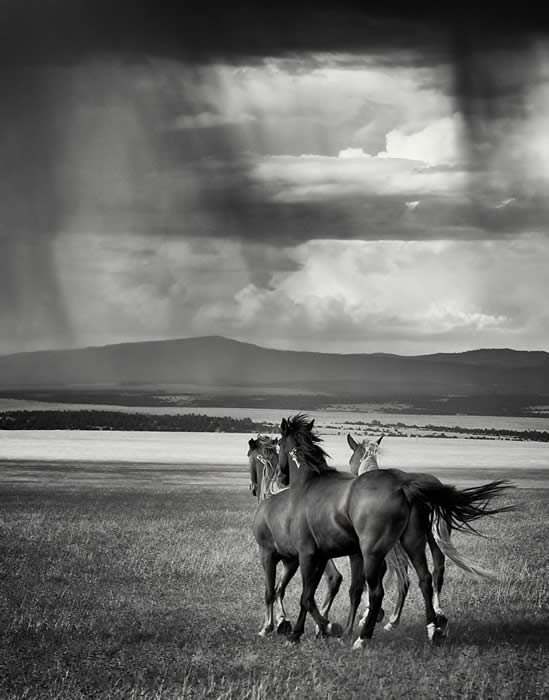
The largest remaining band of wild mustangs in the United States roams the high desert areas of Nevada. About 33,000 horses live in 10 western states and another 30,000 are kept in government corrals.  Click here to learn more about the history and continuing plight of our wild horse population.


~

Click here to go to My Love of Old Hollywood and links to the other participating blogs in Page's blogathon... 

~

Sources:
An Open Book by John Huston, McMillan (1980)
The Misfits: Story of a Shoot by Arthur Miller and Serge Toubiana, Phaidon Press (2000)
Making the Misfits, a production of WNET New York, et al (2002)
wild mustang photos by Kat Livengood