Showing posts with label 1939. Show all posts

Wednesday, February 27, 2013


The notion that 1939 was the greatest of all movie years has been around for so long that it's pretty much an accepted fact these days. A while ago, as I was roaming the blogosphere, I happened upon a post by Peter Bogdanovich on his Indiewire blog (appropriately called Blogdanovich) titled "The Greatest Year?"  I read on, having always respected what Mr. B has to say about films and filmmaking. He not only possesses an encyclopedic knowledge and intimate understanding of the subject, but has also made some classics of his own that I much admire - The Last Picture Show (1971), What's Up, Doc? (1972) and Paper Moon (1973).

With "The Greatest Year?" Bogdanovich looked back on one of his 1972 columns for Esquire magazine. In that article he'd selected and reviewed a great movie year of the past to illustrate his contention that films of the early '70s weren't measuring up. He zeroed in on 1939 in particular because in addition to the fact that it had been a banner year for movies, it was also the year he was born (as were Francis Coppola and William Friedkin, two other major filmmakers of the time). Not long after Bogdanovich's column appeared in Esquire, he recalled, a lengthier, more elaborate piece on the films of 1939 appeared in Life magazine written by film critic Richard Schickel. Schickel once and for all declared '39 to be the great year. The rest, as we know, is history.


Peter Bogdanovich admitted in his Blogdanovich post that he actually believes "the absolute high point" of American film (he prefers the term 'cinema') encompasses 1939, 1940 and 1941. He has a point. 1940, too, was notable for a raft of classics. Here is one man's tribute, via his YouTube channel, to some of the year's best films:


Other of 1940's offerings include Abe Lincoln in Illinois, The Letter, The Mortal Storm, Pride and Prejudice and The Westerner, to name a few. 1941 was no less stellar, bringing Ball of Fire, (ahem) Citizen Kane, The Devil and Daniel Webster, High Sierra, How Green Was My Valley, The Lady Eve, The Little Foxes, The Maltese Falcon, Meet John Doe, Sergeant York, Sullivan's Travels, Suspicion and more. Perhaps I'm less a purist or maybe just more democratic, but I'd extend Hollywood's high point back in time to 1937. That year introduced The Awful Truth (still my favorite screwball), Captains Courageous, Dead End, Lost Horizon and Snow White and the Seven Dwarfs. I'd also add, on the other end, 1942, the moment just before World War II's impact was fully felt in Hollywood. 1942, after all, was the year of Casablanca, The Magnificent Ambersons, Now, Voyager, The Palm Beach Story, This Gun for Hire, To Be or Not to Be, Woman of the Year and Yankee Doodle Dandy. 1937 - 1942 were all vintage years in Hollywood.

Here's what Peter Bogdanovich originally wrote for Esquire in 1972, courtesy of critic/author Clive James's website: The Best American Films of 1939.

   
My top pick from 1939, John Ford's Stagecoach

It may seem ironic that Bogdanovich was disheartened by what he called "the meager pickings" of his own era, a time now viewed as another golden age.  "The New Hollywood" had arrived and international cinema was in full flower. 1972 alone saw the release of Fosse's Cabaret, Bergman's Cries and Whispers, Boorman's Deliverance, Bunuel's The Discreet Charm of the Bourgeoisie and the film many consider the greatest of all, Francis Coppola's The Godfather - not to mention Bogdanovich's own very popular and award-winning What's Up, Doc?  

Parenthetically, 1972 would be the year Joseph Mankiewicz directed his last film. Sleuth, starring Laurence Olivier and Michael Caine, was nominated for four Academy Awards, including Best Director. With this final effort, Mankiewicz became one of few filmmakers who enjoyed success in both the old Hollywood and the new. The second Oscar nomination of his career (he won four and was nominated for eight) had been a Best Picture nod for producing MGM's The Philadelphia Story in 1940.


Thursday, February 7, 2013


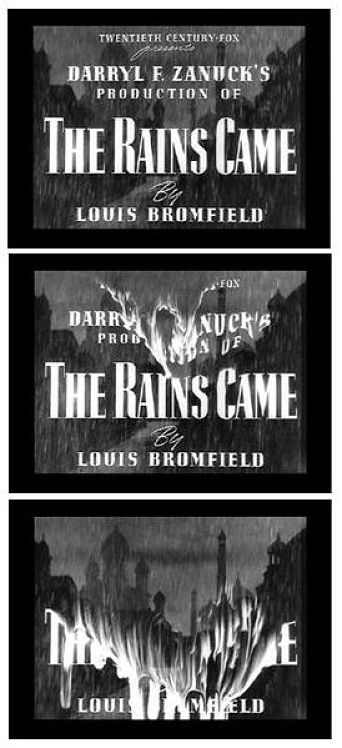
There is no mistaking that drama on a grand scale is about to take place even before the first scene of The Rains Came (1939) begins. Alfred Newman's commanding score pounds, the title sequence rolls over the dark image of a rain drenched ancient city, and as each hand-lettered title appears it is soon washed from the screen as if swept away in a downpour.


The film opens on a more languid note. A group of Indian musicians plays a song, hypnotic and dreamy, beneath a tree filled with chattering monkeys. A white man, taking shade from the heat, observes from the broad veranda where he lounges. This lighter tone persists as the man, British expatriate Tom Ransome (George Brent) is visited by his good friend, Major Rama Safti (Tyrone Power), and then by an American missionary's wife bearing a party invitation. Later on, lovely and wayward Lady Edwina Esketh (Myrna Loy) arrives in India and the mood begins to shift with her troublesome presence.

George Brent and Myrna Loy, alone in a darkened room somewhere in the palace
Halfway into this lavish forbidden love/disaster epic, a massive earthquake strikes and triggers a catastrophic flood. As the plot's steamy intrigues have stirred the emotions, so the cinematic vision of quake and flood overwhelms the senses. For these thrilling sequences the very first Oscar for Best Special Effects was awarded to Fred Sersen (visual effects) and E.H. Hansen (sound effects). The Rains Came, produced by Darryl F. Zanuck and directed by Clarence Brown for 20th Century Fox, was nominated for another five Academy Awards.

It's believed that the first in-camera special effect was part of a short film sequence titled The Execution of Mary Queen of Scots (1895). The effect of a be-heading was achieved with the use of a dummy and a shot known as a substitution shot or a stop trick. A few years later pioneering George Melies produced his 14 minute effects-laden La voyage dans la lune/A Trip to the Moon (1902) and by 1923 Cecil B. DeMille was able to simulate the parting of the Red Sea for the first time with his original version of The Ten Commandments. When the first Academy Awards were presented for 1928 a plaque for Best Engineering Effects was given to Roy Pomeroy for Wings, but the category did not continue. An honorary award was presented to Gordon Jennings (and shared with others) for effects created on 1938's Spawn of the North; the following year the Best Special Effects category was established. 1939, that banner year of legendary Hollywood films, was  Gone with the Wind's year when it came to record-breaking Academy Award wins (eight). Among the five it did not win was the special effects award taken by The Rains Came; a total of seven films had been nominated in the category including The Wizard of Oz.
Myrna Loy and Tyrone Power at the Maharani's music school

The Rains Came was based on Louis Bromfield's best-selling 1937 novel, The Rains Came: A Novel of Modern India. Set in the fictional Indian state of Ranchipur during the last years of the British Raj, the story follows three principal characters. Tom Ransome (Brent) is a charming sot of a British 'younger son' (aristocrat) who arrived Ranchipur seven years earlier to paint a still unfinished portrait. Lady Edwina Esketh (Loy) is the jaded and promiscuous trophy wife of the much older and unrelentingly boorish Lord Esketh (Nigel Bruce). Major Rama Safti (Power) is a high-caste Indian doctor who trained in the U.S. and returned to Ranchipur, bringing with him the modern practice of medicine and enlightened social values. Early on, Ransome and Lady Esketh, former lovers, meet at a party in the royal palace. After the two slip away from the festivities for a bit of private passion, they return and Lady Esketh's roving eye falls upon the handsome 'pale copper Apollo,' Major Safti. To Ransome's displeasure, Edwina makes it clear she plans to seduce the young doctor. Meanwhile, Ranchipur looks forward to the end of its dry season and all anxiously await the coming of the rain. When it comes, it arrives in an unending torrent. Soon a powerful earthquake hits and the swollen local dam collapses. The ensuing calamity disrupts the best laid plans, virtuous and scandalous alike, of everyone in Ranchipur.


Fred Sersen's drawing for flood scene
Flood scene
According to The Hollywood Reporter, the film was budgeted at $2,500,000 with $500,000 for sets and $500,000 for the flood and earthquake scenes. A tank holding 50,000 gallons of water was constructed on a Fox sound stage to create the effects for the flood scenes. 350 grips, carpenters and others worked on these sequences for more than a month.

It was author Bromfield's philosophy that "the story must grow out of the characters, their environment and background" rather than "be imposed on a plot."  The natural disaster of the earthquake, along with the flood, fires and cholera that follow, profoundly alters each main character. Tom Ransome and Lady Esketh, both molded in the world of the British aristocracy, are transformed. Ransome, whose expat life in exotic Ranchipur had grown dissolute and stale, is restored, finding new purpose in the aftermath through service to the Maharani and in discovering new love. Edwina Esketh, once the incarnation of chilly self-indulgence, volunteers at Major Safti's hospital. Having fallen in love with the doctor and no longer in predatory pursuit of him, she wishes to be useful and helpful in his work. Noble Major Safti, who has been a model of duty and devotion to his country as well as a symbol of "the new India," realizes that he cannot - and will not - reason away what has awakened in his heart. These characters and a narrative of illicit love set in a colonial outpost are what make The Rains Came connect as something more than a beautifully filmed and scored special effects extravaganza.

Cast against type (something that rarely happened once she became MGM's "ideal wife"), Myrna Loy is entirely believable as man-eating Edwin Esketh, a spoiled woman who is humbled and changed by love and circumstance. Sparks fly when Loy shares the screen with Tyrone Power. One of Power's strengths is his ability to underplay in intimate scenes. His resonant voice softens and takes on a hint of velvet as he communicates emotion through his eyes. The effect is heart-melting warmth.

Loy and Power share one especially tender scene that takes place in the early morning on a hospital ward. That scene is included at the end of the following clip which also contains a classic sequence in which the very tired Lady Esketh makes and then realizes that she's made a horrific mistake (listen for the sustained-string musical cue): 6/3/13 update: the YouTube clip originally included below was recently deleted from the site.

    
George Brent, who received third billing, is the actual male lead and he, like Loy, believably conveys his character's transformation, in Ransome's case from roue to responsible citizen.  Ransome's involvement with infatuated young Fern Simon (Brenda Joyce) is the film's other dangerous romance.  She is very young, he is decades older and has a reputation. This was Joyce's film debut and it shows. She is a beautiful girl but green and awkward onscreen. Zanuck had initially considered Lana Turner for the role but, unfortunately, settled on the Fox starlet instead. Solid in supporting roles are Nigel Bruce (Lord Esketh), Maria Ouspenskaya (Maharani), H.B. Warner (Maharajah) and Mary Nash (Miss McDaid). As was the custom then, all the key Indian characters are portrayed by Caucasian actors: Power, Ouspenskaya, Warner and Joseph Schildkraut (Mr. Bannerjee).

Alfred Newman's stunning score for The Rains Came is a favorite of mine.  Dramatic (the main theme) and romantic (he uses the sweet and haunting "Hindoo Love Song" as Lady Esketh and Major Safti's love theme), it is also chilling (the music cues that signal danger, as in the scene shown above). Newman received an Oscar nomination for his score (as well as for three other films he scored that year: Wuthering Heights, The Hunchback of Notre Dame and They Shall Have Music). In all, Alfred Newman was nominated for 45 Oscars, won 9 (a record) and is considered one of the "three godfathers" of film music along with Max Steiner and Dmitri Tiomkin.

The Rains Came does not masquerade as a realistic depiction of India in the 1930s (there is no mention of Gandhi or British oppression), it is a visually dazzling romantic epic - a true Hollywood Movie - and irresistible.

~

The Rains Came airs Friday morning, February 8, at 9:30am Eastern/6:30am Pacific on Turner Classic Movies as part of its annual "31 Days of Oscar" celebration.

~

Oscar Nominations
Special Effects  - Fred Sersen, E.H. Hansen (winner)
Music/Original Score - Alfred Newman
Cinematography - Arthur C. Miller
Art Direction - William S. Darling, George Dudley
Film Editing - Barbara McLean
Sound Recording - E. H. Hansen

~

This post is my entry in the 31 Days of Oscar Blogathon hosted by Once Upon a Screen, Outspoken & Freckled and Paula's Cinema Club. Click here for a link to a listing of participating blogs.