Showing posts with label Noir City 9. Show all posts

Sunday, January 23, 2011

Stranger on the Third Floor

So…I paid my 10 bucks to park in the lot adjacent to Sullivan’s Funeral Home on Market Street in San Francisco and was heading for the Wells Fargo ATM near 16th...I checked my phone and noticed a text message…my friend Dick, who I was to meet for dinner before attending opening night of San Francisco’s 9th annual film noir festival.
I called him to find out where he was…on Castro St. between 18th and 19th - also on his way to an ATM. After we got our cash we met at Market and Castro and walked over to Café La Taza on 18th to get a bite.

By the time I finished my meal, glass of wine and coconut ice cream-over-a-warm-cookie dessert, it was quarter to seven and time to get to the theater…the line, we knew, would be long…

It was, and with our print-your-own-tickets in hand we got on line and waited for the doors to open. An eclectic crowd, we agreed...a sprinkling of ladies dressed in ‘40’s finery but most in street wear staring into space or talking with friends. Dick and I talked about my godson Nicky who’s thinking of going to his first big music concert, Coachella in April. 
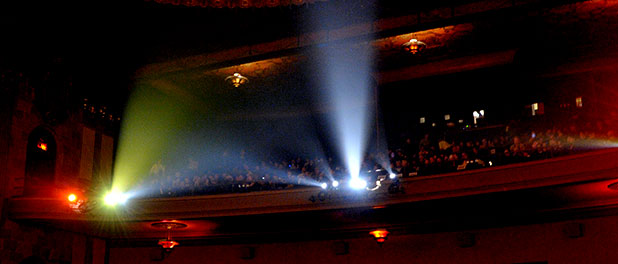
Noir City at San Francisco's Castro Theatre

Once inside we checked seating on the main floor and quickly headed up the steps to the balcony. The Castro has 1,400 seats, so if you get there reasonably on time it’s not hard to find decent seats.

The evening was obviously sold out - the theater filled quickly. Then the lights dimmed, music swelled and we were treated to an intoxicating 6-minute montage created by Serena Bramble featuring clips from the countless noir and neo-noir and crime-themed films set or shot in San Francisco…from The Maltese Falcon to Dark Passage to Vertigo to Basic Instinct and many others in between and beyond…the montage culminated with the greeting, “Welcome to Noir City” and the crowd erupted with cheers and applause…(watch the montage below!)

The Castro Theatre
Next, Eddie Muller, founder of the Film Noir Foundation, took the stage. After introducing this year’s young and slinky Ms. Noir City, he talked about film noir and about the work of preservation and his passion for it. The first screening of the night, High Wall (1947) is one of three newly restored films to premiere at the festival. The UCLA Film & Television Archive supervised the creation of preservation prints with funding provided by the FNF. Muller thanked everyone for coming - the evening’s proceeds, he said, paid for the restoration of the film we were about to see. Finally, he dedicated the event to his friend, mystery writer Joe Gores, who very recently passed away.

The theme of Noir City 9 is Who’s Crazy Now? and both opening night films reflected that premise in spades…High Wall is primarily set in a psychiatric institution, and Stranger on the Third Floor (1940) is about a reporter who suffers a paranoid episode (and fanastic dream) and features an out-and-out madman.

Robert Taylor, High Wall

High Wall stars Robert Taylor, still a major Hollywood star but slightly past his prime at the time this film was made. He and Herbert Marshall do the heavy lifting in this dark confection. Leading lady Audrey Totter was having a big year in 1947 with starring roles in this film as well as The Lady in the Lake, and a co-starring role in The Unsuspected. She’s a little stiff as Taylor’s psychiatrist, but the script doesn't give her much help.  Thankfully, Totter’s natural sex appeal manages to peek through from time to time. Herbert Marshall, who often played weak upstanding men, is the villain here. In a part that vaguely echoes his role in Hitchcock’s Foreign Correspondent, he is one of the strengths in this flawed thriller. To enjoy High Wall, suspension of disbelief is mandatory…the film is an entertaining snapshot rather than a stark reflection of the dark subtext of the post-war late ‘40s.


Laura Ellis
 Intermission. The evening continued with a performance by chanteuse Laura Ellis who, clad in a gorgeous emerald green figure-hugging gown (think Gilda) crooned a luscious ballad that swept me back several decades to a time before my time. A protégé of The Manhattan Transfer’s Alan Paul, Ellis was a wonderful surprise. Would love to hear her version of “Green Eyes” or “Tangerine” and will be keeping an eye on her tour schedule.

The evening just kept getting better. Muller returned with the special guest of the night, Judy Wyler Sheldon, daughter of director William Wyler and actress Margaret Tallichet. Tallichet was leading lady of the night's second feature, Stranger on the Third Floor. Sheldon, who lives in the San Francisco Bay Area and is on the board of the San Francisco Silent Film Society, recounted an anecdote about the first time she saw this film.
William Wyler and Margaret Tallichet

In the 1970s a small local film club advertised a screening of Stranger on the Third Floor and Sheldon decided to attend; she hadn't seen any of her mother's films up to that point. She decided to invite her dad and mom to come along - which they did. As it turned out, the screening was in the home of the club's president and when Judy showed up with not only her husband but her illustrious father and her mother, one of the film's stars, all jaws dropped. She mentioned to the rapt Noir City 9 audience that she hadn't been sure how her father would take not being the center of attention for once, but he turned out to be game and the evening was a big hit. Sometime later Judy Sheldon attended another of the film club's screenings and noticed that the check her father had written to cover admittance had never been cashed but was in a frame on the wall.

Scenes from Stranger on the Third Floor
Stranger on the Third Floor is a 64 minute "B" effort from RKO. BUT. It has been called America's first film noir for its stylistic elements - highlighted by one fabulous and surreal dream sequence. Art Director Van Nest Polglase was involved in just about every RKO film made from 1931 to 1942...including Citizen Kane (1941). Watch Stranger and Kane - a visual connection is unmistakable. The film also boasts cinematographer Nicholas Musuraca (Out of the Past). While there are recognizable faces in the film (Peter Lorre as "the stranger," Elisha Cook, Jr. as Briggs), the two leads are relatively unknown. Margaret Tallichet made few films and was more occupied with her marriage to William Wyler and their family. John McGuire, who plays the reporter, had bit parts in Shadow of a Doubt, White Heat and Sands of Iwo Jima but was off the big screen by 1952. Lorre doesn't have that much screen time, but his scenes are mesmerizing and chilling. Though essentially a "B" morality tale, Stranger on the Third Floor is a must-see for those interested in the evolution of film noir...and American cinema...

Noir City 9 runs through January 30...if there's any chance you can attend - do! This is one of the premiere noir fests in the world and worth every penny of the $10 ticket price ($100 for a festival pass). I'll be back on Wednesday for Jean Renoir's legendary The Woman on the Beach (1947).

Thursday, January 13, 2011


Three films of legendary star to be screened at Noir City 9

Her childhood has been called Dickensian and the rags-to-riches trajectory of her life could easily have provided material for one of her films…

  • She was the youngest of a hard-drinking Irish American bricklayer’s five children
  • She lost her mother at age three when the woman was pushed, while pregnant, from a streetcar
  • Her father abandoned his children (for the second time) and went to sea
  • She lived in a series of foster homes
  • She began working at age 13
Ruby Catherine Stevens, born in 1907 in Brooklyn, New York, grew up fast – and tough. There was one bright spot in an otherwise dreary life - her older sister Mildred was a dancer and, during the summer months, Mildred took Ruby on the road with her. Ruby loved to dance and began learning steps, determined to be a dancer herself.  While still in her early teens she got a job as a chorus girl at the Strand Theater on New York’s Times Square, moved on to the “Keep Kool” Revue and before long was in the Ziegfeld chorus.

Ruby’s big break came in 1926 when a friend introduced her to Willard Mack who was casting “The Noose,” a play headed for Broadway. Mack was impressed with her but felt that she needed a name that implied class and distinction. He found the right name on a playbill: “Barbara Frietchie” with Joan Stanwyck.

Barbara Stanwyck made her first film in 1927 with Broadway Nights. And though she became one of the legends of Hollywood, film success did not come overnight. It wasn’t until the early ‘30s, when she moved west with then-husband Frank Fay that she began to make her mark. Frank Capra saw a screen test and cast her in Ladies of Leisure (1930). A contract with Columbia Pictures followed and her career began to take off. It was during this period that some of her early classics were made and her image as a determined working girl evolved: Night Nurse (1931), Baby Face (1933) and Ladies They Talk About, (1933).

Stanwyck’s personal life remained rocky. Her romance with Broadway actor Rex Cherryman had been cut short when he died suddenly in 1928 at age 30. Her marriage to Fay collapsed in the mid-‘30s as her star rose and his fell. The pair had adopted a baby boy, but Stanwyck and the child developed a strained and then estranged relationship that never healed. She began living with Hollywood heartthrob Robert Taylor in the late ‘30s and her studio, wary of potential scandal, insisted that they marry in 1939.

In 1937 Stanwyck starred in Stella Dallas, a memorable melodrama for which she was nominated for a Best Actress Oscar. In 1938 she starred in Golden Boy with young William Holden, who years later declared he owed his career to her.

Stanwyck proved that she was a capable comedienne with two hit 1941 comedies, Preston Sturges’s The Lady Eve and Howard Hawks’s Ball of Fire. That same year she co-starred in the Capra classic Meet John Doe with Gary Cooper and earned her second Best Actress Oscar nomination.

The 1940s would be the apex of Barbara Stanwyck’s movie career and included her crowning performance, femme fatale Phyllis Dietrichson in Billy Wilder’s film noir supreme, Double Indemnity (1944). Stanwyck garnered her third Best Actress nod for the role.

The decade contained several more popular Stanwyck films: Christmas in Connecticut (1945), The Strange Love of Martha Ivers (1946), The Two Mrs. Carrolls (1947), B.F.’s Daughter (1948) and Sorry, Wrong Number (1948), for which she received her final Best Actress nomination.

It was at around this time that Stanwyck's marriage to Robert Taylor began to fall apart. Taylor had been dallying with some of the celebrated beauties of the time, Lana Turner and Ava Gardner, along with others of less stature, such as the bit actress on Quo Vadis (1951) who created a scandal when she went public with their affair. When Stanwyck gave Taylor an ultimatum he resisted and the pair soon divorced.

Stanwyck never remarried but continued, as she always had, to work hard. She went on to make several more popular films and starred on television in series and mini-series into the mid-1980s.  She was awarded an honorary Academy Award in 1982 for her career achievements.

Barbara Stanwyck died in 1990.


San Francisco’s Noir City 9 will screen three Stanwyck films at this year’s festival:
Sorry, Wrong Number (1948) and The Lady Gambles (1949) on Mon. Jan. 24
The Two Mrs. Carrolls (1947) on Thurs. Jan. 27

Also of note, The High Wall  (1947) starring Robert Taylor (with Audrey Totter) will be shown on opening night, Fri. Jan. 21

Thursday, January 6, 2011


The ninth annual San Francisco film noir festival, Noir City 9, will run from Friday, January 21, through Sunday, January 30, at the historic Castro Theatre; 24 films noir, both celebrated and obscure, will screen.

A presentation of the Film Noir Foundation, this festival is the centerpiece of the organization's effort to find and preserve films in danger of irreparable damage. The foundation's advisory council includes best selling novelists James Ellroy and Dennis Lehane, actress Marsha Hunt and film historian/critic Leonard Maltin.

Film Noir Foundation founder and president Eddie Muller, known as "the czar of noir," is a writer and filmmaker who frequently speaks at noir screenings. Earlier this year he was a special guest at Robert Osborne's 2010 classic film festival in Athens, GA, where he introduced the screening of Double Indmenity. Muller has also provided commentary on noir DVDs (Fallen Angel, The Lineup, They Live by Night and many others).

The Film Noir Foundation also produces festivals in Chicago and Washington, DC.

Click here for screening times and pricing.

The Stranger on the Third Floor (1940)

Friday Jan. 21

High Wall (1947), with Robert Taylor and Audrey Totter
The Stranger on the Third Floor (1940), starring Peter Lorre, considered "the first American film noir"

Saturday Jan. 22

Strangers in the Night (1944), directed by Anthony Mann
Gaslight (1944), with Ingrid Bergman, Charles Boyer and Joseph Cotten
They Won’t Believe Me (1947), with Robert Young, Susan Hayward and Jane Greer
Don’t Bother to Knock (1952), with Richard Widmark and Marilyn Monroe

Sunday Jan. 23

A Double Life (1947), directed by George Cukor, with Ronald Colman (watch a clip featuring Colman's Oscar-winning performance below)
Among the Living (1941), with Albert Dekker, Susan Hayward and Frances Farmer

Monday Jan. 24

The Lady Gambles (1949), with Barbara Stanwyck
Sorry, Wrong Number (1948) directed by Anatole Litvak, with Barbara Stanwyck and Burt Lancaster

Tuesday Jan. 25

The Dark Mirror (1948) directed by Robert Siodmak , with Olivia de Havilland and Lew Ayres
Crack-Up (1947), with Pat O’Brien, Herbert Marshall and Claire Trevor

Wednesday Jan. 26

The Woman on the Beach (1947)
The Woman on the Beach (1947), directed by Jean Renoir, with Robert Ryan and Joan Bennett
Beware My Lovely (1952), with Ida Lupino and Robert Ryan

Thursday Jan. 27

The Two Mrs. Carrolls (1947), with Humphrey Bogart and Barbara Stanwyck
My Name is Julia Ross (1945), with Nina Foch and George Macready

Friday Jan. 28

Crashout (1955), with William Bendix, Arthur Kennedy and William Talman
Loophole (1953), with Barry Sullivan and Charles McGraw

Saturday Jan. 29

Blind Alley (1939) directed by Charles Vidor, with Chester Morris, Ann Dvorak and Ralph Bellamy
Secret Beyond the Door (1948) directed by Fritz Lang,  with Joan Bennett and Michael Redgrave (this year’s “incomprehensible” film)
The Strange Affair of Uncle Harry (1945) directed by Robert Siodmak, with George Sanders, Geraldine Fitzgerald and Ella Raines
So Evil My Love (1948), with Ann Todd, Ray Milland and Geraldine Fitzgerald

Sunday Jan. 30
Angel Face (1952), directed by Otto Preminger, with Jean Simmons and Robert Mitchum
The Hunted (1948), with Preston Foster and Belita

Thursday, November 11, 2010


The San Francisco Film Noir Foundation has set its first-ever Noir City Xmas for Wed., December 15, at the Castro Theatre, and extends an invitation to “enjoy a Cruel Yule...”

The double feature pairs Remember the Night (1940) and Mr. Soft Touch (1949).

TCM has been airing Remember the Night regularly in recent years, and that's where I first saw it. The film stars Fred MacMurray and Barbara Stanwyck as an assistant DA and a thief who share a memorable and affecting holiday before she is set to serve her  jail sentence. Directed by Mitchell Leisen, written by Preston Sturges.  A classic.

Mr. Soft Touch stars Glenn Ford and Evelyn Keyes. A combination of “tight-lipped noir and broad comedy," it was shot on location in San Francisco. The film tells the story of a WW II veteran (Ford) out for revenge when he falls in with a kindly social worker (Keyes).  My first viewing of Mr. Soft Touch will be this “freshly struck 35mm print.”

San Francisco’s 9th annual Noir City Film Festival will run from January 21 – 30, 2011, also at the Castro Theatre; I'll post the screening schedule and ticket information as soon as it's available. Film noir fans should try hard to attend this festival, it's a chance to see both classics and rare "B" gems on the big screen in an old-style movie palace.