Showing posts with label John Gilbert. Show all posts

Thursday, August 25, 2011


Just over a year ago, as Turner Classic Movies prepared to honor silent screen legend John Gilbert with a day of his own for the first time during “Summer under the Stars” 2010, I interviewed Leatrice Gilbert Fountain, daughter of the actor and his second wife, silent screen star Leatrice Joy. Leatrice Fountain and I had become acquainted several months earlier and it seemed a perfect idea to publish a discussion of her father’s career on the same day TCM fêted him.

Leatrice and I have stayed in touch ever since, and over this 4th of July weekend we spent more time talking about her memories…

Leatrice’s story has its origins in 1918, when John Gilbert and Leatrice Joy met on a Peralta Studio picture called One Dollar Bid. He was kind to the nervous actress who hadn’t worked for a while and was preparing for a scene. He was also taken with her - and she thought he was the most attractive man she’d ever seen.  Their romance began when they met by chance months later.

Leatrice Joy
From their early days together and throughout their marriage, Joy had the bigger career and salary. In 1922, the year she married Gilbert, she signed with Paramount to be groomed for stardom by Cecil B. DeMille. She had been working for Goldwyn and when that contract ended, her brother Billy, then her agent, got in touch with DeMille knowing C.B. had lost his great star Gloria Swanson and was looking for a replacement.

John Gilbert was on his way up, but during his time with Joy he hadn’t yet made the films that firmly established his stardom. The couple’s relationship was always tempestuous, and they were apart as often as they were together. For his part, DeMille would have liked the pair to part permanently. Their daughter recounted this story:

“Father had drinking problems, the two would quarrel, and sometimes mother would show up at the studio looking sleepless and unhappy. DeMille finally told her that she must move out of her home until the picture was finished and stay with her mother who lived nearby. This of course infuriated Jack and they fought bitterly. A few days later she was driving on Hollywood Blvd. and saw him ahead of her. He stopped, parked, and walked into a barber shop. She parked behind him, walked into the shop and got into the chair next to his. Neither spoke. When the barber asked her what she wanted she said, I want a haircut just like his (in those days women did not enter the sacred masculine environs of the barber's). It did not cross her mind that this might interfere with the film she was shooting with her long flowing curls. Poor DeMille...”

Some have called Joy a forerunner to Katharine Hepburn and Rosalind Russell because her leading roles were often as emancipated women (and she became famed for her boyish, close-cropped haircut). She was one of Paramount’s top stars and the best known of her films is DeMille’s first version of The Ten Commandments (1923) in which she had one of the featured roles.

Young Leatrice was born in September, 1924, just as her parents were divorcing. Her uncle Billy tried hard to keep Gilbert away from mother and daughter, and her father played virtually no part in the girl’s life for many years; she remembers that she called Billy Joy “Uncle Daddy.”

John Gilbert
Baby Leatrice arrived as John Gilbert’s career was about to skyrocket. He had co-starred in the newly formed MGM’s first production, He Who Gets Slapped (1924), with Lon Chaney and Norma Shearer. But it was in 1925, the year his divorce from Joy was finalized, that Gilbert achieved the heights. He starred in MGM’s production of Erich von Stroheim’s opulent The Merry Widow and also starred in the film that established MGM’s reputation, King Vidor’s smash hit The Big Parade. Just over a year later, not long after the demise of Rudolph Valentino, Gilbert and Greta Garbo co-starred for the first time - in Clarence Brown’s sensual Flesh and the Devil (1926), a runaway success. John Gilbert was now Hollywood’s top romantic lead, adored by millions and in the midst of a great romance with Garbo.

Cecil B. DeMille
At just that time, Leatrice Joy’s career began its decline. In 1925, DeMille departed Paramount, Hollywood’s reigning studio, to create his own production company. When he left, his agreement with Adolph Zukor and Jesse Lasky allowed him to take his stars with him - if they were agreeable. Joy was one of those he took. According to Leatrice Gilbert Fountain, this was at a critical stage of her mother’s career, “she hadn’t yet reached ‘name above the title’ status, but she was being built up.” Joy didn’t want to leave the studio, DeMille’s new company hadn’t yet worked out a distribution deal, and she had been happy at Paramount but, she said later, she was under the impression Zukor and Lasky didn’t want her because they agreed to let DeMille have her. When she realized this wasn’t true, she reacted, according to her daughter, “childishly.” She begged DeMille to release her, but he refused. After that she would not speak to him, “even when they were walking together.”  Joy’s success was modest with the DeMille company; she was assigned to program pictures and DeMille never directed her again. Her daughter mused, “She was a subtle actress who deserved more.”


Leatrice Joy on "To Tell the Truth"

At one point, Joy was off the screen entirely for about 18 months. During that time she toured the country on the vaudeville circuit, performing scenes and singing with an accompanist (her daughter recalled that she was awarded a gold medal as the most popular entertainer on the tour).

Joy’s partnership with DeMille ended unhappily in 1928 and he reportedly held a grudge for years. She signed with MGM and made the last of her silent films for that studio.  The coming of sound effectively ended the film careers of both Leatrice Joy and John Gilbert. Her strong southern accent was considered a detriment, and his voice was called unsuitable.  Joy freelanced for a couple of years for lesser studios and then left movies for nearly a decade. Meanwhile, John Gilbert struggled to revive his waning career until he died suddenly in 1936.

Marilyn Monroe
Joy’s final film was Love Nest (1951), one of Marilyn Monroe’s early films. She told her daughter that Monroe had an effect similar to Jean Harlow’s. She wasn’t talking about her onscreen persona so much as her stunning impact on men - who stopped in their tracks and stared the moment they caught sight of her.

Leatrice Gilbert Fountain remembers Jean Harlow. Her family was linked to the ‘platinum blonde’ on both sides. Members of her mother's family were Christian Scientists, as was Harlow, “…my family was very fond of her. My grandmother was Jean's Christian Science Practitioner (like a healer). She was a really lovely person who always paid attention to a scruffy little girl hanging around [Leatrice].” She remembers the young actress as “a warm, friendly, easy-going girl. She didn’t push herself, others pushed her.” Leatrice’s ‘Uncle Daddy,’ Billy Joy, was Harlow’s first agent and arranged for her initial screen test – for which she wore a dress lent to her by Leatrice Joy. At that time Harlow was under contract to Howard Hughes, an agreement she discussed at length with the more experienced Joy.

John Gilbert (right) at Jean Harlow's wedding
On the other side of the family, John Gilbert was the best man at Harlow’s wedding to her second husband, Paul Bern, in 1932. Bern was a writer, director and producer at MGM, and a close friend of Irving Thalberg. Bern had at once shared a bachelor pad with John Gilbert and Carey Wilson, an MGM screenwriter Oscar-nominated for Mutiny on the Bounty (1935). Leatrice chuckled as she recalled that many years later silent screen star Colleen Moore referred to the place, a house above Sunset Blvd., as “a circus” for all that went on there.

Leatrice Gilbert's first film
Leatrice remembers getting to know the children of other stars, Harold Lloyd’s daughters went to school with her at the Westlake School for Girls; she knew Maria Riva, Marlene Dietrich’s daughter, also born in 1924. Riva, who had a brief career as an actress and appeared on TV in the early ‘50s, seemed to Leatrice a “quiet, withdrawn child” very unlike her illustrious mother.

Leatrice also got to know child actors like Freddie Bartholomew and Judy Garland once she made her own foray into ‘the family business.’

At 12, she portrayed Ann Rutherford (‘Annie Hawks’) as a child in Of Human Hearts (1938), starring Walter Huston, James Stewart and Beulah Bondi (Oscar-nominated for her supporting performance). Around the same time she made a screen test for Hunt Stromberg and was cast as the lead in MGM’s upcoming production of National Velvet. The test, she told me, was a scene set the day before the Grand National, in which Velvet and Mi have a talk. Stromberg was planning to shoot the picture in England, but the advent of World War II in Europe and other issues at MGM put the picture on hold for years…

Ava Gardner
As an MGM contract player in the early ‘40s, Leatrice appeared in several films, including Random Harvest (1942), A Guy Named Joe (1943), Kismet (1944) and Thirty Seconds Over Tokyo (1944). During this time she knew all the other young hopefuls on the MGM lot, liked many and became friends with some, including future star Ava Gardner. She recalls of Ava that she was “beautiful, down-to-earth and warm when so many were distant and aloof…she was so personable.”  Leatrice thought back to an evening when she, Ava and another friend went out on the town to one of Old Hollywood’s great night spots, the Mocambo. She remembered that all eyes in the room followed Ava...and Ava took it in stride, paying little attention to her devastating effect on others.

In 1944 Leatrice joined the war effort by becoming a WAC. She was a clerk-typist for just a year when the war ended.  Out of the Army, she went to New York and for two years attended the school of Tamara Daykarhanova, formerly of the Moscow Art Theatre, source of “the method” approach to acting. Daykarhanova had been with Maria Oupenskaya’s New York acting school before Ouspenskaya relocated. At the studio Leatrice met her first husband, a fellow student.

Many years later, Leatrice became interested in the life and career of her father and eventually wrote his definitive biography, Dark Star (St. Martin's Press, 1985). Her exhaustive research on his life put her in touch with many luminaries of Hollywood’s ‘golden age.’  She interviewed the likes of Joan Crawford, Norma Shearer, Colleen Moore, Lillian Gish, Marlene Dietrich, John Ford, Howard Hawks, King Vidor, Clarence Brown and many others. She came to know and was assisted in her journey to learn more by esteemed film historian/filmmaker Kevin Brownlow (winner of an Oscar in 2010, the Governor’s Award). Along with taking part in silent film festivals world-wide in her continuing effort to restore her father's professional reputation, Leatrice became an oft-quoted source for books and documentaries about Hollywood icons as well as Hollywood itself. In the last few months I’ve come across her comments in biographies of Jean Harlow, Louis B. Mayer and Cecil B. DeMille. Charlotte Chandler’s 2011 biography of Marlene Dietrich quotes Leatrice at length so I asked Leatrice about Chandler, the somewhat enigmatic author of several Hollywood bios…

Leatrice Gilbert Fountain
“...I knew her and ran into her continually at MOMA in the heyday of the film department (there was nothing like it anywhere except for Langlois in Paris). And she seemed to know everyone. How she has kept herself a mystery is one in itself.”

I could’ve asked Leatrice to reminisce for days, but her two visiting sons returned from a fishing expedition and it was time for us both to return to the 4th of July weekend and our daily lives. We agreed to talk again soon…

Click here to view my original interview with Leatrice. Click here for my piece on the fabled history of her father's house in Hollywood.

Sunday, February 6, 2011


Marlene Dietrich is one of very few film stars whose career not only spanned 60+ years but who also enjoyed icon status for most of those years. Her life in film began in the early 1920s with silent pictures. It came to a close with Maximillian Schell's 1984 Oscar-nominated documentary, Marlene, in which she speaks but does not appear on camera.
Marlene in the '30s
Dietrich shot to fame as Lola Lola in Josef von Sternberg's The Blue Angel (1930). Shortly after the film premiered, she left Germany for the U.S. where she and von Sternberg collaborated on six more films during the 1930s. The first, Morocco (1930), was nominated for four Oscars, including a Best Actress nod for Dietrich. By the end of the decade her career had cooled but was reignited when she co-starred, at von Sternberg’s urging, with James Stewart in the 1939 hit, Destry Rides Again. Although Dietrich continued making films in the 1940s, most were shot before the U.S. entered the war or made after the war ended. Though she appeared in only nine films from 1950 - 1978, several are classics: Hitchcock's Stage Fright (1950), Fritz Lang's Rancho Notorious (1952), Billy Wilder's Witness for the Prosecution (1957), Orson Welles's Touch of Evil (1958) and Stanley Kramer's Judgment at Nuremberg (1961). Her final film role was in Just a Gigolo (1978) starring David Bowie; while the movie is forgettable, her brief appearance is not.

chanteuse
In 1953, the Sahara Hotel in Las Vegas offered Dietrich the unheard of sum of $30,000 a week to perform on stage. Her run was so successful that she was quickly signed for a similar engagement in London. The London show was also a smash and she followed it with a return engagement at the Sahara. This was the beginning of Dietrich's celebrated career (and reinvention) as a high-ticket chanteuse that lasted through the mid-1970s. In 1972 she performed her concert act as a TV special and earned an impressive-for-the-era $250,000 for it.

Marlene Dietrich is remembered for her several classic films, her concert career, her breathtaking glamour and her many amorous adventures. But there was another side to the actress that is less well known today...

World War II on the ground
While she was in England in 1937 working on a film, von Ribbentrop, Hitler's ambassador to Great Britain at the time, approached and pressured her to return to Germany. She refused and became a U.S. citizen in 1939. When America entered World War II, Dietrich was one of the first stars to sell war bonds. She entertained troops on front lines all over Europe and in North Africa, appeared at sevicemen's canteens and made anti-Nazi broadcasts in Germany. In addition, Dietrich and other successful Eastern European émigrés in Hollywood provided both financial assistance and moral support to refugees from the European film community who fled the Nazi onslaught. 

World War II with Allied troops

The OSS (the CIA of the time) had a Morale Operations (MO) branch that began producing 'black' (propaganda) radio programs in 1943. These programs reached listeners throughout Europe and the Mediterranean and were intended to create discord in the Axis countries. In 1944, the MO began to recruit Hollywood talent to boost the quality of programming on its stations. The MO’s most popular station was Soldatensender (Soldiers' Radio), and one of the most popular songs it played was Dietrich's "Lili Marlene" with 'black' lyrics created especially for the German version. The Nazi government banned the broadcast of the song, but the ban was lifted in the face of a backlash among Axis soldiers. "Lili Marlene" soon became the song played at the end of every Soldantensender broadcast.

In 1945, the U.S. government awarded Marlene Dietrich the Presidential Medal of Freedom, one of the first presented. Similarly, France made her a chevalier of the Legion of Honor.

But Dietrich's largesse did not begin with World War II…

John Gilbert and Marlene Dietrich
 In 1934 Dietrich became romantically involved with one of the great stars of the silent era, John Gilbert. Gilbert's young daughter Leatrice came to know Dietrich through her father. In her 1985 biography of him, Dark Star, Leatrice Gilbert Fountain wrote of Dietrich's kindness to her, particularly after John Gilbert's death in early 1936.

According to Leatrice, during Dietrich's romance with John Gilbert the actress tried to help revitalize his career as well as his health. She arranged for Gilbert to test for the role of her jewel-thief partner in Desire (1936). Gilbert got the part but unfortunately, shortly after filming began, he suffered a heart attack and was replaced in the role.

Leatrice recalled visiting her father's house on December 24,1935 and being dazzled by the beautiful Christmas tree, decorated in the German tradition by Dietrich herself. She noted that Dietrich had thoughtfully slipped away that day so she could spend time alone with her father. Just over two weeks later John Gilbert was dead of a heart attack.


Following his funeral, Dietrich contacted Leatrice's mother with information and advice about Gilbert's will that could benefit his daughter. Though her mother was unable to successfully pursue the information Dietrich provided, more important to young Leatrice was the relationship she developed with the actress.

with Cary Grant in Blonde Venus
Days after John Gilbert's funeral, Leatrice received an enormous bouquet from Dietrich with a card in her handwriting, "I adored your father. Let me adore you."

Leatrice Gilbert Fountain wrote in Dark Star that for many years thereafter Dietrich made a point of spending time with her. She remembered Dietrich as a "fairy godmother" and told how the star took her to theater openings, on long walks and talks, baked cookies and cakes for her and generally made her feel like "a princess." All this was at a time when Dietrich was very busy with her film career.

Fountain reflected, "I wonder if Marlene Dietrich realized what a difference her presence made to me." She also recounted stories of Dietrich's early days in Hollywood when word began to circulate that she paid the overdue rent of a studio secretary who'd lost her job, that she picked up the hospital bill for the child of a studio electrician and other such acts of generosity. Fountain emphasized that Dietrich did not take credit for these deeds nor would she talk to Fountain about her efforts to help John Gilbert; Leatrice had to go to other sources to learn the details.

Marlene Dietrich died at age 90 in Paris on May 6, 1992. Her celebrity remains legendary, but her goodwill deserves a place in the Dietrich legend as well.


Marlene Dietrich in Just a Gigolo, 1978

Monday, October 18, 2010


John Gilbert
  Estate was Home to Hollywood Notables for 55 Years

In the mid-1920s, when he was a top star at MGM, leading man John Gilbert built a house at 1400 Tower Grove Road in the Benedict Canyon area of Beverly Hills. A two-story Spanish-colonial with tennis court and swimming pool, the estate was on a narrow road that curled up a hill behind the Beverly Hills Hotel.

Gilbert’s daughter, Leatrice, then a young girl, remembered her father greeting her from the top of a long, red-tiled stairway when she arrived for her first visit to his home in the early 1930s. She recalled soft light filtering through high, leaded windowpanes as she climbed the steps.

During one of her visits, he showed her a secret panel in an alcove adjacent to the living room and a button hidden under one of the bookshelves. The button opened a door to a stairway that led to the basement. He told her there had been a bar in the basement before Prohibition was repealed.
1400 Tower Grove Rd., early '30s (click picture for larger view)
She recalled that one evening at sunset, while they walked up the hillside in back, her father warned her to keep an eye out for rattlesnakes... and Leatrice remembered that from the top of the hill you could see "all Los Angeles out to the ocean" and Santa Catalina Island on the horizon.  Leatrice later wrote that it was clear to her even as a child that her father loved the place.

When it was built, the first floor of the main house featured an entry area and a large space for entertaining. Blessed with stunning panoramic views, the second floor held the living room, dining room, kitchen, master bedroom and bath. Most rooms were furnished in 17th-Century Spanish reproductions, a style popular in Hollywood at the time.

Harold Grieve, a silent-era art and set decorator (Ben-Hur, The Thief of Bagdad, The Sea Wolf) who was a founder of AMPAS and later became an interior designer, worked on the home several times over several years.
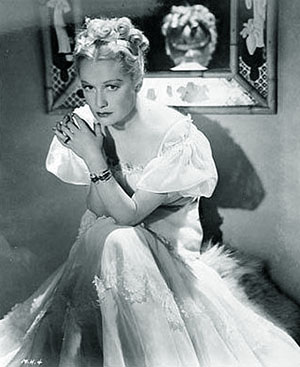
Miriam Hopkins
Gilbert's wives and girlfriends were many, and his master bath and bedroom were redecorated as women came and went, according to Grieve. For example, when Greta Garbo came into the picture, Grieve installed walls and a sunken tub of black marble in the master bath. John Gilbert died in January 1936 and, soon after, actress Miriam Hopkins purchased the home and hired Grieve to redecorate it once more. The house was redone in the emerging Art Moderne style. The newly contemporary walls of Miss Hopkins’ living room provided a showcase for works from her art collection, paintings by artists such as Picasso, Renoir and Matisse. 

David O. Selznick and Jennifer Jones

The Tower Grove Road property's legend was enhanced with the arrival of its next resident, producer David O. Selznick, in 1945.
Selznick rented the house when he separated from his wife Irene (L. B. Mayer’s daughter) after he'd become involved with actress Jennifer Jones. Selznick purchased the property from Hopkins just before marrying Jones in 1949.
With this sale, the home was substantially remodeled.
Selznick/Jones grounds
 Plate-glass windows were installed to dramatize the views and bring indoors the lush beauty of the foliage surrounding the house. Another notable change, the addition of a first floor bedroom/dressing room for Jennifer Jones, featured a striking waterfall just outside her window that could be turned on and off with a switch.

Selznick/Jones home
The Selznicks hosted dinner parties, screened movies and lived a grand life on Tower Grove Road for twenty years, until David O. Selznick’s death in 1965.  Selznick's obituary in the New York Times reported that he had "lived in an elegantly rustic home on an estate atop a hill overlooking Beverly Hills." Jennifer Jones and their daughter remained there until 1969. The house was then sold to Ted Ashley, Chairman of the Board of Warner Bros., the man credited with overseeing one of the studio's most successful eras, 1969 - 1980. It was during Ashley’s residence that Leatrice Gilbert Fountain was invited into the home her father built, a place she had not visited since childhood. 
Ted Ashley, Jack Warner & Jack Valenti in 1969
 
Eight years later, in 1977, hit-maker Elton John bought the house. John’s style was more flamboyant and his taste included Art Deco and Art Moderne (echoes of Miriam Hopkins!). His master bedroom featured a wall covered in mirrors and another covered in ultrasuede. Not too unexpected for a rock star of the '70s, especially one famous for appearing on stage in outrageously over-the-top costumes.


Elton John in the 1970s
 In 1981 the house was sold to its first non-entertainment industry resident. The businessman who purchased it had apparently planned only to remodel, but structural problems were uncovered and the building was demolished to make way for an enormous mansion.

When John Gilbert lived on Tower Grove Road, other major stars like Harold Lloyd and Jean Harlow lived not far away. Today Jay Leno, Halle Berry and other 21st Century A-listers reside in the area.


Selznick/Jones study