Showing posts with label William Wyler. Show all posts

Thursday, October 18, 2012


Actress Jeanne Eagels, one of the great legends of early 20th century American theater, became the toast of the New York stage by the time she was 30. She most famously originated the role of Sadie Thompson on Broadway in John Colton's Rain (based on a Somerset Maugham short story); the play ultimately ran for a record-setting 648 performances. Eagels appeared in only a handful films during her career, most of them silents. The two sound films she did make were both produced in 1929, and she received a Best Actress nod for her performance in the first, a film adaptation of Somerset Maugham's The Letter. But Eagels' contention for an Academy Award occurred posthumously, for she had passed away, at age 39, in October 1929.


The acclaimed Bette Davis/William Wyler re-make of The Letter (1940) has been seen far more widely than the earlier Eagels/Jean de Limur version, but on October 24, Turner Classic Movies will air the 1929 original. New York Times film critic Dave Kehr has described Eagels' acting style as "radically innovative," and next Wednesday morning TCM viewers will have a chance to find out why.

Jeanne Eagels and Herbert Marshall in The Letter (1929)

Jeanne Eagels was born Eugenia Eagles in Kansas City, Missouri, in 1890. She left school to go to work while still a child and joined the Dubinsky Brothers traveling theater company as a dancer sometime between the age of 12 and 15. There she would eventually take lead roles in popular dramas such as "Camille, " "Romeo and Juliet" and "Uncle Tom's Cabin." Eagels later joined another touring company and made her way to New York where she hoped to develop her career. Though she was, for a time, a 'Ziegfeld Girl,' her primary focus was to build a theatrical reputation on the 'legitimate stage.' She was cast in a variety of small roles and, at some point, apparently developed a distinctly British accent off-stage. It was while she was vacationing in Paris that American actor Julian Etinge noticed and admired her, though they did not meet at that time. As it turned out, Etinge and Eagels would soon co-star in "The Crinoline Girl" (1914).

Portrait of Jeanne Eagels, 1918
In early 1916, Eagels earned her first Broadway credit with a featured role in "The Great Pursuit," which ran for just 29 performances. It was in 1917 that her star truly began to rise over The Great White Way with co-starring roles in three plays opposite George Arliss: "The Professor's Love Story," "Disraeli," and "Hamilton."  She went on to appear opposite George Abbott in David Belasco's hit, "Daddies," from 1918 - 1919. Eagels was so popular in her 1920 starring role in "The Wonderful Thing" that her entrances were greeted with such enthusiastic applause she had to wait for the house to quiet before she could go on. She opened in "Rain" in 1922 and it ran on Broadway and on tour over the next four years. She turned down many roles following the play's enormous success (including the role of Roxie Hart in the 1926 production of "Chicago"), but returned to Broadway in 1926 for George Cukor's production of "Her Cardboard Lover" with Leslie Howard.

Before going on tour with "Her Cardboard Lover," Eagels took time out to star in MGM's silent production of the Monta Bell-directed "Man, Woman and Sin" (1927) opposite silent screen idol John Gilbert. Bell would produce and write the dialogue for her talking debut in The Letter two years later.

At the height of her stage career Eagels, who had health issues along with a fondness for alcohol, became notably unreliable. When, in 1928, she failed to appear for scheduled performances of "Her Cardboard Lover" in Milwaukee and St. Louis, the show's producers requested that Actor's Equity ban her from appearing on stage with other Equity members. An 18 month ban ensued. During that time she appeared on the vaudeville circuit performing scenes from "Rain."  She was also free to make films - for which stage actors with trained voices were now in great demand. Following her high-voltage performance in "The Letter," Eagels starred opposite Fredric March in Jealousy (1929). This film was also re-made much later with Bette Davis in the starring role - as Deception in 1946. Eagels' next film was to have been The Laughing Lady (1929), but she dropped out of the project and her role went to Ruth Chatterton. 

Jeanne Eagels, 1921

While in New York in September 1929, Jeanne Eagels underwent successful in-patient surgery for ulcers on her eyes.  A few weeks later, apparently fully recovered, she suddenly fell ill. She was taken to a private hospital where, as she waited to be seen by a doctor, she went into convulsions and died.  Three different coroner's reports followed and all agreed that her demise was caused by an overdose - but each named a different substance. One report pointed to alcohol, another blamed chloral hydrate and a third attributed her death to heroin.

Jeanne Eagels was admired as an actress by many in her day. Bette Davis was reportedly a fan and Louis B. Mayer, taken with Eagels' performance, purportedly deemed The Letter required viewing for actors under contract to MGM at the time. But Eagels' turbulent life off-screen also inspired. "The Shooting Star," a Broadway play of 1933 starring Francine Lattimore was based on her life. The storyline for Dangerous (1935), the film in which Bette Davis portrayed a declining Broadway star (and for which she won her first Oscar), reflected elements of Eagels' own decline. And, in 1957, Kim Novak starred in the biopic Jeanne Eagels, a film that played fast and loose with the facts of Eagels' life story.
 
~ 

The Letter (1929) starring Jeanne Eagels, Reginald Owen and Herbert Marshall airs on TCM Wednesday, October 24 at 8:45 am Eastern/4:45 am Pacific. A few hours later, at 11 am Eastern/8 am Pacific, TCM will air the Lewis Milestone-directed version of Rain (1932) starring Joan Crawford.

Jeanne Eagels as Leslie Crosbie in The Letter (1929)
Sources:
Internet Broadway DataBase
Jeanne Eagels website

Thursday, June 28, 2012

 
This piece is my contribution for The Movie Projector's blogathon in honor of William Wyler. Click here for more information and links to participating blogs.

Of director William Wyler, Bette Davis once declared, “It was he who helped me realize my full potential as an actress.” Of the actress, Wyler would recall, “She was a director’s dream.” Together they made three very popular and critically acclaimed Hollywood films. The pair first collaborated on the 1938 Warner Bros. production of Jezebel. For her performance Bette Davis won the second of her two Best Actress Academy Awards. Davis was sorely disappointed that Wyler had not received a Best Director nod for his work on the film and would later credit her Oscar-winning portrayal to him, “It was all Wyler,” she wrote.

Bette Davis and William Wyler
In January 1940, Warner Bros. announced that Bette Davis would star in a remake of a film adapted from a play Somerset Maughamhad dramatized from his own short story, The Letter. In April, William Wyler was hired to direct, on loan from Samuel Goldwyn who would, in turn, be able to use Bette Davis for his upcoming The Little Foxes, which would be the last film Wyler and Davis would make together. In an interview years later, Wyler recalled that he had read Howard Koch’s script for The Letter and liked it and that he wanted to work with Davis again. His only regret was that cinematographer Gregg Toland was unavailable. For her part, Davis was eager to work with Wyler on another very promising project; Maugham’s sensational tale of British colonial “white mischief” was set in the exotic Far East and replete with adultery, deceit and murder.

The Malay Peninsula
By the time he traveled to British Malaya in 1921, Somerset Maugham was a well established writer of best-selling fiction and popular stage plays. While in the colonies he met an attorney, Courtenay Dickinson, who told him of a scandalous case he’d handled ten years earlier. In 1911, Dickinson represented the wife of the headmaster at a boys’ school in Kuala Lumpur who shot and killed a male friend one night while her husband was out. The headmaster was William J. Proudlock, a British citizen, and his school was the prestigious Victorian Institute, founded in the capital city in 1894. Proudlock’s wife, Ethel, had been visited by William Crozier Stewart, an engineering consultant, while her husband was at dinner with an associate one night in April 1911. Though Mrs. Proudlock claimed that Stewart had attempted rape and that she shot him (several times) in self-defense, she was found guilty at trial and sentenced to death. The outcry of the local British community prevailed, however, and Ethel Proudlock was freed after serving a scant five months in prison. Maugham developed a fictionalized account of the case, with details changed and flourishes added; Maugham said of himself, “I have never pretended to be anything but a story teller.” The Letter first appeared in a collection of his short stories in 1924.

Somerset Maugham’s stage adaptation of The Letterdebuted in London in 1927, starring Gladys Cooper as rubber plantation wife Leslie Crosbie and Nigel Bruce as plantation manager Robert Crosbie. The play premiered on Broadway later that year starring Katharine Cornell.In 1929, illustrious American actress Jeanne Eagels played the lead in a Paramount film directed by Jean de Limur; her co-stars included Reginald Owen as Crosbie and Herbert Marshall as shooting victim Geoffrey Hammond. Eagels received a posthumous Best Actress Oscar nomination for her performance.

Jeanne Eagels and Reginald Owen, The Letter (1929)

Somerset Maugham’s short story opens in Singapore within the offices of Howard Joyce, the attorney representing Leslie Crosbie, who is charged with murder. Joyce’s clerk, Ong, ushers in Robert Crosbie, husband of the accused. The lawyer expresses concern that Crosbie is not bearing up well under the strain of his wife’s arrest and incarceration. Maugham re-engineered the opening to powerful dramatic effect when he adapted it for the stage. As the curtain rises, the sound of a pistol shot is heard. A man (Hammond) staggers across a sitting-room toward its veranda and cries “Oh, my God!” A woman (Crosbie) follows, firing her gun into him even after he has fallen.

Howard Koch’s script for William Wyler’s film opened with an exterior shot of the Crosbie bungalow, the sound of a sudden gunshot followed by a woman stalking a man as he flees, her revolver blazing. Reading this scenario for the first time, Wyler thought it was literally “starting with a bang” and decided the scene should be set up “…with an opposite mood. A mood of silence, quiet, people sleeping…” Wyler also wanted to evoke “…a feeling of the dank, humid jungle atmosphere of rubber plantation country” and opened the film with an uncut and wordless 2-minute sequence:

Under a vivid full moon and cloud cluttered night sky, the camera sweeps through a rubber plantation where a tree oozes latex into a collection pot as Malay workers lounge or sleep in hammocks and a white Cockatoo perches on a fence. A gunshot shatters the quiet and the startled bird takes flight. A man emerges onto the veranda of a lamp-lit bungalow and lurches down its steps. Close on his heels strides a woman with a gun, her face a study in fierce resolve. She fires shot after shot into his body until he is a crumpled a heap at the foot of the steps. The moon goes dark behind a drift of clouds as Max Steiner’s ominous and hypnotic theme surges.


Wyler reflected,“…it was a more effective opening this way, by having this silence,” and Howard Koch, who fondly remembered working on The Letter, remarked on Wyler’s fine-tuned “instinct for staging.” The opening sequence of The Letter, which took a full day to shoot, establishes not only the film’s noirish mood and hot-house atmosphere, but also the controlled ferocity intrinsic to Leslie Crosbie’s character. From this spectacular beginning The Letter unfolds slowly and deliberately, revealing and suggesting its secrets with painstaking care. The film evolves with unrelenting tension and suspense and is remarkable for its astonishingly expressive camera work and atmospheric effects…

The image of the full moon, breaking through heavy clouds or peering down between the fan-like leaves of palm trees, recurs and has been much discussed over the years. According to Wyler, the image of the moon was his attempt “to bring in something mysterious and supernatural” to the story. He knew that this repeated image would lend itself to many interpretations, but his own desire was to add “…a bit of supernaturalism, which I thought belonged.” Another of Wyler’s noteworthy atmospheric accents is the occasional sound of tinkling wind chimes. According to Wyler this was not a planned effect, but something he came up with during filming. There happened to be decorative Chinese wind chimes on the set and when the soundman began to complain that the tinkling annoyed him, the director considered the possibilities and decided they could be used to interesting effect. He thought the chimes made “…an eerie kind of noise, which would heighten the suspense.”

James Stephenson reads "the letter"
At the time The Letter was released, William Wyler had recently commented that he believed the sole responsibility for the quality of any film rests entirely with its director. He felt that the director, whose every decision culminates in what ultimately appears onscreen, is accountable for everything including the performances of the players. The Letter is marked by high caliber acting all around and two impeccable portrayals in particular. Bette Davis is radiant yet coolly controlled as the emotionally repressed Leslie Crosbie, a woman capable of coy charm, relentless guile and calculating deceit - as well as violent rage. James Stephenson, in a breakthrough performance as Howard Joyce, Leslie’s attorney, depicts an intelligent, inherently civilized man manipulated into a wretched compromise. His Howard Joyce, suspicious of the case from the start, endures a visibly wrenching struggle with his own conscience as he becomes ever more entangled in the moral intricacies of Leslie’s defense. The scenes between Bette Davis and James Stephenson are some of the richest moments in the film.

On one important point Wyler and Davis disagreed and that was how the actress should deliver her crucial line at the film’s climax. In the scene, Leslie and Robert Crosbie (Herbert Marshall) are alone together in a darkened room, their marriage in tatters. When Robert asks Leslie if she loves him, she at first says yes, then cracks and cries out, “….with all my heart, I still love the man I killed!” Wyler wanted Davis to look Herbert Marshall directly in the eye as she said these words, but Davis disagreed, she felt no woman could do that, it was too brutal, she would avert her eyes. The two fought and could not agree. Finally, and for the first time in her career, Bette Davis walked off the set. She soon returned and later recalled, “I came back eventually – end result, I did it his way. It played validly, heaven knows, but to this day I think my way was the right way.” She also remarked, “I lost, but I lost to an artist.” 37 years later, Davis was honored as the fifth recipient, and the first woman, to be gvien the Life Achievement Award by the American Film Institute (William Wyler had received the award the previous year). In her 1987 memoir This ’n That, she remembered that the high point of the evening, for her, was when Wyler spoke. He said, “If tonight I brought up the subject of [that] scene in The Letter, Bette would insist on going back to Warner Brothers and reshooting it the way she wanted it.” According to Bette,  “Willie’s speech was short and funny and had the added advantage of being true.”

One battle Wyler did not win was with the Production Code. He had made a change to Maugham's ending. The author's and de Limur’s versions end with Leslie's realization that her punishment for her crime will be to live out her years in a country she despises with a man for whom she feels no passion. The closing line is her confession that even now she loves the man she shot. Wyler and Koch devised a more dramatic demise for Mrs. Crosbie, she would die by the dagger of Hammond’s widow. Wyler’s plan was that, “The thing should end with [Gale Sondergaard] killing Bette Davis.” But at the time “nobody could get away with killing somebody, so for censorship reasons we had to tack on the scene of her being arrested.” Wyler could never accept this “silly anticlimactic” ending and complained to the end of his days that the scene of Sondergaard's arrest still ought to be cut from his picture.

~

The Letter was nominated for seven Academy Awards: Best Picture (Warner Bros.), Best Director (Wyler), Best Actress (Davis), Best Supporting Actor (James Stephenson, who died suddenly in 1941), Best Music, Original Score (Max Steiner), Best Cinematography, Black and White (Tony Gaudio) and Best Film Editing (Warren Low).

 ~

The Letter airs on Turner Classic Movies Friday, June 29, 6:00am Eastern/3:00am Pacific.


Sources:
A Talent for Trouble, Jan Herman, Putnam (1995)
William Wyler - The Authorized Biography, Axel Madsen, Thomas Y. Crowell Co. (1973)
Dark Victory: The Life of Bette Davis, Ed Sikov, Henry Holt (2007)
"Imagery and Sound in William Wyler's The Letter," interview by Charles Higham, Columbia University Oral Research Office (1972)
The Letter: A Play in Three Acts, W. Somerset Maugham, George H. Duran Co. (1925)
The Complete Short Stories of W. Somerset Maugham, Doubleday (1934)

Sunday, January 23, 2011

Stranger on the Third Floor

So…I paid my 10 bucks to park in the lot adjacent to Sullivan’s Funeral Home on Market Street in San Francisco and was heading for the Wells Fargo ATM near 16th...I checked my phone and noticed a text message…my friend Dick, who I was to meet for dinner before attending opening night of San Francisco’s 9th annual film noir festival.
I called him to find out where he was…on Castro St. between 18th and 19th - also on his way to an ATM. After we got our cash we met at Market and Castro and walked over to Café La Taza on 18th to get a bite.

By the time I finished my meal, glass of wine and coconut ice cream-over-a-warm-cookie dessert, it was quarter to seven and time to get to the theater…the line, we knew, would be long…

It was, and with our print-your-own-tickets in hand we got on line and waited for the doors to open. An eclectic crowd, we agreed...a sprinkling of ladies dressed in ‘40’s finery but most in street wear staring into space or talking with friends. Dick and I talked about my godson Nicky who’s thinking of going to his first big music concert, Coachella in April. 
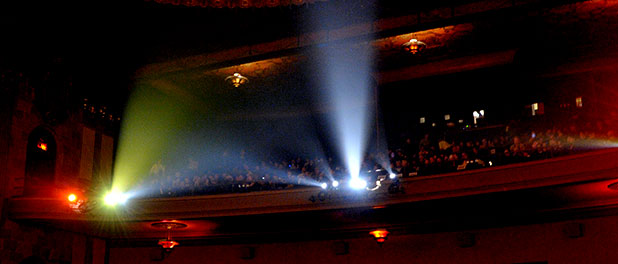
Noir City at San Francisco's Castro Theatre

Once inside we checked seating on the main floor and quickly headed up the steps to the balcony. The Castro has 1,400 seats, so if you get there reasonably on time it’s not hard to find decent seats.

The evening was obviously sold out - the theater filled quickly. Then the lights dimmed, music swelled and we were treated to an intoxicating 6-minute montage created by Serena Bramble featuring clips from the countless noir and neo-noir and crime-themed films set or shot in San Francisco…from The Maltese Falcon to Dark Passage to Vertigo to Basic Instinct and many others in between and beyond…the montage culminated with the greeting, “Welcome to Noir City” and the crowd erupted with cheers and applause…(watch the montage below!)

The Castro Theatre
Next, Eddie Muller, founder of the Film Noir Foundation, took the stage. After introducing this year’s young and slinky Ms. Noir City, he talked about film noir and about the work of preservation and his passion for it. The first screening of the night, High Wall (1947) is one of three newly restored films to premiere at the festival. The UCLA Film & Television Archive supervised the creation of preservation prints with funding provided by the FNF. Muller thanked everyone for coming - the evening’s proceeds, he said, paid for the restoration of the film we were about to see. Finally, he dedicated the event to his friend, mystery writer Joe Gores, who very recently passed away.

The theme of Noir City 9 is Who’s Crazy Now? and both opening night films reflected that premise in spades…High Wall is primarily set in a psychiatric institution, and Stranger on the Third Floor (1940) is about a reporter who suffers a paranoid episode (and fanastic dream) and features an out-and-out madman.

Robert Taylor, High Wall

High Wall stars Robert Taylor, still a major Hollywood star but slightly past his prime at the time this film was made. He and Herbert Marshall do the heavy lifting in this dark confection. Leading lady Audrey Totter was having a big year in 1947 with starring roles in this film as well as The Lady in the Lake, and a co-starring role in The Unsuspected. She’s a little stiff as Taylor’s psychiatrist, but the script doesn't give her much help.  Thankfully, Totter’s natural sex appeal manages to peek through from time to time. Herbert Marshall, who often played weak upstanding men, is the villain here. In a part that vaguely echoes his role in Hitchcock’s Foreign Correspondent, he is one of the strengths in this flawed thriller. To enjoy High Wall, suspension of disbelief is mandatory…the film is an entertaining snapshot rather than a stark reflection of the dark subtext of the post-war late ‘40s.


Laura Ellis
 Intermission. The evening continued with a performance by chanteuse Laura Ellis who, clad in a gorgeous emerald green figure-hugging gown (think Gilda) crooned a luscious ballad that swept me back several decades to a time before my time. A protégé of The Manhattan Transfer’s Alan Paul, Ellis was a wonderful surprise. Would love to hear her version of “Green Eyes” or “Tangerine” and will be keeping an eye on her tour schedule.

The evening just kept getting better. Muller returned with the special guest of the night, Judy Wyler Sheldon, daughter of director William Wyler and actress Margaret Tallichet. Tallichet was leading lady of the night's second feature, Stranger on the Third Floor. Sheldon, who lives in the San Francisco Bay Area and is on the board of the San Francisco Silent Film Society, recounted an anecdote about the first time she saw this film.
William Wyler and Margaret Tallichet

In the 1970s a small local film club advertised a screening of Stranger on the Third Floor and Sheldon decided to attend; she hadn't seen any of her mother's films up to that point. She decided to invite her dad and mom to come along - which they did. As it turned out, the screening was in the home of the club's president and when Judy showed up with not only her husband but her illustrious father and her mother, one of the film's stars, all jaws dropped. She mentioned to the rapt Noir City 9 audience that she hadn't been sure how her father would take not being the center of attention for once, but he turned out to be game and the evening was a big hit. Sometime later Judy Sheldon attended another of the film club's screenings and noticed that the check her father had written to cover admittance had never been cashed but was in a frame on the wall.

Scenes from Stranger on the Third Floor
Stranger on the Third Floor is a 64 minute "B" effort from RKO. BUT. It has been called America's first film noir for its stylistic elements - highlighted by one fabulous and surreal dream sequence. Art Director Van Nest Polglase was involved in just about every RKO film made from 1931 to 1942...including Citizen Kane (1941). Watch Stranger and Kane - a visual connection is unmistakable. The film also boasts cinematographer Nicholas Musuraca (Out of the Past). While there are recognizable faces in the film (Peter Lorre as "the stranger," Elisha Cook, Jr. as Briggs), the two leads are relatively unknown. Margaret Tallichet made few films and was more occupied with her marriage to William Wyler and their family. John McGuire, who plays the reporter, had bit parts in Shadow of a Doubt, White Heat and Sands of Iwo Jima but was off the big screen by 1952. Lorre doesn't have that much screen time, but his scenes are mesmerizing and chilling. Though essentially a "B" morality tale, Stranger on the Third Floor is a must-see for those interested in the evolution of film noir...and American cinema...

Noir City 9 runs through January 30...if there's any chance you can attend - do! This is one of the premiere noir fests in the world and worth every penny of the $10 ticket price ($100 for a festival pass). I'll be back on Wednesday for Jean Renoir's legendary The Woman on the Beach (1947).