
TCM'S ANNUAL FESTIVAL OF STARS DRAWS TO A CLOSE
Since 2003, August on Turner Classic Movies has meant a 31 day parade of stars, each day filled with the films of a different one, each honored for 24-hours of what is known and celebrated as "Summer Under the Stars."
This year, many received a day of their own for the first time. I was surprised to discover that Charles Laughton, Montgomery Clift and Ronald Colman hadn't been featured before. I wasn't at all surprised, but was infinitely thrilled to find that Jean Gabin, icon of the French cinema, was to be honored for the first time.
In his introduction to Renoir's brilliant La Bête humaine (1938) when it aired, Ben Mankiewicz remarked that Gabin was to Europe what Bogart was to the U.S. Many have called Gabin ‘the world’s coolest movie star;’ indeed, Jean-Paul Belmondo seems something of a poser by comparison.
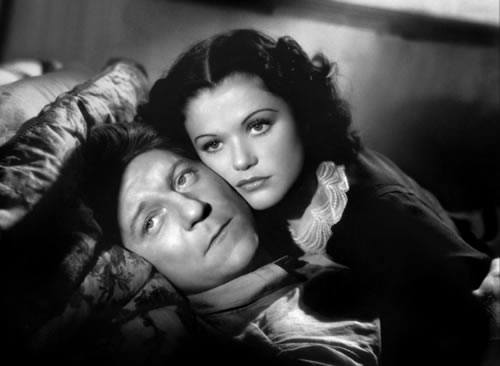 |
| Gabin and Simone Simon, La Bête humaine (1938) |
I’m no stranger to the charms of Jean Gabin. Many years ago, when a profusion of revival houses regularly screened foreign classics, I had the great luck to see Gabin's best known films - Jean Renoir’s La Grande illusion (1937) and Marcel Carné’s La Jour se léve (1939) - on the big screen. And last February, while working on a post about Ida Lupino for a film noir blogathon, I watched for the first time Gabin’s American film debut, Moontide (1942); Lupino co-starred. It's an oddly charming bit of dockside noir and it rekindled my interest in the magnetic M. Gabin.
Once I realized TCM would soon be honoring him, I sat down in front of the DVR with my copy of the channel's "Now Playing" guide and programmed accordingly. I’ve been watching what I recorded ever since...some films more than once. Of those I hadn't seen before, two from 1954 stood out. The early '50s had been a period when the French actor's career seemed to be just about over. Not so, as it turned out.
 |
| Touchez pas au grisbi (1954) |
Jacques Becker's Touchez pas au grisbi was the film, according to Mankiewicz, that "marked Gabin's return to prominence" (others have termed it his "spectacular comeback"). In it, Gabin portrays Max the Liar, a lifelong criminal, well respected among his underworld peers, who has pulled off his last great heist and is set to "retire." Gabin's Max is as confidently matter-of-fact and laconic as any successful, self-possessed businessman. His treatment of his women as well as the men who serve him is fairly off-hand. Only his partner, the luckless Riton, seems to stir visible affection in fatalistic Max. Director Jacques Becker, though not of the school, was an influence on the French New Wave, and this film preceded Melville's rather similar Bob le flambeur and Dassin's Rififi by a year. A very young Jeanne Moreau appears in a supporting role.
Marcel Carné’s L’Air de Paris is an entirely different sort of film. Very popular in its day with audiences, though not with French critics (those enfants terrible of Cahiers du Cinema), it is romantic and charming, with Gabin portraying Victor, a character softer than, though as blasé as Max the Liar, opposite the magnificent Arletty (of Carné’s Les Enfants du paradis, and Gabin's co-star in Carné’s La Jour se léve) and Roland Lesaffre (To Catch a Thief). Victor is a one-time boxer, now a trainer, who has discovered a young fighter (Lesaffre) he believes he can take to the top; his wife Blanche (Arletty) is less enthusiastic.
 |
| Arletty |
I will be saving and viewing these films for some time to come. From other sources, I'll soon be watching Zou Zou (1934) co-starring Josephine Baker, and Carné’s Le quai de brumes (1938). With more to come: Renoir's French Can-Can (1955), about the beginnings of the Moulin Rouge.
August 31 marks the end of "Summer Under the Stars" and on that day the spotlight goes to Marlene Dietrich, a supernova of a movie and concert star if there ever was one. TCM last bestowed this honor on her in 2003.
 |
| Marlene Dietrich and Jean Gabin, 1946 |
Marlene Dietrich and Jean Gabin were romantically involved for several years in the 1940s. Dietrich gave Josef von Sternberg her loyalty and credit for her career, she provided a life-long marriage and a ranch in the Valley to her husband Rudi, and she bestowed her charms on various and sundry, but it was Gabin she remembered as the great love of her life...je comprends.
 |
| The Devil is a Woman (1935), directed by Josef von Sternberg, costumes by Travis Banton |
Marlene Dietrich, August 31, 2011, "Summer Under the Stars" on TCM
All Times Eastern/Pacific:
6:00 am/3:00 am The Monte Carlo Story (1957), with Vittorio De Sica
7:45 am /4:45 am Knight Without Armour (1937), with Robert Donat
9:45 am/6:45 am The Lady is Willing (1942), with Fred MacMurray
11:30 am/8:30 am Kismet (1944), with Ronald Colman
1:15 pm/10:15 am Stage Fright (1950) with Jane Wyman, directed by Alfred Hitchcock
3:15 pm/12:15 pm Rancho Notorious (1952), with Mel Ferrer, directed by Fritz Lang
4:45 pm/1:45 pm Marlene Dietrich: Her Own Song (2001), documentary
6:30 pm/3:30 pm Shanghai Express (1932), with Clive Brook, directed by Josef von Sternberg
8:00 pm/5:00 pm The Scarlet Empress (1934), with John Lodge, directed by Josef von Sternberg
10:00 pm/7:00 pm The Devil is a Woman (1935), with Lionel Atwill, directed by Josef von Sternberg
11:30 pm/8:30 pm Manpower (1941), with George Raft, Edward G. Robinson, directed by Raoul Walsh
1:30 am/10:30 pm A Foreign Affair (1948), with Jean Arthur, directed by Billy Wilder
3:30 am/12:30 am The Blue Angel (1930), with Emil Jannings, directed by Josef von Sternberg


