|
| Stranger on the Third Floor |
So…I paid my 10 bucks to park in the lot adjacent to Sullivan’s Funeral Home on Market Street in San Francisco and was heading for the Wells Fargo ATM near 16th...I checked my phone and noticed a text message…my friend Dick, who I was to meet for dinner before attending opening night of San Francisco’s 9th annual film noir festival.I called him to find out where he was…on Castro St. between 18th and 19th - also on his way to an ATM. After we got our cash we met at Market and Castro and walked over to Café La Taza on 18th to get a bite.
By the time I finished my meal, glass of wine and coconut ice cream-over-a-warm-cookie dessert, it was quarter to seven and time to get to the theater…the line, we knew, would be long…
It was, and with our print-your-own-tickets in hand we got on line and waited for the doors to open. An eclectic crowd, we agreed...a sprinkling of ladies dressed in ‘40’s finery but most in street wear staring into space or talking with friends. Dick and I talked about my godson Nicky who’s thinking of going to his first big music concert, Coachella in April.
 |
| Noir City at San Francisco's Castro Theatre |
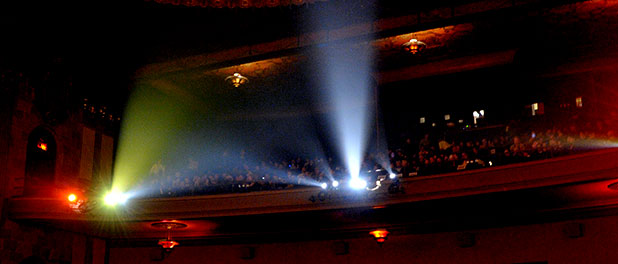
Once inside we checked seating on the main floor and quickly headed up the steps to the balcony. The Castro has 1,400 seats, so if you get there reasonably on time it’s not hard to find decent seats.
The evening was obviously sold out - the theater filled quickly. Then the lights dimmed, music swelled and we were treated to an intoxicating 6-minute montage created by Serena Bramble featuring clips from the countless noir and neo-noir and crime-themed films set or shot in San Francisco…from The Maltese Falcon to Dark Passage to Vertigo to Basic Instinct and many others in between and beyond…the montage culminated with the greeting, “Welcome to Noir City” and the crowd erupted with cheers and applause…(watch the montage below!)
 |
| The Castro Theatre |
Next, Eddie Muller, founder of the Film Noir Foundation, took the stage. After introducing this year’s young and slinky Ms. Noir City, he talked about film noir and about the work of preservation and his passion for it. The first screening of the night, High Wall (1947) is one of three newly restored films to premiere at the festival. The UCLA Film & Television Archive supervised the creation of preservation prints with funding provided by the FNF. Muller thanked everyone for coming - the evening’s proceeds, he said, paid for the restoration of the film we were about to see. Finally, he dedicated the event to his friend, mystery writer Joe Gores, who very recently passed away.
The theme of Noir City 9 is Who’s Crazy Now? and both opening night films reflected that premise in spades…High Wall is primarily set in a psychiatric institution, and Stranger on the Third Floor (1940) is about a reporter who suffers a paranoid episode (and fanastic dream) and features an out-and-out madman.
 |
| Robert Taylor, High Wall |
High Wall stars Robert Taylor, still a major Hollywood star but slightly past his prime at the time this film was made. He and Herbert Marshall do the heavy lifting in this dark confection. Leading lady Audrey Totter was having a big year in 1947 with starring roles in this film as well as The Lady in the Lake, and a co-starring role in The Unsuspected. She’s a little stiff as Taylor’s psychiatrist, but the script doesn't give her much help. Thankfully, Totter’s natural sex appeal manages to peek through from time to time. Herbert Marshall, who often played weak upstanding men, is the villain here. In a part that vaguely echoes his role in Hitchcock’s Foreign Correspondent, he is one of the strengths in this flawed thriller. To enjoy High Wall, suspension of disbelief is mandatory…the film is an entertaining snapshot rather than a stark reflection of the dark subtext of the post-war late ‘40s.
 |
| Laura Ellis |
Intermission. The evening continued with a performance by chanteuse Laura Ellis who, clad in a gorgeous emerald green figure-hugging gown (think Gilda) crooned a luscious ballad that swept me back several decades to a time before my time. A protégé of The Manhattan Transfer’s Alan Paul, Ellis was a wonderful surprise. Would love to hear her version of “Green Eyes” or “Tangerine” and will be keeping an eye on her tour schedule.The evening just kept getting better. Muller returned with the special guest of the night, Judy Wyler Sheldon, daughter of director William Wyler and actress Margaret Tallichet. Tallichet was leading lady of the night's second feature, Stranger on the Third Floor. Sheldon, who lives in the San Francisco Bay Area and is on the board of the San Francisco Silent Film Society, recounted an anecdote about the first time she saw this film.
 |
| William Wyler and Margaret Tallichet |
In the 1970s a small local film club advertised a screening of Stranger on the Third Floor and Sheldon decided to attend; she hadn't seen any of her mother's films up to that point. She decided to invite her dad and mom to come along - which they did. As it turned out, the screening was in the home of the club's president and when Judy showed up with not only her husband but her illustrious father and her mother, one of the film's stars, all jaws dropped. She mentioned to the rapt Noir City 9 audience that she hadn't been sure how her father would take not being the center of attention for once, but he turned out to be game and the evening was a big hit. Sometime later Judy Sheldon attended another of the film club's screenings and noticed that the check her father had written to cover admittance had never been cashed but was in a frame on the wall. |
| Scenes from Stranger on the Third Floor |
Stranger on the Third Floor is a 64 minute "B" effort from RKO. BUT. It has been called America's first film noir for its stylistic elements - highlighted by one fabulous and surreal dream sequence. Art Director Van Nest Polglase was involved in just about every RKO film made from 1931 to 1942...including Citizen Kane (1941). Watch Stranger and Kane - a visual connection is unmistakable. The film also boasts cinematographer Nicholas Musuraca (Out of the Past). While there are recognizable faces in the film (Peter Lorre as "the stranger," Elisha Cook, Jr. as Briggs), the two leads are relatively unknown. Margaret Tallichet made few films and was more occupied with her marriage to William Wyler and their family. John McGuire, who plays the reporter, had bit parts in Shadow of a Doubt, White Heat and Sands of Iwo Jima but was off the big screen by 1952. Lorre doesn't have that much screen time, but his scenes are mesmerizing and chilling. Though essentially a "B" morality tale, Stranger on the Third Floor is a must-see for those interested in the evolution of film noir...and American cinema...Noir City 9 runs through January 30...if there's any chance you can attend - do! This is one of the premiere noir fests in the world and worth every penny of the $10 ticket price ($100 for a festival pass). I'll be back on Wednesday for Jean Renoir's legendary The Woman on the Beach (1947).