Showing posts with label Elia Kazan. Show all posts

Friday, September 9, 2011


Classic Film Boy and The Lady Eve Discuss the Fascinating Irene Mayer Selznick

Welcome to Take 2, a conversation about Irene Mayer Selznick, the daughter of MGM studio head Louis B. Mayer and first wife of famed producer David O. Selznick. Both Classic Film Boy (CFB) and I (TLE) recently read A Private View, Mayer Selznick’s 1983 autobiography.We were impressed by the story of this strong woman who grew up and lived in Hollywood during its golden age and went on to become an esteemed Broadway producer in her own right. CFB invited me to discuss her life with him and, over the past month or so, we did:

CFB: It is great to find another fan of Irene Mayer Selznick’s autobiography. I knew very little about her until I read Scott Berg’s Kate Remembered, his biography of Katharine Hepburn, with whom he became great friends. He was also friends with Irene, and she really intrigued me. By this time it was later in her life, after her autobiography had been published, and I wanted to know more about this woman.

TLE: Over the past few years I’ve had an experience that could be called “all roads
lead to Irene Mayer Selznick” – I kept coming upon interesting references to her as I
read about or researched other subjects. Eventually, I knew I had to get my hands
on her autobiography. This led me to also peruse biographies of her father as well as
David Thomson’s bio of David O. Selznick - primarily to learn more about Irene in
relation to the two key men in her life.

CFB: I’ll need to read the David Thomson book. I’ve read a few others on David O. Selznick. It interests me that several books infer that Irene had an iron will and you didn’t want to cross her. Yet I didn’t get that feel from her autobiography. I guess the truth lies somewhere in between. Still, I very much wish I could have met this woman.

The Mayers: Edie, Louis B., wife Margaret and Irene in the 1920s
You would expect that someone who was brought up in Hollywood during the 1920s would have been part of the jazz age/flapper set. Yet I was amazed at the quiet life Irene and her sister Edie lived. It wasn’t sheltered, but it wasn’t flamboyant, either.

TLE: My impression was that Irene and Edie’s lives under their father’s roof were intensely scrutinized and fairly insulated. Louis B. was vigilant and protective to the point of warning his girls not to become smitten with #1 Hollywood bachelor Irving Thalberg (before he married Norma Shearer) because of his ill health. Irene wrote that they were allowed to socialize with him but were never seated next to him at dinners or events.

Irene seems to me to have been a stifled child. She behaved very self-protectively, careful not to reveal much about her thoughts or feelings to her parents. She had a stammer, something that developed in childhood and apparently lasted most of her life.  Probably the most telling statement she made about her early life was that her parents had given her everything but a sense of her own worth.

Irene and David O. Selznick on the town
Irene grew up to be more her father’s daughter than her mother’s. She was very bright, discerning and determined. And she was a good-looking woman, stylish and modern in her day. I have the impression that David O. Selznick counted on her for quite a bit during their 19-year marriage – which may be why he could never completely let her go. She had been his foundation and sounding board during those years when he achieved the heights.

CFB: Great impressions, and you are on target. I do think Louis B. was overly protective, yet Irene never seemed to shy away from more intellectual pursuits. Where her older sister, Edie, definitely focused on the clothes and societal aspects of life as she came of age, she preferred people whose minds she admired. I enjoyed her fond recollections of William Randolph Hearst (and not-too-fond memories of Marion Davies, who also had a stammer). He treated Irene as a woman with a brain, and she treasured their conversations together. David did the same thing – he recognized that she was his equal in that regard.

As for her father, Irene paints a side of Louis B. in her autobiography that many may not be aware of. She recalls when he – notoriously fond of Americana and family-friendly fare – saw A Streetcar Named Desire, which Irene produced for the stage. Louis B. came to the tryouts in New Haven, and Irene was worried about his reaction. Others were respectful but weren't gushing, but it was Louis B. who pulled Irene into a room and told her, “You don’t have a hit, you’ve got a smash. You wait and see.” She was then shocked to see her father and Elia Kazan, the play’s director, deep in conversation and clearly enjoying each other’s company!

I also agree with you that Irene was a good-looking woman, although Edie didn’t think she put enough into how she looked. I love this from Irene’s book:

Irene and Edie Mayer in the 1920s
Edie to Irene: “Do me a favor, darling. While I want you to look beautiful for yourself, actually I’m being selfish. Everyone thinks I’m years younger than you, but there are some people from way back who remember. So take care of yourself for my sake, because you make me years older than I appear.”

Irene’s response when a friend asked how old Edie was: “She used to be two years older than me. Now she is younger than springtime.”

TLE: You touch on a significant aspect of Irene’s life, her disastrous relationship with her sister, Edie. Theirs was a sibling rivalry that eventually drove them completely apart. Edie had suffered ill-health when she was young and, as a result, received a lot of special parental care and attention. Because it was expected of her, Irene deferred to her “frail” sister’s every whim. As the two grew up, Irene became the more popular of the two and was part of Hollywood’s up-and-coming younger crowd. This didn’t escape Edie's notice.
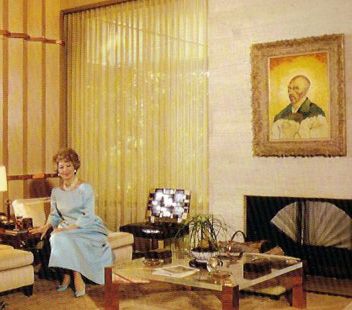
Edie Mayer Goetz at home...with Van Gogh
Edie was a woman of great social ambition. Her husband, Bill Goetz, was a producer, though not a trailblazer in the way L. B. Mayer or David Selznick were. Mayer brokered Goetz’s partnership at 20th Century Fox and it’s said that the snide inside-the-industry crack “the son-in-law also rises” was aimed as much at Goetz as it was Selznick. Goetz’s most significant film was Sayonara (1957), and it earned an Oscar nomination for Best Picture. He was a canny and forward-thinking businessman and enormously popular in Hollywood. Once the Selznick’s split up, he and Edie were at the heart of its social scene and remained so until his death in 1969. Edie quickly lost her social clout once Goetz died.

Irene’s ambition seems of an entirely different nature. Her inclination was to be in on the action, not a decorative accessory or hostess. Her diary from her teen years includes comments on films she saw at MGM previews. These journal entries reveal Irene to have been perceptive and frank in her observations – even at 17. Her take on Romola (1924): “…L. Gish good as always but didn’t make the most of her opportunities – leading male part should not have been the villain – not enough love interest.”

Irene with her sons Jeffrey and Daniel Selznick
In her book Irene writes that it amused her father to ask her opinion of a movie and then try to argue her out of her point of view. When she was dating Selznick, they went to a preview of a picture of his one night and afterward he asked what she thought of it. Irene replied with noncommittal remarks - and he challenged her, “…speak up; no one’s going to hold it against you. If you’re afraid, I promise you no one will ever know a word you’ve said.” Irene writes that she was afraid but over time she felt free enough to say anything she wanted to him. Selznick told her that he was undoing the damage her father had done.

David Selznick was the younger son of Lewis J. Selznick, L.B. Mayer’s one-time employer and long-time anathema. The Selznick boys were on Mayer’s “off-limits” list for his girls, but Irene and David, once committed, were not to be stopped. It seems to me that Irene may not yet have had a true sense of her own worth, but she was developing a mind and will of her own.

CFB: She clearly had a will of her own, and I like how you track it from those observations about film to her conversations with David. She really needed an iron will, considering the men in her life. She could stand up to her father and husband, so dealing with Edie probably was more frustrating than anything else.

Irene was great friends with Katharine Hepburn, and you know Hepburn was no pushover. Still, Irene spent years in analysis, and she was never afraid to admit it or discuss how it helped her. Perhaps that is what grounded her considering the characters around her.

Katharine Hepburn and Irene in Jamaica, asking directions...
Going back to Berg’s book, he was friends with Irene for nearly 20 years until she died, and it’s a nice companion piece to Irene’s autobiography. He describes her as such when they met in the 1970s:

“I don’t think she was more than five feet tall – with short dark hair in bangs and the shrewdest pair of eyes I have ever seen; and I know she was one of the most powerful presences I have ever beheld. … It would be less than precise to call Mrs. Selznick an extremely difficult person, but she was easily the most challenging I have ever met. One never let down one’s guard with Irene, unless looking to be knocked out or thrown out. Emotional, volatile and analytical, she took nothing at face value, probing layers beneath layers in even the simplest matters.”

Berg was very fond of Irene, and it’s interesting to have this insight when you read her autobiography. Her book was no frivolous undertaking to cash in on her fame, and I believe she took great care to analyze her life before setting it down on paper. 

Eve, I feel like we could talk about Irene for days, but perhaps we should wrap this up. Any final thoughts about this fascinating woman?

TLE: I’d like to talk a bit about Irene Mayer Selznick’s accomplishments after she departed Hollywood. Her family and friends are extremely interesting, of course, and her life was entwined with the history of movies in America, which is covered in her book, but there was more – she managed to reinvent herself and carve out a career of her own in New York.

Irene’s decision to leave Selznick and relocate on the East Coast was bold. She wasn’t sure what she might achieve, but turned to old friends for advice, friends like famed playwright/director Moss Hart who urged her to pursue her dream of becoming a theatrical producer. After a while, she rented an office, hired a general manager and got going. Her first production, an Arthur Laurents play starring Shirley Booth, didn’t get to Broadway but closed after an out of town tryout. Laurents later retooled the play, came up with a new title, but kept Shirley Booth  - who won a Tony for her role. David Lean later adapted it to film; this was Summertime (1955) starring Irene’s good friend Katharine Hepburn.

Final scenes: A Streetcar Named Desire on Broadway, 1947
It was on Irene’s 40th birthday that she received the script for what became her second production and it was this play that established her – and everyone associated with it. The play was A Streetcar Named Desire by Tennessee Williams; it debuted on Broadway in 1947 to a half-hour standing ovation. According to Irene, the play made director Elia Kazan “a king.” It also made Marlon Brando a star (he went straight to Hollywood after the play and never looked back), brought a Tony Award to Jessica Tandy, who played Blanche Dubois in New York, and a Pulitzer Prize to Williams. The film adaptation would win four Oscars.

Irene was certainly a powerhouse, she went toe-to-toe with the indomitable Kazan when they worked on Streetcar (perhaps second nature to her by now, after dealing with her father and husband). In fact, Tennessee Williams had a habit of referring to her as “Dame Selznick,” apparently acknowledging her pedigree and her demeanor.

Bell, Book and Candle on Broadway
Irene produced several more Broadway plays. Her production of Bell, Book and Candle in 1950 starred Rex Harrison and Lilli Palmer and was adapted to film in 1958 and became a hit starring James Stewart and Kim Novak. Irene’s production of The Chalk Garden in 1955 brought her a Tony nomination; the film adaptation starred Deborah Kerr.

In her memoirs Irene described her life as a play in three acts, the first as her father’s daughter, the second as wife to her husband, and the third act was her career in the theater. She wrote, “With perseverance I’ve gotten this far. Now, with a little more luck, I’d like to grow very old as slowly as possible.” She died in New York in 1990 at age 83.

I’ve really enjoyed this, CFB, and want to thank you for inviting me to discuss Irene Mayer Selznick's incredible story with you.

CFB: You're welcome. Detailing her amazing theater work – which many people may not know  of – is a wonderful way to wrap up a conversation about Irene. She wasn’t just the daughter of mogul Louis B. or the wife of wunderkind David O. She was a tough, sharp and respected Broadway producer, and her stage work alone represents a strong legacy. 

Irene Mayer Selznick
Following is an audio clip of a 1948 radio program that begins with Elia Kazan and Irene Mayer Selznick accepting the New York Drama Critics' "Best American Play" Award for Tennessee Williams. The program goes on to feature portions of the play itself, with narration by Kazan and scenes performed by the original Broadway cast - including Marlon Brando, Kim Hunter and Jessica Tandy:


Click here to visit Classicfilmboy's Movie Paradise. Click here to learn more about the evolution of A Streetcar Named Desire.

Friday, May 6, 2011


When playwright Tennessee Williams decided to pick up where he left off on the play-in-progress he called The Poker Night, it was 1946 and he was comfortably ensconced in New Orleans in a French Quarter apartment overflowing with fine antiques.

Less than a year earlier, Williams's The Glass Menagerie had opened on Broadway. With this play, in the words of playwright Arthur Miller, Williams "lifted lyricism to its highest level in our theatre's history." But Williams struggled before this success came, suffering lean years after winning a special prize given by The Group Theatre in 1938. Though he had received grants, gotten a play produced and even been under contract as an MGM screenwriter during those years, none of it had panned out. His play Battle of Angels, starring Miriam Hopkins, previewed in Boston to good reviews, but created a furor and closed. He flopped at MGM, unwilling or unable to create "a celluloid brassiere for Lana Turner."

Laurette Taylor, star of The Glass Menagerie
It was in 1943 while visiting his family in St. Louis, that Williams began work on a play he called The Gentleman Caller. He became the toast of Broadway in 1945 when the play, retitled The Glass Menagerie, opened to rave reviews and was voted the best play of the year by The New York Drama Critics Circle. During the play's run Williams put together a poker game in order to learn and understand a game that would figure in a story that had begun to form in his mind.

A lifelong wayfarer, Williams had spent time in The Big Easy before and found it a most congenial city. When he returned to linger for a while in 1946, he quickly settled into a regular routine. Writing throughout the early part of the day, he would need a breather by afternoon and head for a favorite nearby watering hole. There he indulged in the bar's specialty, a Brandy Alexander, and played the jukebox until it was time to get something to eat and, later, go for a swim.

Hotel La Concha, Key West
Williams was in the midst of his work on the play when his grandfather, the Rev. Walter Edwin Dakin, arrived in New Orleans for a visit. Widowed, nearing 90 and nearly blind, the beloved old man had been living in some distress at the home of Williams's parents. The playwright decided to take a break from dreary weather and go on a motor trip to Florida with his grandfather. They eventually reached Key West and took a suite at the top of the Hotel La Concha. Here Williams continued to work in earnest on completing his play. Exuberant spirit that he was, he took time to party with friends in the area, Miriam Hopkins and Ernest Hemingway's ex-wife Martha among them. It wasn't until he returned to New Orleans that Williams completed his final draft of The Poker Night and sent it to his literary agent.

~

Irene Mayer Selznick had been a true Hollywood princess. Her father, Louis B. Mayer, was the head of MGM for more than 25 years, and Irene and her older sister Edie were the only children of L.B. and his first wife, Margaret. The girls' lives were incredibly charmed as well as profoundly sheltered.

Irene and Edie both married in 1930, their weddings only weeks apart. Irene's husband was David O. Selznick, the movie-making wunderkind who later headed his own studio and masterminded the production of Gone With the Wind and the career of Jennifer Jones.
 
L.B. Mayer had famously remarked that Irene could've run MGM...if only she'd been a boy. What Irene did run for many years was the complex Selznick household, the at-home version of Selznick's studio...an opulent, frenetically busy 24-hour operation. Selznick may have lived to make movies, but he also gambled, womanized, popped speed and swilled alcohol at a breakneck pace. By 1945, Irene had had enough. Late one night her husband turned to her in bed and asked why she was still awake - she blurted that the the jig was up and she wanted out...then promptly rolled over and fell asleep.

Irene and David Selznick
Though she and David Selznick didn't immediately divorce and her father tried to induce her to stay on the West Coast with a high level job at MGM, Irene relocated to New York. She had dreams of becoming a theatrical producer and, on the advice of good friend Moss Hart, rented an office and hired a general manager. Her first outing was the production of an Arthur Laurents play, Heartsong, starring Shirley Booth. The play closed in Philadelphia but evolved over the years (and with another title) into a Broadway hit that still later became David Lean's Summertime (1955) with Katharine Hepburn.

Irene's first production may not have made it to Broadway, but she was noticed. Soon after, she heard from literary agent Audrey Wood who told her, "My most cherished and important client has a play I would like to put in your hands. It is his best play yet. His name is Tennessee Williams." Irene received the script on her 40th birthday.

Wood, aware of Irene's inexperience but appreciative of her taste, dedication and connections, cajoled and coaxed and eventually arranged for her to meet Williams in Charleston, South Carolina. The playwright asked the up-and-coming producer if she preferred the play's original title, The Poker Night, or the one he was presently considering. And he asked her about the newer title - did she prefer "called desire" or "named desire"? The encounter had begun with both parties ill-at-ease, but in the end contracts were signed and the pair was set to embark on the original production of A Streetcar Named Desire.

~

Irene Mayer Selznick, Elia Kazan and Tennesee Williams
Irene returned to New York and Tennessee soon followed. Once he arrived he methodically made his way around to town to check on the latest plays. After he'd seen Arthur Miller's All My Sons, his heart was set on Elia Kazan, the play's director, for Streetcar. Irene was originally familiar with Kazan as an actor, having seen his breakout performance in the 1935 production of Clifford Odets's Waiting for Lefty. Kazan had begun to direct major stage productions in the early 1940s. Irene sent him the Streetcar script and he turned it down. Influenced by his wife, Molly Day Thacher, who had been instrumental in discovering and championing Tennessee Williams, and the lucrative contract he was offered, he reconsidered.
 
Bette Davis was Irene's first choice for the role of Blanche Dubois, the female lead, but she was unavailable. Margaret Sullavan was considered, but Williams didn't think she was right for the part, he "kept picturing her with a tennis racquet in one hand." Fay Bainter's name came up and Kazan apparently mentioned Mary Martin, but it was through Williams that the play's leading lady was found.

Jessica Tandy as Blanche Dubois
Actor Hume Cronyn, a financial supporter of Williams in his early days on the scene, had recently produced and directed four one-act plays at The Actor's Lab in Hollywood. Three were by Williams and one of them, Portrait of a Madonna, starred Cronyn's wife, Jessica Tandy. Cronyn arranged to have this play staged for Williams when he, Irene and Kazan were on the West Coast. All three attended and were astonished by Tandy's performance. She was quickly signed to play Blanche. For the primary supporting roles, Karl Malden was the only actor considered for the part of Mitch, and Irene suggested Kim Hunter for the role of Stella.

John Garfield was everyone's first choice for the male lead, Stanley Kowalski. The actor had worked steadily on the New York stage before venturing to Hollywood in the late '30s. His screen career began with a star-making turn in Michael Curtiz's Four Daughter's (1938). In 1947 Garfield was about to begin production on Kazan's film adaptation of A Gentleman's Agreement. He would be available afterward and was interested in the play - but his demands proved to be too great.

Next to be offered the role was youthful Burt Lancaster who had just debuted onscreen in Robert Siodmak's The Killers (1946). Though Lancaster didn't take the role, he later told Irene that he'd "yearned" to. Other actors considered for the part included Van Heflin, Edmund O'Brien and...Gregory Peck.

Marlon Brando (center) in I Remember Mama
23-year old Marlon Brando had been a busy young actor since his first major stage role in I Remember Mama. He appeared in Antigone with Cedric Hardwicke, gained notice in Maxwell Anderson's Truckline Café, co-starred in a revival of Candida with Katharine Cornell and appeared in Ben Hecht's A Flag is Born with Paul Muni. In 1946 he was voted Broadway's Most Promising Newcomer. According to Brando, Harold Clurman, who directed him in Truckline Café, suggested him to Kazan for Streetcar. But neither Kazan nor Irene were completely convinced and the final decision was left to the playwright. After spending time with Brando, Williams was ebullient and the actor was hired; he was the last of the principals to be cast. Williams later compared the "luminous power" of Brando's onstage charisma to that of Laurette Taylor who had dazzled as the star of The Glass Menagerie.

When the play opened in New Haven, Louis B. Mayer was there. Irene hadn't wanted to be distracted by his presence and tried to discourage him - to no avail. Despite technical difficulties, the consensus was that Streetcar had played well. But Irene was disappointed at the lack of excitement expressed by the group gathered in her hotel room after the show. She recalled that there was "too much respect floating around and not enough enthusiasm." Then her father asked to speak with her privately. He told her "you don't have a hit, you've got a smash...you wait and see," then he told her to go back to her guests - but not to listen to them.

A Streetcar Named Desire premiered on Broadway at the Ethel Barrymore Theatre on December 3, 1947 and was an instant sensation, receiving a standing ovation that lasted for half an hour. Jessica Tandy, who was universally singled out in the opening night reviews, won a Tony Award, the play was voted the best play of 1948 by the New York Drama Critics Circle and Tennessee Williams won the 1948 Pulitzer Prize for Drama. Streetcar ran for two years and 855 performances and it was the last play of Marlon Brando's theatrical career. The actor soon left for Hollywood, enormous fame and a long, erratic, if often brilliant, film career.

In 1949 Laurence Olivier directed Streetcar on London's West End. Vivien Leigh starred as Blanche with Bonar Colleano as Stanley.
Marlon Brando and Vivien Leigh

When the play was adapted to film in 1951, all the Broadway principals were retained except Jessica Tandy. The role of Blanche went to Vivien Leigh. Years later Karl Malden observed, "If Jessica had played it, I wouldn't have been in the movie and neither would Kim Hunter. Because Jessica was no star, and neither was Brando. But Vivien, who after Gone With the Wind was the biggest thing you ever saw - she could carry us all." Kazan, who accepted the casting of Leigh, remembered, "She had a small talent, but the greatest determination to excel of any actress I've known." Brando thought Leigh was a perfect Blanche because, "...in many ways she was Blanche." Kazan allowed that her emerging psychological problems may have been an asset to her performance as the disintegrating belle, and Leigh later said that the grueling role had tipped her into madness.

Elements of the play, particularly the seamy details of Blanche's past, were toned down or altered for the film, but Kazan was able to preserve the integrity of Williams's creation, masterfully translating its dark poetry and palpable sensuality to the screen. Streetcar was much celebrated, nominated for twelve Academy Awards and winner of four - including a Best Actress award to Vivien Leigh. It is considered the classic among film adaptations of Williams's work.

~

More than 35 years later Irene Mayer Selznick would look back and reflect on that spectacular evening when A Streetcar Named Desire opened in New York. For all that the play's success meant to her that night, she did not foresee the impact it was about to have. With her first Broadway production, she became an established, sought-after theatrical producer. The play, she remembered, made Elia Kazan "a king" and changed forever the lives of all four of its principal players. Most fittingly, she wrote, "it gave Tennessee enduring glory."

March 26, 2011 marked the 100th anniversary of the birth of Tennessee Williams. The University of Texas at Austin, home of the Williams archive, is presenting "Becoming Tennessee Williams" from February 1 - July 21. The exhibit includes manuscripts, correspondence, photos and artwork. Click here to learn more.


Sources:

Memoirs (1975) by Tennessee Williams
A Private View (1983) by Irene Mayer Selznick
The Kindness of Strangers (1985) by Donald Spoto
Songs My Mother Taught Me (1994) by Marlon Brando
Elia Kazan (2005) by Richard Schickel