Showing posts with label Marilyn Monroe. Show all posts

Saturday, September 8, 2012


Turner Classic Movies honors jazz-dance pioneer Jack Cole on Monday night, September 10, with a five-movie tribute to his film work. The choreographer, credited with playing a key role in defining the onscreen personas of Rita Hayworth and Marilyn Monroe, has been the subject of several articles by noted Los Angeles Times dance writer and critic, Debra Levine, who co-hosts TCM’s tribute with Robert Osborne.

If Jack Cole’s name doesn't ring a bell, here are a few examples of his choreography…

From Gilda (1946):


From Gentlemen Prefer Blondes (1953): 


From There’s No Business Like Show Business (1954):


From Designing Woman (1957):


From Les Girls (1957):


In all, Jack Cole worked on two dozen films from the ‘40s to the ‘60s. He had been in great demand from the beginning - Betty Grable and Rita Hayworth sought him - and, after she worked with him on Gentlemen Prefer Blondes, Marilyn Monroe insisted on his participation for every film she made that included a musical routine.

Cole also worked in TV, in clubs and on Broadway and was nominated for a Tony Award in 1966 for Man of La Mancha(1965 – 1971).

Jack Cole and Marilyn Monroe rehearsing "Diamonds are a Girl's Best Friend"

Choreography by Jack Cole on TCM Monday, September 10
(all times Eastern/Pacific)

8pm/5pm - Tonight and Every Night (1945) starring Rita Hayworth
10pm/7pm - On the Riviera (1951) starring Danny Kaye and Gene Tierney
11:45pm/8:45pm - Gentlemen Prefer Blondes (1953) starring Marilyn Monroe and Jane Russell
1:30am/10:30pm - Les Girls (1957) starring Gene Kelly, Mitzi Gaynor and Kay Kendall
3:30am/12:30am - River of No Return (1954) starring Marilyn Monroe and Robert Mitchum

Debra Levine has written several detailed pieces on the life and work of Jack Cole. Click on titles for links:

Jack Cole Made Marilyn Monroe Move

Jack Cole (1911 - 1974)

American Master Choreographer Jack Cole Feted at Jacob's Pillow

"Amada Mio" from Gilda

Tuesday, August 21, 2012


The Classic Movie Blog Association is sponsoring the Gene Kelly Centennial Blogathon from August 20 - 25 and this is my contribution to the event. Please click here for links to the other participating blogs.

~

1960 was the year that

Echo I
  • an American U-2 spy plane was shot down over Russia and its pilot, Francis Gary Powers, was imprisoned there
  • young Cassius Clay (later Muhammad Ali) won the gold medal in the light heavyweight competition at the Summer Olympics in Rome
  • Harper Lee's To Kill a Mockingbird and John Updike's Rabbit, Run were published
  • NASA launched the first communications satellite, Echo I, into space
  • the first working laser was built by American T. H. Maiman
  • #1 hit songs of that year included the Everly Brothers' "Cathy's Clown," The Drifters' "Save the Last Dance for Me" and Percy Faith's version of the theme from A Summer Place
  • on TV, Western series ruled the ratings, with Gunsmoke, Wagon Train and Have Gun Will Travel ranked one, two and three for the year
  • Camelot, starring Richard Burton, Julie Andrews and Robert Goulet, debuted on Broadway
  • John F. Kennedy was elected the 35th President of the United States

As the new decade dawned and the U.S. prepared to embark on a New Frontier, Hollywood was in a state of flux, still reeling from the impact of television on movie attendance. Alfred Hitchcock, whose films since 1954 had been almost exclusively Technicolor/Vistavision dazzlers featuring top stars, shocked audiences and critics with the psychological thriller Psycho. Filmed in black and white, with TV production values and just one bankable star who is killed off in the first half-hour, Psycho was the highest grossing film for that year in the U.S. None of the top ten box office hits of 1960 were musical films. Two musicals did surface in the year's top twenty, Vincente Minnelli's Bells are Ringing with Judy Holliday and the George Cukor-directed Marilyn Monroe vehicle, Let's Make Love.
Mitzi Gaynor, Kay Kendall, Gene Kelly and Taina Elg - Les Girls
Gene Kelly had made his last musical for MGM, the studio with which his name and career are forever intertwined, in 1957. The film was Les Girls, a vibrant extravaganza directed by George Cukor, co-starring Mitzi Gaynor, Kay Kendall and Taina Elg. Cukor was unhappy about Gaynor in the leading lady role ("one of MGM's flat tires") and with the prospect of Helen Rose designing costumes. He had to live with Gaynor but insisted on Orry-Kelly for costumes and the designer went on to win an Oscar for his work.

Kelly's next film, the drama Marjorie Morningstar (1958), teamed him with a nearly grown-up Natalie Wood. Later that year he would return to Broadway and direct the original production of The Flower Drum Song, a Rodgers and Hammerstein musical that went on to garner six Tony Award nominations and to win one.

With the musical film genre on the wane, Kelly happily accepted an invitation early in 1960 from A.M. Julien of the the Paris Opéra and Opéra-Comique and travelled to Paris to devise a modern ballet for the company. While in France Kelly made a quick trip back to the States to appear in George Cukor's latest film-in-progress.

The Billionaire, a romantic comedy/musical was offered to Marilyn Monroe by producer Jerry Wald of 20th Century Fox. Though it had been hoped Billy Wilder would direct, he was already working on The Apartment (1960). And so the package Wald brought to Marilyn and that she accepted included director George Cukor, screenwriter Norman Krasna and co-star Gregory Peck. The film's slight premise followed the shenanigans of a billionaire (Peck) who discovers that an Off-Broadway revue spoofing him is in the works. When he surreptitiously attends a rehearsal of the show, its star (Monroe) mistakes him for an actor on audition. The billionaire falls for the cabaret star and decides he must learn to be a nightclub performer so he can join the act and woo her. Incidentally, since he is a billionaire and can afford the best possible tutors, he eventually hires three of great expertise - Milton Berle to instruct him in the art of comedy, Bing Crosby to help him learn to sing and Gene Kelly to teach him dance moves.

Playbill, 1959
Just as the production got underway, the Writers Guild went on strike. Because there were script problems, this was a major setback. To keep the project moving, Jerry Wald approached Marilyn's husband, playwright Arthur Miller, offering him the job of developing and rewriting the script. Miller, surprisingly, broke ranks with the striking writers and agreed, quickly delivering revisions. Wald then sent Miller's script directly to Gregory Peck who, alarmed at the extent to which Marilyn's role had been enlarged, balked and asked to be released from his role as the titular billionaire. Many actors were mentioned, but French singer/actor Yves Montand, who had lately taken Broadway by storm with his one-man show, won the part; he would make his American film debut in the film now titled Let's Make Love.

As with each of Marilyn Monroe's late-career films, there would be problems on the set. Though the star was coming off a smash hit film, the one considered the best of her career, Billy Wilder's Some Like it Hot (1959), she was in trouble. According to her half-sister, Berniece Miracle, "It was in 1960 that Marilyn began to come completely apart." She believed the drugs Marilyn had initially taken to relax and get to sleep "had turned against her," affecting her moods and ability to work.

Though George Cukor struggled mightily to keep filming on track, the production fell expensively behind schedule. Arthur Miller was called back for further rewrites. And the powers at Fox, mystified by her capricious demands, began to believe that Marilyn was actually mad. As if there wasn't enough chaos, Marilyn created a public scandal by openly carrying on an affair with Yves Montand, whose wife, Simone Signoret, had just won the Oscar for Best Actress.

In the midst of this commotion, Gene Kelly made the 6,000 mile flight from Paris to Hollywood to film his cameo for the picture. Arriving on a Sunday night, he filmed for two hours with Montand on Monday and departed for Paris and his ballet project on Tuesday. Quickly in and out, his may have been the best experience of anyone on the film.

Yves Montand, Marilyn Monroe and Gene Kelly on the set
Let's Make Love opened to great fanfare in September 1960. 20th Century Fox slyly used the Monroe/Montand affair to generate publicity and the crowds turned out - taking the film to #17 among 1960's U.S. box office hits. How audiences managed to sit through the film's first hour is hard to fathom. Let's Make Love gets off to a painfully long, slow start and never gains enough momentum to stir much interest. The cameos of Berle, Crosby and Kelly are highlights, and Montand's charms emerge, at last, during the final 20 minutes or so. But, though the film was promoted with the (silly) tagline, "It's dedicated to the NEW Monroe Doctrine!", Marilyn, whose physical appearance thankfully improves over the course of the film, conjures nothing so much as a careworn rendition of a character that, by now, had become a cliché. It is saddening to watch an actress, a great and gifted star, who had so wished to be taken seriously, wriggle, writhe and whisper her way through the film. Character icons Tony Randall and Wilfred Hyde-White are wasted in a muddle that might best be described, to use a term of the time, as "dullsville."

Gene Kelly's 45-minute jazz ballet, Pas de Dieux, was a great success in Paris. His next film, the critically acclaimed, Oscar-nominated Stanley Kramer drama, Inherit the Wind, was released just a few month after Let's Make Love. He would remain busy throughout the 1960s - appearing in the 1962 - 1963 TV series, Going My Way, the 1964 Fox musical comedy/romance, What a Way to Go! with Shirley MacLaine (in a role originally intended for Marilyn Monroe) and the imaginative Jacques Demy musical, Les demoiselles de Rochefort (1967) with Catherine Deneuve and her equally beautiful (now long-lost) sister, Françoise Dorléac. The decade would also bring Kelly opportunities to direct - the poignant Jackie Gleason vehicle Gigot (1962), the comedy hit A Guide for the Married Man (1967) starring Walter Matthau and the musical Hello, Dolly! (1969) starring Barbra Streisand.

Gene Kelly and Françoise Dorléac in Les demoiselles de Rochefort
  ~
 

Turner Classic Movies honors Gene Kelly's centenary birthday today, August 23, with 24 hours of his films as part of its annual Summer Under the Stars celebration in August. Click here to learn more...And click here for links to blogs participating in Michael and Jill's Summer Under the Stars blogathon on Gene Kelly's day.

~

Sources:
Marilyn Monroe by Barbara Leaming, Crown (1998)
George Cukor: Master of Elegance by Emanuel Levy, William Morrow & Co. (1994)
 

Monday, August 13, 2012


Where does the first step begin on a journey to fate? For me it was sometime in August of 1960, just a kid on a camping trip with his parents and their friends. Lake Tahoe was the destination, with side trips to Squaw Valley, Reno, Carson City, and Virginia City, Nevada. Little did I know, nor anyone else in our little party, that we would run into the production of The Misfits, starring Marilyn Monroe, Clark Gable, and Montgomery Clift, as directed by John Huston. It was clear from the entourage around Gable and Marilyn that this was a very big deal. And my father reinforced this message with his excited exclamation, “there’s Marilyn Monroe and Clark Gable!” although he probably uttered this in French, my parents’ and their friends’ native language. 

My recollections of this event are from the mists of time, and likely distorted by accretions of images and later reflections on the significance of the occasion, and the powerful warping auras of the stars themselves. As a kid turning twelve I was already highly aware of the significance of stardom. We did after all live very close to Hollywood, and in those days before paparazzi, seeing stars was not uncommon. But seeing Marilyn and Clark Gable at work was like entering the stratosphere. My best recollection of the scene was that it was taking place in a casino in Reno, likely Harrah’s Club. Production personnel were orbiting around the magic couple.  An aura emanated from Marilyn. In spite of the effects on her of nerves or drugs, which I wouldn’t have known anything about, she was glowing from the lights and the sheen of her platinum blonde hair. I don’t believe a scene was being filmed at the moment, since she seemed to be smiling and basking in the rapt attention of the small audience that was there, of which we were a part. Clark Gable was smiling too, though in a sort of cool, smirky way, aging, but still the king of the jungle. I couldn’t see their figures very well, and I was old enough to know that Marilyn’s figure was very special. But with the big stars, then and now, “we had faces” was all-important, and with these two in particular, their very unique faces reverberated in the room.  I had a particular affinity to Clark Gable. I grew up with prominent ears, the cause of a childhood complex, and my father would always tell me that this physical feature was what made Clark Gable famous. I believed him, and as a chubby kid with a funny name, I believed in the possibility that there was hope for me yet. Seeing Clark Gable in person might just provide that twist of fate that would correct my negative self-image. “See what I mean,” my father said to reinforce his message. 

That perception of Clark Gable, directly seen and experienced, provided me the kind of connection that seems magically possible to children; a more direct connection than just seeing him on the screen, as I had done, during a re-release of Gone with the Wind.  
Clark Gable, Marilyn Monroe, Montgomery Clift
Marilyn seemed even more magical. Here in real life and in plain sight she still seemed ethereal. Perhaps it was that very quality that made people, especially men, want to possess her, and somehow to hold onto a cloud. She was the embodiment of contradiction, an ethereal, almost angelic image that was hotly desired for her earthly body, and that most famous of movie stars, capable of moving mountains, yet unable to control her own life or emotions.

Finally we moved away from all the action, onward to seeing other sights, me looking backward at the marvel just beheld. Alas, the whole scene was destined to be an ethereal vision. Clark Gable, “the King” died of a heart attack three months later in November 1960. The Misfits premiered in February 1961, to mixed reviews.  Then my father died on June 5, 1962 and Marilyn Monroe died two months after that on August 5, 1962, now fifty years ago.  How could these giants just disappear? My own fate had indeed led me to The Misfits, a rendezvous with the realization that I too might become one.  Marilyn’s star now shines ever more brightly, a testament to film and the power of image. We continue to try to hold onto a cloud.

The Misfits was not a hit in 1961. No one then knew, of course, that it would be the last film that both Clark Gable and Marilyn Monroe would ever star in, nor that Montgomery Clift would also die five years later. The audience wasn’t ready for this modern, existential film in 1961. Its reputation, because of all its baggage, doomed it to the “missed opportunity,” or “underrated film” category. Today it is being rediscovered. The Misfits is not a fun film to watch, its barren landscape parallels its wounded characters. But it is a true reflection of the human condition, and for film buffs, a unique view into the life of several movie legends. For me, it was a rendezvous with destiny – an opportunity to see those legendary stars before they faded, and the passion to now write about them and the world they lived in, a world I briefly transited.


Christian Esquevin is the author of Adrian: Silver Screen to Custom Label, published by the Monacelli Press in 2008. The book is about the life and career of MGM’s famed Golden Age costume designer Gilbert Adrian and his subsequent fashion business. Christian also produces his Silver Screen Modiste blog covering classic film fashion. This is Christian's third guest contribution to this blog, and for each piece I am eternally grateful...
TLE

Saturday, August 4, 2012

photo by Jack Cardiff

One chilly winter morning in 1953, a 15-year-old boy took a bus from his home in New Jersey to New York City in search of adventure. His conception of the city then was of Times Square and he roamed the neighborhood until daylight began to fade. As he made his way to the Port Authority Terminal and his bus trip home, he noticed a long black limousine driving slowly toward him. The limo came to a stop and its driver jumped out and opened the back door at the curb. As he did, he motioned the boy to stay where he was so his passenger would have a clear path across the sidewalk. Nearly 60 years later, the man who had been that boy remembered,"...a white-gloved hand reached out for help and it was given. Then came a face of dizzying beauty..." She was blonde and she wore a long gown that appeared to be made of "tiny white pearls seemingly flung at her in wild abandon and clinging to every pore. Around her neck, over her wrists and on her ears were brightly sparkling diamonds." The boy's heart was already pounding when, as she turned, the woman noticed him, smiled and whispered, "Hi."

photo by Richard Avedon
The bedazzled boy, Frank Langella, who grew up to be an Oscar-nominated, three-time Tony-winning actor, was stunned. He had serendipitously encountered Marilyn Monroe, "the girl" who enraptured the world that year in Gentlemen Prefer Blondes and How to Marry a Millionaire and would soon create pandemonium with The Seven Year Itch. Years later Richard Avedon, one of many famed photographers for whom the actress posed, would comment, "There was no such person as Marilyn Monroe. Marilyn Monroe was an invention of hers. A genius invention that she created like an author creates a character."

The vision that materialized before wide-eyed young Frank Langella on a New York street was the painstaking creation of the former Norma Jeane Baker, but the realization of this fantasy creature had required inspiration and encouragement from others. Not too unlike an orphan on a quest in a folk tale, she rose from humble origins, faced great obstacles and setbacks and, with the aid of others along with her own hard work and desire, transformed her life.

Norma Jeane Baker, age nine
In 1935, Grace McKee, a friend and co-worker of Gladys Baker at a Hollywood editing lab, became her unstable friend's court-appointed guardian and the legal guardian of the woman's nine-year-old daughter, Norma Jeane. A childless peroxide blonde with "stage mother" instincts, McKee filled the little girl's imagination with lavish fancies of one day becoming a bombshell movie star like the one with whom she herself was obsessed - Jean Harlow. When Grace married "Doc" Goddard, Norma Jeane was, for a time, sent to live in the red-brick mansion that served as the Los Angeles Orphans Home. Grace would take the girl out to lunch and a movie most Saturdays and regularly had the child's hair styled at a beauty parlor. Norma Jeane would be returned to the orphanage with her hair freshly curled and be-ribboned and, on occasion, wearing makeup Grace had applied to her very young face. The guardian coached the girl on her smile and paraded her in front of friends crowing "isn't she pretty?" and bragged that the child was going to grow up to be beautiful and famous. It would be little more than a decade after becoming Norma Jeane Baker's guardian that Grace Goddard would, because her charge was not yet 21, sign the girl's first contract with 20th Century Fox.

When Johnny Hyde, a powerful William Morris agent on the West Coast, met 22-year-old Marilyn Monroe on New Year's Eve 1949, she was a starlet adrift in the wilderness of the "party circuit" looking for a break. At one time known as producer "Joe Schenk's girl," she had been under contract to Fox for a year, from 1946 to 1947, and with Columbia Pictures for just six months in 1948. It was during her stint at Fox that she had adopted her screen name with the help of Ben Lyon, the studio's casting director. "Monroe" was her mother's family name; Lyon suggested "Marilyn." He had known and loved Broadway star Marilyn Miller before his marriage to Bebe Daniels, and Norma Jeane Baker reminded him of the talented and lovely blonde, blue-eyed actress who had died young.
Marilyn Monroe in 1950

For Johnny Hyde, meeting Marilyn Monroe led to an enchantment that brought an end to his marriage and the beginning of his tireless promotion of her career. He saw a singular quality in the sensuous blonde and worked to make things happen quickly for her. By the time of his sudden death in 1950, Hyde had negotiated parts for her in John Huston's The Asphalt Jungle (1950) and Joseph Mankiewicz's All About Eve (1950). Her success in these roles led to a new, more generous contract with Fox, an agreement that was secured by Hyde.

Howard Hawks had been unimpressed with the starlet when he first met her in 1948. But after seeing her in The Asphalt Jungle, he realized she had something. And when she was cast in a supporting role in one of his films, Monkey Business (1952), he took a closer look at her potential. Hawks became convinced that Fox chief Darryl Zanuck was misreading Marilyn's appeal, too often casting her in the wrong sort of films. He told Zanuck, "You're making realism with a very unreal girl. She's a completely storybook character..." and urged him to produce Gentlemen Prefer Blondes, a studio property, and cast her in it; furthermore, he agreed to direct.

In 1949 Gentlemen Prefer Blondes had made Carol Channing a Broadway sensation; in 1953, the screen adaptation had an even more powerful impact on the career of Marilyn Monroe. With the film's tremendous success, Marilyn left behind forever her years as a struggling cheesecake model/rising newcomer and emerged a bona fide superstar. She proved to have a talent for comedy and a fine sense of timing and, with Howard Hawks creating the ideal vehicle for her and overseeing an elegant Technicolor upgrade of her look and style, she embodied to scintillating perfection a funny, sexy, sweet and unique confection that produced fireworks on the screen.

In Gentlemen Prefer Blondes, Marilyn Monroe and top-billed co-star Jane Russell are well-matched as a pair of gorgeous gal-pal showgirls on the loose on the high seas and in Paris. Delectably dizzy/witty blonde Lorelei and droll, down-to-earth brunette Dorothy cut loose in clever comic scenes and dynamic musical routines. Both perform renditions of the centerpiece number, "Diamonds are a Girl's Best Friend." Marilyn's version became legendary. 

Fox strikes again! This video clip has been blocked.

Fox's next assignment for its new star was not as solid a film as her last, but it was even more popular. How to Marry a Millionaire (1953) teamed Marilyn with not just one but two other glittery leading ladies - Betty Grable and Lauren Bacall. Another glamor-fest, the story follows three models who rent a ritzy penthouse in Manhattan for a year in hopes of luring and marrying wealthy suitors before their lease expires. Bacall's is the central storyline and hers is the commonsense character; Grable and Marilyn are both ditzy-but-dear dumb blonde types. Marilyn, of course, is the knockout in the trio and, next to her, Betty Grable seems a decade out-of-date. How to Marry a Millionaire was the #5 box office hit of 1953, with Gentlemen Prefer Blondes close behind at #6. As for Marilyn Monroe, she was on top.

Marilyn in a classic Travilla gown
By the time Darryl Zanuck conspired with Billy Wilder to adapt the Broadway adultery romp, The Seven Year Itch, to the screen for Marilyn in 1955, there was no longer any need to pair her with another actress or even an established leading man to bolster the film's box office appeal. Though it is minor Wilder, The Seven Year Itch is the film that certified Marilyn as a phenomenon. On Broadway, George Axelrod's play centered on the brief affair of a married man with his gorgeous neighbor while his family is away on vacation. Even though Hollywood's Production Code demanded that there be no adultery in the adultery comedy, the onscreen presence of Marilyn Monroe was enough to tantalize and satisfy a worldwide audience. The studio's enticing publicity campaign - it was all about Marilyn in a billowy white dress - created a furor.

For a while the sensitive but wily star was able to navigate Hollywood's treacherous rapids. She managed to use the scandal of nude calendar photos to her advantage; she explained away the revelation that she was not, technically, an orphan; and she weathered the outcry stirred by the public remarks of Joan Crawford who implied she was lewd and vulgar. But Marilyn could never cope with her performance anxiety. 

Billy Wilder, ever outspoken and eminently quotable, quipped about his tribulations in working with Marilyn, "I had no problems with Monroe. It was Monroe who had problems with Monroe."

Marilyn sans makeup
Fritz Lang, who had directed her in Clash by Night (1952), remembered that she was "...scared as hell to come to the studio, always late, couldn't remember her lines..." And Howard Hawks noted, "The more important she became, the more frightened she became." Whitey Snyder, Marilyn's makeup artist from her Fox screen test to her funeral, thought her anxiety was connected to her appearance. He said that though she knew every makeup trick there was and used them to marvelous effect, "...it was all an illusion: in person, out of makeup, she was very pretty but in a plain way, and she knew it." It was more than that, though. Marilyn Monroe wasn't simply at the mercy of a fantastical physical image that required scrupulous upkeep. Her ever-shifting entourage included more than hair, makeup and massage professionals, she was also closely attended by personal confidants, studio advisors, talent agents, attorneys, psychotherapists, trophy husbands - and drama coaches.

Determined to be more than a pretty onscreen face with a voluptuous body, she took acting seriously. Teacher Natasha Lytess, employed by Fox at Marilyn's insistence, coached her even as the actress performed in front of the camera. Howard Hawks balked at this and successfully barred Lytess from the set of Gentlemen Prefer Blondes. Billy Wilder referred to her as "that creature Lytess" but put up with her on The Seven Year Itch.

By the mid-'50s, Marilyn was studying with "method" guru Lee Strasberg at the Actors Studio in New York. Julie Newmar, a member of the Studio at the time, remembered her performance of a scene from Anna Christie with Maureen Stapleton. She recalled that Marilyn's hand actually shook as she lifted a drink from the bar. In her view, Marilyn reflected precisely the essence of Strasberg's teachings - she had become Anna Christie. Of Lee Strasberg, Newmar mused that he favored three kinds of artists, "the highly gifted; the injured, tortured souls; and the beauty queens. He adored Marilyn." Soon Lytess was replaced as Marilyn's personal acting coach by Paula Strasberg, Lee's wife.
...with Brando promoting a 1955 Actors Studio benefit

Billy Wilder happily agreed to tackle another project with Marilyn in 1959; her natural luminosity was "something extra, something special" that he believed no one else could bring to the film. He would struggle mightily with her on the comedy masterpiece Some Like it Hot and was critical of the effect method acting seemed to have had on her. Before she took up Strasberg's approach, he said, Marilyn came before the camera as if she were about to walk a tightrope over a pit. After adopting "the method" it seemed to him that she focused her full concentration on only the pit...

Over the years, perhaps in an attempt to deal with her terror of "the pit" and other personal woes, Marilyn became dependent on drugs - pills that lifted her up or calmed her down or put her to sleep - and alcohol. Her reputation for being unreliable and difficult grew to epic proportions. Those who worked on her later films reported that she sometimes appeared on the set as if in a daze and, during the filming of Some Like it Hot, screenwriter Izzy Diamond recalled that she sipped liquor from a thermos that ostensibly contained coffee.

photo by George Barris
When Marilyn returned to Hollywood in 1960 after years of making her home in New York, she sought the care of Freudian analyst Ralph Greenson. The doctor, who treated her until her death, diagnosed her as "a borderline paranoid addictive personality." Norma Jeane Baker had endured a confusing and chaotic childhood, passed from home to home among friends and family - to an orphanage and back - until she was handed off in marriage at just 16.  Young Marilyn Monroe was also passed around - among the powerful men of Hollywood - during her years as an aspiring starlet. From a psychological standpoint, then, it's no surprise that her relationships were intense and volatile, her identity unstable, her emotions erratic and her actions impulsive. Greenson, who viewed her as a perennial orphan, discarded traditional therapeutic methods and took up a highly unorthodox approach in treating her. In a misguided attempt to "save" her, he welcomed Marilyn into his home and family and took on the role of "father" as well as therapist. He had set for himself an impossible task.

Something's Got to Give (1962)
Even at the peak of her popularity, Marilyn was considered risqué, a sex symbol, and was not taken seriously. Her film roles changed little over time and became, for her, a deadly repetition – the artless, often giddy showgirl, or ex-showgirl. Cherie in Bus Stop (1956), Elsie in The Prince and the Showgirl (1957), Sugar in Some Like it Hot, Amanda in Let’s Make Love (1960) and even Roslyn in The Misfits (1961) are variations on a type the actress wanted to break. With her final, unfinished film, George Cukor’s Something’s Got to Give, she was cast in a role that might have helped her broaden the "Marilyn Monroe" persona; Ellen Wagstaff Arden was beautiful but she was also married and the mother of two small children. Had she been able to finish the film, Marilyn might have gone on to romantic comedy roles a la Doris Day or Shirley MacLaine. It’s also possible she could have moved into mature dramatic roles as Ava Gardner, Lee Remick and others did. But this was not to be. Life as a cultural metaphor and brand-name commodity may simply have been too much for a woman already consumed by an array of insecurities.

50 years ago Marilyn Monroe stepped out of the dream and into eternity. Her extravagant fulfillment of a childhood guardian’s fuzzy fantasies had taken her on a journey both harrowing and exhilarating, but her life would come to no fairytale ending. Only with death would come transcendence, and the mythical being she so carefully fashioned and brought to vibrant life lives on, unforgettable and bewitching.

photo by Bert Stern
This post is my contribution to the Summer Under the Stars blogathon hosted by Jill of Sittin' on a Backyard Fence and Michael of ScribeHard on Film. Click here to learn more...
 
 ~

Notes:
Marilyn Monroe: The Biography by Donald Spoto, Harper Collins (1993)
Marilyn Monroe by Barbara Leaming, Crown (1998)
On Sunset Blvd.: The Life and Times of Billy Wilder by Ed Sikov, Hyperion (1998)
Marilyn Monroe: Metamorphosis by David Wills and Stephen Schmidt, It Books (2011)
Dropped Names by Frank Langella, Harper (2012)

Friday, June 8, 2012


Marilyn Monroe was scheduled to work on Something’s Got to Give, a George Cukor film in production for 20th Century Fox, on June 1, 1962, her 36th birthday. That Marilyn arrived on the set on time and worked all day, managing to complete scenes with leading man Dean Martin and co-star Wally Cox, was a cause for celebration in itself, considering Marilyn had worked on only a handful of the film’s 30+ days in production. At the end of the day, a birthday party was thrown on the set featuring a cake festooned with sparklers and Marilyn's favorite champagne, Dom Perignon. Afterward Marilyn attended a charity baseball game at Dodger Stadium and was serenaded with a chorus of “Happy Birthday” during the event.

Marilyn turns 36
Dodger Stadium, June 1, 1962
The next morning, Saturday, June 2, a distraught Marilyn called the home of her vacationing psychiatrist, Dr. Ralph Greenson, and asked his children to come over. There they found her in bed, disheveled and inconsolable. According to Greenson’s son, Daniel, Marilyn rattled off a long list of complaints, concluding with the comment that her life wasn’t worth living. A colleague of Dr. Greenson’s, Dr. Milton Wexler, was summoned and he quickly appropriated the arsenal of sedatives he found in her room. It was later determined that Marilyn’s behavior was likely triggered by an overdose of Dexamyl, an anti-depressant.

Marilyn did not appear on the set of Something’s Got to Give the following Monday, and when her attorney, Mickey Rudin, tried to persuade her to return to work, she became furious and accused him of siding with the studio. Rudin, who was also her psychiatrist’s brother in law, contacted Dr. Greenson who was still in on holiday in Europe and the doctor agreed to fly home at once.

On Tuesday, June 5, Marilyn stayed home from work again. Dean Martin reportedly walked off the set in frustration and the production was temporarily suspended. An emergency meeting was called for Wednesday the 6th at Fox with both Dr. Greenson and Rudin in attendance. The studio was not convinced that either could guarantee that Marilyn would be able to finish the film and finally made a decision that had long been considered – she would be replaced. And so, 50 years ago today, on Friday, June 8, 1962, it was announced that Marilyn Monroe had been fired from Something's Got to Give.

Lee Remick
When Lee Remick was hired to replace her, Dean Martin responded, "I have the greatest respect for Miss Remick and her talent and for all other actresses who were considered for the role, but I signed to do the picture with Marilyn Monroe, and I will do it with no one else."

Dean Martin and Marilyn Monroe during the making of Something's Got to Give
George Cukor, who also directed Marilyn in Let's Make Love (1960), later remarked, "I liked her very much. I found her extremely intelligent - inarticulate, but extremely intelligent. And driven. She was a very peculiar girl...There may be an exact psychiatric term for what was wrong with her, I don't know - but truth to tell, I think she was quite mad."

Director George Cukor with Marilyn on the set
Eventually the picture, a remake of the Cary Grant/Irene Dunne classic, My Favorite Wife (1940), was produced - but with a different director, cast and title. Move Over, Darling starring Doris Day and James Garner was released on Christmas 1963.

Doris Day

Monday, May 28, 2012


Pulitzer Prize winning playwright Arthur Miller traveled to Reno, Nevada, in the spring of 1956 to divorce his first wife. Fulfilling the state's six week residency requirement until the marriage was legally dissolved, Miller stayed at a cabin on Pyramid Lake, about 100 miles from "the biggest little city in the world." During his time in this "forbidding but beautiful place," he got to know a few modern-day cowboy types who made their living capturing wild mustangs and selling them to be butchered for dog food. Miller was invited to join them on one of these hunts. From his experiences in a "whole state full of misfits," Arthur Miller later fashioned a short story that was published the following year in Esquire magazine.


Arthur Miller and Marilyn Monroe
But before he wrote the story and just after he returned from Reno, Miller wed Marilyn Monroe, then at the height of her enormous fame. It was a time when the actress was desperate to make films of substance, and once she and Miller moved to New York she began studying at the Actors' Studio and making plans to set up her own production company. After Miller's story appeared in Esquire, a friend suggested he develop it into a screenplay. Inspired by the idea of writing a part for his wife that would allow her to demonstrate her overlooked acting ability, Miller scripted the moody tale of a disaffected divorcee who encounters three disparate cowboys and ends up accompanying them when they go "mustanging" in the high desert of Nevada.

Anticipation began to build the moment word started to spread that the great playwright had written The Misfits for his glamorous movie star wife. Before it was released, the film had become the stuff of legend.

An iconic photo...Front row: Montgomery Clift, Marilyn Monroe, Clark Gable. Second row:  Eli Wallach, John Huston. In back: producer Frank Taylor, Arthur Miller (on ladder).
John Huston was living in Ireland in 1959 when Frank Taylor, Miller's one-time publisher and the man chosen by the writer to produce the film, sent him the script. Huston pronounced it excellent and agreed to direct. Huston had been Marilyn Monroe's director of choice for The Misfits. She remembered that he had cast her as Angela in his film, The Asphalt Jungle (1950), one of her early breakthrough roles, was ever grateful to him for it and trusted him to guide her through the challenging dramatic role Miller had written for her.

Clark Gable on the set of The Misfits
Clark Gable, who by this time had been appearing in films for more than 35 years and had been a movie star - "the King" - for most of them, had to be cajoled to accept the male lead. Though he found the script intriguing, he didn't know what to make of the story. Miller persuaded him, calling it an "eastern western," about people trying, but afraid, to connect. 

Huston remembered working with Gable on The Misfits: "He thought of himself as an actor, not a screen personality. He liked reminiscing about his early days in the theater - old-time actors' talk. I saw very soon that Clark knew exactly what he was doing. Two or three times I thought I saw ways to improve his performance. I was mistaken." Gable's portrayal of Gay Langland, an aging wrangler displaced in the modern world, is complex and moving. Co-stars Eli Wallach, Montgomery Clift, and lately Marilyn Monroe, were committed "method" actors, but Wallach later recalled Gable and the other Hollywood veteran on the set, Thelma Ritter, as true acting "pros."

Clark Gable was impressed, too. Watching Montgomery Clift, as rodeo cowboy Perce, deliver his first major scene (below) in one take, Gable remarked, "My God, he's really good, isn't he?"


The Misfits has been called Arthur Miller's valentine - in Eli Wallach's words, a "love piece" - to Marilyn Monroe, and members of the crew observed that Miller seemed besotted with her as filming got underway. But when the grueling shoot came to an end three months later, not only would the Miller/Monroe marriage be over but Marilyn Monroe would never complete another film.

Marilyn Monroe on the set
Colin Clark, author My Week with Marilyn and The Prince, the Showgirl and Me, wrote that when he met Billy Wilder he mentioned to him that he, too, had worked with Marilyn Monroe. Wilder replied, "Ah, then you know the meaning of pure pain!"

By the time The Misfits was being made in 1960, Marilyn's erratic on-the-set behavior was well known. Cast and crew would wait...and wait...and wait. Sometimes she would appear, sometimes she wouldn't. She had great trouble remembering and delivering her lines and often required multiple takes. Her latest drama coach, Paula Strasberg, was ever present and Marilyn would look to her rather than John Huston for direction while filming her scenes. And there were drugs and alcohol...

Huston recalled, "She was taking pills to go to sleep and pills to wake up in the morning...she seemed to be in a daze half the time." She became less and less reliable, eventually broke down completely and had to be hospitalized. Clark Gable, according to Huston, "...was nonplussed by Marilyn's behavior. It was as though she'd revealed some horrid fact of life that just couldn't be accepted in his scheme of things."

But Huston also remembered, "When she was herself...she could be marvelously effective. She wasn't acting - I mean she was not pretending to an emotion. It was the real thing."

Marilyn as Roslyn
The Misfits was released on what would have been Clark Gable's 60th birthday, February 1, 1961, but Gable had died of a massive heart attack 2-1/2 months earlier, shortly after the film wrapped. Fortunately, the actor had seen Huston's first cut and was so happy with it he told both the director and Arthur Miller that he thought it the best work of his career. Despite Gable's enthusiasm - and producer Frank Taylor's intention to make "the ultimate motion picture" thanks to an all-star cast and crew - The Misfits was a commercial failure and received a mixed critical response. In Miller's view the critics were "baffled" by it.

If the The Misfits has problems it may be that it was too much Miller's film and not enough Huston's. Regardless of compelling themes, strong performances, photography by Russell Metty, film editing by George Tomasini and an evocative score by Alex North (listen below), the film too often becomes theatrically talky and contrived. And Roslyn, the central character, is so unreal at times that she seems to have been spun out of arty fancies about the actress who portrays her. It is also likely that the difficulties and complications that plagued the production afflicted the film itself.


The Misfits is an unusual and poetic film that may not entirely mesh, but it does fascinate. The powerful climactic mustang capture sequence is as disturbing to watch as it is difficult to forget, and the final scene between Gable and Monroe seems the prophetic farewell of two of Hollywood's biggest stars.

Roslyn: "How do you find your way back in the dark?"

Gay: "Just head for that big star straight on. The highway's underneath it, it'll take us right home."

Marilyn Monroe and Clark Gable...fade out...
~

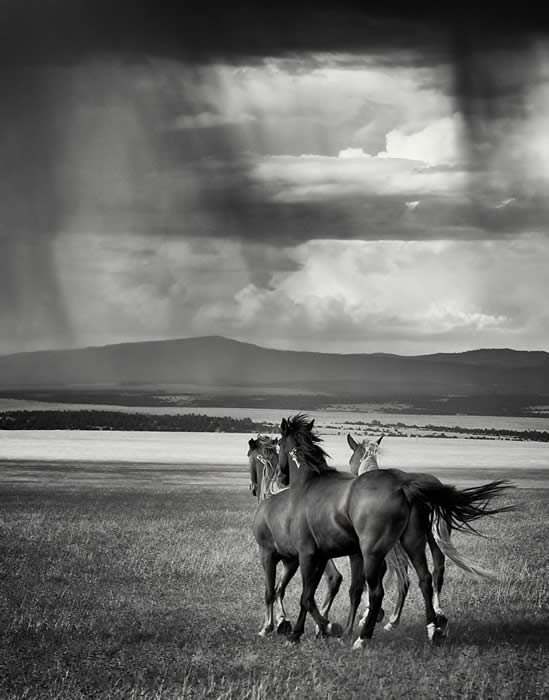
The largest remaining band of wild mustangs in the United States roams the high desert areas of Nevada. About 33,000 horses live in 10 western states and another 30,000 are kept in government corrals.  Click here to learn more about the history and continuing plight of our wild horse population.


~

Click here to go to My Love of Old Hollywood and links to the other participating blogs in Page's blogathon... 

~

Sources:
An Open Book by John Huston, McMillan (1980)
The Misfits: Story of a Shoot by Arthur Miller and Serge Toubiana, Phaidon Press (2000)
Making the Misfits, a production of WNET New York, et al (2002)
wild mustang photos by Kat Livengood