Showing posts with label Louis B. Mayer. Show all posts

Friday, September 9, 2011


Classic Film Boy and The Lady Eve Discuss the Fascinating Irene Mayer Selznick

Welcome to Take 2, a conversation about Irene Mayer Selznick, the daughter of MGM studio head Louis B. Mayer and first wife of famed producer David O. Selznick. Both Classic Film Boy (CFB) and I (TLE) recently read A Private View, Mayer Selznick’s 1983 autobiography.We were impressed by the story of this strong woman who grew up and lived in Hollywood during its golden age and went on to become an esteemed Broadway producer in her own right. CFB invited me to discuss her life with him and, over the past month or so, we did:

CFB: It is great to find another fan of Irene Mayer Selznick’s autobiography. I knew very little about her until I read Scott Berg’s Kate Remembered, his biography of Katharine Hepburn, with whom he became great friends. He was also friends with Irene, and she really intrigued me. By this time it was later in her life, after her autobiography had been published, and I wanted to know more about this woman.

TLE: Over the past few years I’ve had an experience that could be called “all roads
lead to Irene Mayer Selznick” – I kept coming upon interesting references to her as I
read about or researched other subjects. Eventually, I knew I had to get my hands
on her autobiography. This led me to also peruse biographies of her father as well as
David Thomson’s bio of David O. Selznick - primarily to learn more about Irene in
relation to the two key men in her life.

CFB: I’ll need to read the David Thomson book. I’ve read a few others on David O. Selznick. It interests me that several books infer that Irene had an iron will and you didn’t want to cross her. Yet I didn’t get that feel from her autobiography. I guess the truth lies somewhere in between. Still, I very much wish I could have met this woman.

The Mayers: Edie, Louis B., wife Margaret and Irene in the 1920s
You would expect that someone who was brought up in Hollywood during the 1920s would have been part of the jazz age/flapper set. Yet I was amazed at the quiet life Irene and her sister Edie lived. It wasn’t sheltered, but it wasn’t flamboyant, either.

TLE: My impression was that Irene and Edie’s lives under their father’s roof were intensely scrutinized and fairly insulated. Louis B. was vigilant and protective to the point of warning his girls not to become smitten with #1 Hollywood bachelor Irving Thalberg (before he married Norma Shearer) because of his ill health. Irene wrote that they were allowed to socialize with him but were never seated next to him at dinners or events.

Irene seems to me to have been a stifled child. She behaved very self-protectively, careful not to reveal much about her thoughts or feelings to her parents. She had a stammer, something that developed in childhood and apparently lasted most of her life.  Probably the most telling statement she made about her early life was that her parents had given her everything but a sense of her own worth.

Irene and David O. Selznick on the town
Irene grew up to be more her father’s daughter than her mother’s. She was very bright, discerning and determined. And she was a good-looking woman, stylish and modern in her day. I have the impression that David O. Selznick counted on her for quite a bit during their 19-year marriage – which may be why he could never completely let her go. She had been his foundation and sounding board during those years when he achieved the heights.

CFB: Great impressions, and you are on target. I do think Louis B. was overly protective, yet Irene never seemed to shy away from more intellectual pursuits. Where her older sister, Edie, definitely focused on the clothes and societal aspects of life as she came of age, she preferred people whose minds she admired. I enjoyed her fond recollections of William Randolph Hearst (and not-too-fond memories of Marion Davies, who also had a stammer). He treated Irene as a woman with a brain, and she treasured their conversations together. David did the same thing – he recognized that she was his equal in that regard.

As for her father, Irene paints a side of Louis B. in her autobiography that many may not be aware of. She recalls when he – notoriously fond of Americana and family-friendly fare – saw A Streetcar Named Desire, which Irene produced for the stage. Louis B. came to the tryouts in New Haven, and Irene was worried about his reaction. Others were respectful but weren't gushing, but it was Louis B. who pulled Irene into a room and told her, “You don’t have a hit, you’ve got a smash. You wait and see.” She was then shocked to see her father and Elia Kazan, the play’s director, deep in conversation and clearly enjoying each other’s company!

I also agree with you that Irene was a good-looking woman, although Edie didn’t think she put enough into how she looked. I love this from Irene’s book:

Irene and Edie Mayer in the 1920s
Edie to Irene: “Do me a favor, darling. While I want you to look beautiful for yourself, actually I’m being selfish. Everyone thinks I’m years younger than you, but there are some people from way back who remember. So take care of yourself for my sake, because you make me years older than I appear.”

Irene’s response when a friend asked how old Edie was: “She used to be two years older than me. Now she is younger than springtime.”

TLE: You touch on a significant aspect of Irene’s life, her disastrous relationship with her sister, Edie. Theirs was a sibling rivalry that eventually drove them completely apart. Edie had suffered ill-health when she was young and, as a result, received a lot of special parental care and attention. Because it was expected of her, Irene deferred to her “frail” sister’s every whim. As the two grew up, Irene became the more popular of the two and was part of Hollywood’s up-and-coming younger crowd. This didn’t escape Edie's notice.
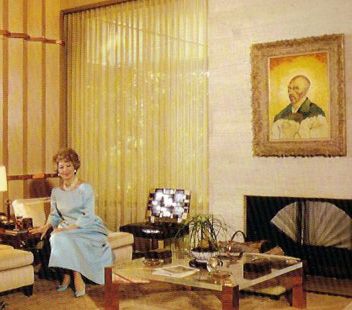
Edie Mayer Goetz at home...with Van Gogh
Edie was a woman of great social ambition. Her husband, Bill Goetz, was a producer, though not a trailblazer in the way L. B. Mayer or David Selznick were. Mayer brokered Goetz’s partnership at 20th Century Fox and it’s said that the snide inside-the-industry crack “the son-in-law also rises” was aimed as much at Goetz as it was Selznick. Goetz’s most significant film was Sayonara (1957), and it earned an Oscar nomination for Best Picture. He was a canny and forward-thinking businessman and enormously popular in Hollywood. Once the Selznick’s split up, he and Edie were at the heart of its social scene and remained so until his death in 1969. Edie quickly lost her social clout once Goetz died.

Irene’s ambition seems of an entirely different nature. Her inclination was to be in on the action, not a decorative accessory or hostess. Her diary from her teen years includes comments on films she saw at MGM previews. These journal entries reveal Irene to have been perceptive and frank in her observations – even at 17. Her take on Romola (1924): “…L. Gish good as always but didn’t make the most of her opportunities – leading male part should not have been the villain – not enough love interest.”

Irene with her sons Jeffrey and Daniel Selznick
In her book Irene writes that it amused her father to ask her opinion of a movie and then try to argue her out of her point of view. When she was dating Selznick, they went to a preview of a picture of his one night and afterward he asked what she thought of it. Irene replied with noncommittal remarks - and he challenged her, “…speak up; no one’s going to hold it against you. If you’re afraid, I promise you no one will ever know a word you’ve said.” Irene writes that she was afraid but over time she felt free enough to say anything she wanted to him. Selznick told her that he was undoing the damage her father had done.

David Selznick was the younger son of Lewis J. Selznick, L.B. Mayer’s one-time employer and long-time anathema. The Selznick boys were on Mayer’s “off-limits” list for his girls, but Irene and David, once committed, were not to be stopped. It seems to me that Irene may not yet have had a true sense of her own worth, but she was developing a mind and will of her own.

CFB: She clearly had a will of her own, and I like how you track it from those observations about film to her conversations with David. She really needed an iron will, considering the men in her life. She could stand up to her father and husband, so dealing with Edie probably was more frustrating than anything else.

Irene was great friends with Katharine Hepburn, and you know Hepburn was no pushover. Still, Irene spent years in analysis, and she was never afraid to admit it or discuss how it helped her. Perhaps that is what grounded her considering the characters around her.

Katharine Hepburn and Irene in Jamaica, asking directions...
Going back to Berg’s book, he was friends with Irene for nearly 20 years until she died, and it’s a nice companion piece to Irene’s autobiography. He describes her as such when they met in the 1970s:

“I don’t think she was more than five feet tall – with short dark hair in bangs and the shrewdest pair of eyes I have ever seen; and I know she was one of the most powerful presences I have ever beheld. … It would be less than precise to call Mrs. Selznick an extremely difficult person, but she was easily the most challenging I have ever met. One never let down one’s guard with Irene, unless looking to be knocked out or thrown out. Emotional, volatile and analytical, she took nothing at face value, probing layers beneath layers in even the simplest matters.”

Berg was very fond of Irene, and it’s interesting to have this insight when you read her autobiography. Her book was no frivolous undertaking to cash in on her fame, and I believe she took great care to analyze her life before setting it down on paper. 

Eve, I feel like we could talk about Irene for days, but perhaps we should wrap this up. Any final thoughts about this fascinating woman?

TLE: I’d like to talk a bit about Irene Mayer Selznick’s accomplishments after she departed Hollywood. Her family and friends are extremely interesting, of course, and her life was entwined with the history of movies in America, which is covered in her book, but there was more – she managed to reinvent herself and carve out a career of her own in New York.

Irene’s decision to leave Selznick and relocate on the East Coast was bold. She wasn’t sure what she might achieve, but turned to old friends for advice, friends like famed playwright/director Moss Hart who urged her to pursue her dream of becoming a theatrical producer. After a while, she rented an office, hired a general manager and got going. Her first production, an Arthur Laurents play starring Shirley Booth, didn’t get to Broadway but closed after an out of town tryout. Laurents later retooled the play, came up with a new title, but kept Shirley Booth  - who won a Tony for her role. David Lean later adapted it to film; this was Summertime (1955) starring Irene’s good friend Katharine Hepburn.

Final scenes: A Streetcar Named Desire on Broadway, 1947
It was on Irene’s 40th birthday that she received the script for what became her second production and it was this play that established her – and everyone associated with it. The play was A Streetcar Named Desire by Tennessee Williams; it debuted on Broadway in 1947 to a half-hour standing ovation. According to Irene, the play made director Elia Kazan “a king.” It also made Marlon Brando a star (he went straight to Hollywood after the play and never looked back), brought a Tony Award to Jessica Tandy, who played Blanche Dubois in New York, and a Pulitzer Prize to Williams. The film adaptation would win four Oscars.

Irene was certainly a powerhouse, she went toe-to-toe with the indomitable Kazan when they worked on Streetcar (perhaps second nature to her by now, after dealing with her father and husband). In fact, Tennessee Williams had a habit of referring to her as “Dame Selznick,” apparently acknowledging her pedigree and her demeanor.

Bell, Book and Candle on Broadway
Irene produced several more Broadway plays. Her production of Bell, Book and Candle in 1950 starred Rex Harrison and Lilli Palmer and was adapted to film in 1958 and became a hit starring James Stewart and Kim Novak. Irene’s production of The Chalk Garden in 1955 brought her a Tony nomination; the film adaptation starred Deborah Kerr.

In her memoirs Irene described her life as a play in three acts, the first as her father’s daughter, the second as wife to her husband, and the third act was her career in the theater. She wrote, “With perseverance I’ve gotten this far. Now, with a little more luck, I’d like to grow very old as slowly as possible.” She died in New York in 1990 at age 83.

I’ve really enjoyed this, CFB, and want to thank you for inviting me to discuss Irene Mayer Selznick's incredible story with you.

CFB: You're welcome. Detailing her amazing theater work – which many people may not know  of – is a wonderful way to wrap up a conversation about Irene. She wasn’t just the daughter of mogul Louis B. or the wife of wunderkind David O. She was a tough, sharp and respected Broadway producer, and her stage work alone represents a strong legacy. 

Irene Mayer Selznick
Following is an audio clip of a 1948 radio program that begins with Elia Kazan and Irene Mayer Selznick accepting the New York Drama Critics' "Best American Play" Award for Tennessee Williams. The program goes on to feature portions of the play itself, with narration by Kazan and scenes performed by the original Broadway cast - including Marlon Brando, Kim Hunter and Jessica Tandy:


Click here to visit Classicfilmboy's Movie Paradise. Click here to learn more about the evolution of A Streetcar Named Desire.

Friday, April 8, 2011


During World War II Hollywood churned out popular pictures both entertaining and patriotic, bolstering home front morale and earning enormous box receipts. Between 1942 and 1945, Americans were spending 23% of their recreation dollars on movies and by 1946 weekly attendance was over 90,000,000. But the boom years would soon go bust.

A decline in movie attendance began in the late '40s driven by changing audience tastes and two major events. In 1948, the Supreme Court ruled that certain film industry practices violated anti-trust laws and required studios to divest themselves of their theater chains. Without a guaranteed outlet for every film produced, filmmaking became riskier and the studios began cutting costs and making fewer films. And then, just as the 20th century reached its mid-point, the industry faced a threat unlike anything that had come before - the arrival of commercial television.

empty seats
Metro-Goldwyn-Mayer, headed by founder Louis B. Mayer since the 1920s, had been the dominant studio for nearly two decades. But the blow to the studio system and declining audiences affected production companies large and small.  By 1951, Mayer was forced out and MGM’s head of production, Dore Schary, took over.

Director Vincente Minnelli had been one of MGM’s top directors since his breakout film, Meet Me in St. Louis, the top-grossing film of 1944. Minnelli married the film’s star, Judy Garland, in 1945. The following year he and Garland produced Liza Minnelli, but from 1946 to 1948 the director's career was uneven, including only minor successes along with outright failures. But a 1949 effort, Madame Bovary, was successful and a point of pride with Minnelli. For the most part he'd felt sidelined from major film work by the overwhelming demands of his marriage to the emotionally volatile MGM star.

In 1950 MGM assigned Minnelli to a Robert Walker comedy, The Skipper Surprised his Wife. The director was rescued from this bland task by producer Pandro Berman who offered him a more enticing project. Also a comedy, it was an adaptation of Edward Streeter’s 1949 bestseller, Father of the Bride, for which Berman owned screen rights. Because the two stories shared similarities, Berman wanted the director of Meet Me in St. Louis on his new production.
 
Jack Benny
As the project began to develop, comedian Jack Benny heard about it and approached Dore Schary. He told the production boss he wanted the role of Stanley Banks, the father of the bride. Without consulting the film’s production team, Schary all but promised Benny the part. Berman was not pleased, nor was Minnelli who went to Benny Thau, veteran MGM executive, and told him he wanted Spencer Tracy for the part and no one else. Thau gave Minnelli the bad news that Tracy was out of the running – the actor had already flatly refused to do the picture.

1950 would mark Spencer Tracy’s 20th year in movies. The winner of back-to-back Best Actor Oscars in 1938 and 1939, he was by this time one of the most respected actors around. Laurence Olivier remarked that he learned more about acting from watching Tracy than from any technique. But away from the set Tracy wrestled with a serious problem - he was a notorious drinker. Between the efforts of MGM’s PR team and Katharine Hepburn’s care, Tracy had been able to avoid scandal and continue working. By the late '40s it appeared the actor’s drinking had tapered off somewhat, however, his hard living had aged him and he looked older than his years. Despite all this, Tracy was still much in demand and worked steadily, even as the industry went into a serious slump.

Hepburn and Tracy, Adam's Rib (1949)
In the midst of the box office downturn, Adam’s Rib (1949), one of the the best of the Tracy/Hepburn battle-of-the-sexes comedies, became a major hit. Though Tracy’s follow-up had been a less memorable potboiler called Malaya (1949), Vincente Minnelli remained convinced that he was the only actor to play Stanley Banks. Eventually, Minnelli decided to enlist Katharine Hepburn’s help. Hepburn invited him over for dinner and, during the meal, Minnelli told Tracy that with him in the lead the comedy had the potential to become a real classic.This was all it took to win Tracy over and he agreed to take the part. It came out that the actor had not refused to do the picture at all, but had known others were being considered for the part and assumed Minnelli didn't want him. To save face, Tracy had resorted to spreading a rumor that he had turned down Father of the Bride.

Joan Bennett was chosen to play the bride's mother, Ellie Banks. Bennett and Tracy had last co-starred in Raoul Walsh’s Me and My Gal (1932) eighteen years earlier. That film had ended with Tracy and Bennett’s characters marrying each other, and Tracy liked to joke that the plot of Father of the Bride indicated that his 1932 “marriage” to Bennett had worked out.  

Elizabeth Taylor in the 1950s
 Elizabeth Taylor, as bride-to-be Kay Banks, supplied the delectable frosting on the rich cake of Father of the Bride's cast. Spencer Tracy cracked that the film's only hard-to-believe detail was that the lovely girl could possibly be his daughter. Taylor was just 17 when she made the picture, but had already begun to portray more mature characters; at 16 she’d played the wife of 38-year-old Robert Taylor in Conspirator (1949). But Elizabeth Taylor was not so mature off-screen. She was still under the thumb and eagle eye of her mother and although the young actress had begun to date, her romances consisted of girlish infatuations and arranged dates mined for publicity by MGM. She was, despite her stunning beauty and poise, quite naïve when it came to love.

Father of the Bride, like Meet Me in St. Louis before it, is in its way a fond glimpse into American family life. Contemporary when it was released, the film plays today as a snapshot of a bygone, fairly idyllic, era. That mid-century moment is caught as if in amber by the solid screenplay of screenwriting team Frances Goodrich and Albert Hackett, Vincente Minnelli's meticulous attention to what is now period detail...a well-chosen cast, cinematographer John Alton and the minimal, mostly diegetic soundtrack of Adolph Deutsch. Father of the Bride is invariably referred to as a “sparkling comedy.” It most certainly sparkles and brims with sophisticated humor as it casts a skeptical, if bemused, eye on the incongruous goings-on at the heart of its plot, the American marriage ritual, circa 1950. The plot follows suburban lawyer Stanley Banks who is by turns besieged and put upon as he as he spends an enormous amount of money to finance every stage of a tradition that will end in his beloved daughter Kay leaving home. Adding insult to injury, Banks is (amusingly) ignored, belittled, the butt of jokes and barely tolerated while at the same time forced to pay and pay and pay. As the wedding nears he is beset by irrational fears and surreal nightmares. Given that the Stanley Banks character, a lovable and loving curmudgeon, carries the film, Minnelli's judgment was unerring when he insisted on Tracy or no one for the part.

Elizabeth Taylor and Joan Bennett
Father of the Bride was released on June 16, 1950, and was an immense hit. Contributing what can best be described as a publicist's dream, Elizabeth Taylor married her first husband, Nicky Hilton, just weeks earlier. Hilton was the son of the founder of Hilton Hotels, and though the pair had only begun dating months earlier, they succumbed to a whirlwind courtship. MGM naturally, and heartily, approved. Taylor's marriage at the very moment she starred as a virginal bride onscreen was an early indicator of something that would become a habit...her life imitating her art. Taylor's marriage to Hilton ended less than a year after it began...even before a quickie follow-up film to Father of the Bride was released in late 1951.

Father's Little Dividend (1951) is a charming, if less inspired, sequel. The dividend is Kay and her husband's first child and the plot, once again, covers the indignities Mr. Banks (Tracy) must endure...this time as grandfatherhood approaches. It, too, was a hit, but it was not on a par with Father of the Bride which had earned Oscar nominations for Best Picture, Best Screenplay and Best Actor and become an instant classic.

By the time both films had been released, Minnelli and Garland were divorced. Their final split came not long after MGM terminated Garland's contract in 1950. As she struggled to rebound and rebuild her career, Minnelli went back to work with a vengeance. He embarked on the most productive and celebrated decade of his career, a period that included An American in Paris (1951), The Bad and the Beautiful (1952), The Band Wagon (1953), Brigadoon (1954), Lust for Life (1956), Designing Woman (1957), Gigi (1958) and Some Came Running (1958). Minnelli received a Best Director Oscar nomination for An American in Paris (winner of six Oscars including Best Picture) and won for Gigi (winner of nine Oscars including Best Picture). Though Minnelli wasn't nominated, The Bad and the Beautiful won five Oscars.

Spencer Tracy went on make another 17 films and earn five more Best Actor Oscar nominations. His later years were difficult; he fell off and got back on the wagon, became withdrawn and taciturn and lost his health. He was fired from a picture for the first time with Tribute to a Bad Man (1956); it would the last time he worked for MGM. He was so ill during the making of his final film, Guess Who's Coming to Dinner (1967) that he was uninsurable and Hepburn put up her own money to help cover the costs. Spencer Tracy died a few weeks after the film was completed and received a posthumous Academy Award nomination for his performance.

Elizabeth Taylor made a permanent transition to adult roles with Father of the Bride. Her stardom was cemented a year later with the haunting George Stevens drama A Place in the Sun (1951). Taylor went on to become one of the biggest film stars of the 1950s and 1960s and remained a celebrity for the rest of her life.

The studios of Hollywood met a less cheerful fate. By 1951, TV had made significant inroads into the movie audience. Cities with TV stations showed a decrease in movie attendance and wherever TV appeared, theaters closed. The age of the studio system came to an end by 1954. In 1956, Dore Schary, who had tried in vain to restore MGM's glory, was fired and in 1957 Louis B. Mayer, who had never recovered from his ouster, died at age 73. Television, of course, continued to flourish. By the end of 1952 there were 19,000,000 TV sets in homes across America and by 1955 there were 31,000,000...

Some have called Father of the Bride prototypical of the family-oriented TV sitcoms of the '50s and early '60s. In fact, in 1961 a series version of Father of the Bride debuted on CBS; it was shot at MGM studios. Ruth Warrick (Citizen Kane) played Ellie Banks, Myrna Fahey starred as Kay...and Leon Ames, who had portrayed the father, Alonzo Smith, in Minnelli's Meet Me in St. Louis, took the role of Stanley Banks.