Showing posts with label David O. Selznick. Show all posts

Wednesday, November 2, 2011


Halloween has come and gone, a time change looms (“fall back”) and winter is just around the corner. Early twilight and cool evenings are here and it seems to me that when the weather starts getting nippy and night falls early, nothing satisfies like a crackling fire, something either steaming or iced to drink and a well-chosen book or movie to settle into. What I'm reading and watching as autumn deepens this year are books and the films that were made of them.

The Uninvited, 1944
I’ve been reading Dorothy Macardle’s classic ghost story, The Uninvited, a novel that made its way to film by way of Paramount Pictures in 1944. I’d seen The Uninvited again recently and became curious about its original source material.  I’ve also picked up Daphne du Maurier’s romantic thriller Rebecca once more and have happily revisited the 1940 Hitchcock-directed Selznick production.

Rebecca, 1940
I don’t know how old I was when I first read the words, “Last night I dreamt I went to Manderley again,” but do know I was young because, when I came upon du Maurier’s description of 50-foot rhododendrons I didn’t know what they were or how to pronounce the word (...if only I could remember what I called them in my imagination back then...). As I re-read Rebecca, I realized how completely Hitchcock’s Oscar-winning film had supplanted the book, erasing nearly all but the opening line and “rhododendrons” from my memory.

The film is a generally literal adaptation, barring Production Code-dictated changes (most notably, Rebecca's death is accidental in the film rather than outright murder as in the book) and a few other alterations. This is largely thanks to producer David O. Selznick, who was wary when it came to tinkering with literature.

Selznick, Fontaine & Hitchcock at Academy Awards dinner
Hitchcock and Selznick weathered a famously rocky collaboration on Rebecca, Hitchcock’s first American film and his first under contract to Selznick International Pictures. The director counted himself lucky that Selznick was still involved with Gone with the Wind - which lessened his interference on Rebecca to some extent. For his part, Selznick was flabbergasted by the director’s stubborn habit of shooting very little ‘coverage’ – or extra footage, effectively “editing in camera” (filming only what he wanted for the final cut). Once Hitchcock completed the shoot, the producer did what he could to more explicitly stamp the production as his own. In particular he supervised the film’s score, having music added to almost every scene – which accounts for intermittent intrusions of musical bombast. Selznick biographer David Thomson writes that the producer learned that no matter how involved he was, “there were secrets of craft, nuance and meaning that only a director controlled.” According to Thomson, Rebecca had been a battle between director and producer that left Selznick feeling defeated.

He should not have been so glum. Rebecca is plainly a Selznick project, a glossy and rich first rate production. The film was an unqualified success and brought the producer his second Best Picture Oscar in a row, one of the two Oscars Rebecca won out of the eleven total nominations it received. But Selznick was accustomed to dominating his directors and Hitchcock had outfoxed him…

Despite the fact that Rebecca has been called the least ‘Hitchcockian’ of the director's films and that Hitchcock later virtually disowned it, it bears unmistakable signature touches. The character interpretations of Florence Bates (Mrs. Van Hopper) and George Sanders (Jack Favell) are darkly witty comic turns - entirely in the Hitchcock tradition. And from relatively inexperienced Joan Fontaine in the central role, the director determinedly mined the performance of her young life. Judith Anderson’s iconic Mrs. Danvers, a brilliantly shaded tour de force, evolved out of a collaboration between actress and director about which she remarked, “I knew I was in the presence of a master; I had utter trust and faith in him.”

Judith Anderson and Joan Fontain in Rebecca

Rebecca's visual style also bears the recognizable imprint of its director. Hitchcock and cinematographer George Barnes concocted a persistently foreboding atmosphere that permeates the film from its first frames.  In fact, the film's opening images - of Manderley's ornate iron-gated entrance, its misty landscape and the mansion's ghostly silhouette - are often cited as an influence on Citizen Kane. Hitchcock and Barnes also notably and inventively contrived to create a character, or the presence of a character, who never once appears onscreen - the titular Rebecca. The scene above beautifully illustrates...

Daphne du Maurier and her children at Menabilly
Daphne du Maurier once described Rebecca, her most well-known and popular novel,  as a study in jealousy. Many have offered opinions on what inspired the plot - was it du Maurier's relationship with her mother and father? Was it based on the writer's insecurities about her husband's beautiful, glamorous, dark-haired former fiancee? It is known that du Maurier spent time during childhood at two grand country mansions, Milton Hall in Cambridgeshire and Menabilly (which she later owned) in Cornwall, and that the two estates were both likely models for Manderley and its grounds. Regardless of conjecture about du Maurier's inspirations, few have questioned that Rebecca is a triumph of its genre - it has been continuously in print over the eight decades since its original publication.

Daphne du Maurier
Du Maurier's Rebecca is a shrewd, seductive 20th century update on the gothic mystery/romance. Its persistent lure is dream-like imagery and a vulnerable narrator's voice throbbing with melancholy and hinting at dark secrets and heartbreak. Soon enough the reader is trapped, like the second Mrs. de Winter, in the world of psychological torment that is Manderley.

For me, du Maurier's novel and the Hitchcock/Selznick film are, taken together, an unbeatable way to greet the season's chill...

Friday, September 9, 2011


Classic Film Boy and The Lady Eve Discuss the Fascinating Irene Mayer Selznick

Welcome to Take 2, a conversation about Irene Mayer Selznick, the daughter of MGM studio head Louis B. Mayer and first wife of famed producer David O. Selznick. Both Classic Film Boy (CFB) and I (TLE) recently read A Private View, Mayer Selznick’s 1983 autobiography.We were impressed by the story of this strong woman who grew up and lived in Hollywood during its golden age and went on to become an esteemed Broadway producer in her own right. CFB invited me to discuss her life with him and, over the past month or so, we did:

CFB: It is great to find another fan of Irene Mayer Selznick’s autobiography. I knew very little about her until I read Scott Berg’s Kate Remembered, his biography of Katharine Hepburn, with whom he became great friends. He was also friends with Irene, and she really intrigued me. By this time it was later in her life, after her autobiography had been published, and I wanted to know more about this woman.

TLE: Over the past few years I’ve had an experience that could be called “all roads
lead to Irene Mayer Selznick” – I kept coming upon interesting references to her as I
read about or researched other subjects. Eventually, I knew I had to get my hands
on her autobiography. This led me to also peruse biographies of her father as well as
David Thomson’s bio of David O. Selznick - primarily to learn more about Irene in
relation to the two key men in her life.

CFB: I’ll need to read the David Thomson book. I’ve read a few others on David O. Selznick. It interests me that several books infer that Irene had an iron will and you didn’t want to cross her. Yet I didn’t get that feel from her autobiography. I guess the truth lies somewhere in between. Still, I very much wish I could have met this woman.

The Mayers: Edie, Louis B., wife Margaret and Irene in the 1920s
You would expect that someone who was brought up in Hollywood during the 1920s would have been part of the jazz age/flapper set. Yet I was amazed at the quiet life Irene and her sister Edie lived. It wasn’t sheltered, but it wasn’t flamboyant, either.

TLE: My impression was that Irene and Edie’s lives under their father’s roof were intensely scrutinized and fairly insulated. Louis B. was vigilant and protective to the point of warning his girls not to become smitten with #1 Hollywood bachelor Irving Thalberg (before he married Norma Shearer) because of his ill health. Irene wrote that they were allowed to socialize with him but were never seated next to him at dinners or events.

Irene seems to me to have been a stifled child. She behaved very self-protectively, careful not to reveal much about her thoughts or feelings to her parents. She had a stammer, something that developed in childhood and apparently lasted most of her life.  Probably the most telling statement she made about her early life was that her parents had given her everything but a sense of her own worth.

Irene and David O. Selznick on the town
Irene grew up to be more her father’s daughter than her mother’s. She was very bright, discerning and determined. And she was a good-looking woman, stylish and modern in her day. I have the impression that David O. Selznick counted on her for quite a bit during their 19-year marriage – which may be why he could never completely let her go. She had been his foundation and sounding board during those years when he achieved the heights.

CFB: Great impressions, and you are on target. I do think Louis B. was overly protective, yet Irene never seemed to shy away from more intellectual pursuits. Where her older sister, Edie, definitely focused on the clothes and societal aspects of life as she came of age, she preferred people whose minds she admired. I enjoyed her fond recollections of William Randolph Hearst (and not-too-fond memories of Marion Davies, who also had a stammer). He treated Irene as a woman with a brain, and she treasured their conversations together. David did the same thing – he recognized that she was his equal in that regard.

As for her father, Irene paints a side of Louis B. in her autobiography that many may not be aware of. She recalls when he – notoriously fond of Americana and family-friendly fare – saw A Streetcar Named Desire, which Irene produced for the stage. Louis B. came to the tryouts in New Haven, and Irene was worried about his reaction. Others were respectful but weren't gushing, but it was Louis B. who pulled Irene into a room and told her, “You don’t have a hit, you’ve got a smash. You wait and see.” She was then shocked to see her father and Elia Kazan, the play’s director, deep in conversation and clearly enjoying each other’s company!

I also agree with you that Irene was a good-looking woman, although Edie didn’t think she put enough into how she looked. I love this from Irene’s book:

Irene and Edie Mayer in the 1920s
Edie to Irene: “Do me a favor, darling. While I want you to look beautiful for yourself, actually I’m being selfish. Everyone thinks I’m years younger than you, but there are some people from way back who remember. So take care of yourself for my sake, because you make me years older than I appear.”

Irene’s response when a friend asked how old Edie was: “She used to be two years older than me. Now she is younger than springtime.”

TLE: You touch on a significant aspect of Irene’s life, her disastrous relationship with her sister, Edie. Theirs was a sibling rivalry that eventually drove them completely apart. Edie had suffered ill-health when she was young and, as a result, received a lot of special parental care and attention. Because it was expected of her, Irene deferred to her “frail” sister’s every whim. As the two grew up, Irene became the more popular of the two and was part of Hollywood’s up-and-coming younger crowd. This didn’t escape Edie's notice.

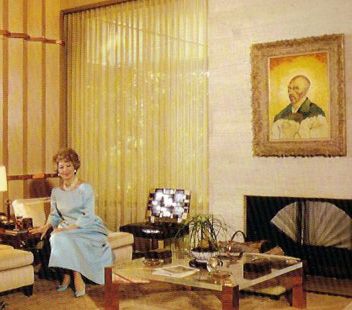
Edie Mayer Goetz at home...with Van Gogh
Edie was a woman of great social ambition. Her husband, Bill Goetz, was a producer, though not a trailblazer in the way L. B. Mayer or David Selznick were. Mayer brokered Goetz’s partnership at 20th Century Fox and it’s said that the snide inside-the-industry crack “the son-in-law also rises” was aimed as much at Goetz as it was Selznick. Goetz’s most significant film was Sayonara (1957), and it earned an Oscar nomination for Best Picture. He was a canny and forward-thinking businessman and enormously popular in Hollywood. Once the Selznick’s split up, he and Edie were at the heart of its social scene and remained so until his death in 1969. Edie quickly lost her social clout once Goetz died.

Irene’s ambition seems of an entirely different nature. Her inclination was to be in on the action, not a decorative accessory or hostess. Her diary from her teen years includes comments on films she saw at MGM previews. These journal entries reveal Irene to have been perceptive and frank in her observations – even at 17. Her take on Romola (1924): “…L. Gish good as always but didn’t make the most of her opportunities – leading male part should not have been the villain – not enough love interest.”

Irene with her sons Jeffrey and Daniel Selznick
In her book Irene writes that it amused her father to ask her opinion of a movie and then try to argue her out of her point of view. When she was dating Selznick, they went to a preview of a picture of his one night and afterward he asked what she thought of it. Irene replied with noncommittal remarks - and he challenged her, “…speak up; no one’s going to hold it against you. If you’re afraid, I promise you no one will ever know a word you’ve said.” Irene writes that she was afraid but over time she felt free enough to say anything she wanted to him. Selznick told her that he was undoing the damage her father had done.

David Selznick was the younger son of Lewis J. Selznick, L.B. Mayer’s one-time employer and long-time anathema. The Selznick boys were on Mayer’s “off-limits” list for his girls, but Irene and David, once committed, were not to be stopped. It seems to me that Irene may not yet have had a true sense of her own worth, but she was developing a mind and will of her own.

CFB: She clearly had a will of her own, and I like how you track it from those observations about film to her conversations with David. She really needed an iron will, considering the men in her life. She could stand up to her father and husband, so dealing with Edie probably was more frustrating than anything else.

Irene was great friends with Katharine Hepburn, and you know Hepburn was no pushover. Still, Irene spent years in analysis, and she was never afraid to admit it or discuss how it helped her. Perhaps that is what grounded her considering the characters around her.

Katharine Hepburn and Irene in Jamaica, asking directions...
Going back to Berg’s book, he was friends with Irene for nearly 20 years until she died, and it’s a nice companion piece to Irene’s autobiography. He describes her as such when they met in the 1970s:

“I don’t think she was more than five feet tall – with short dark hair in bangs and the shrewdest pair of eyes I have ever seen; and I know she was one of the most powerful presences I have ever beheld. … It would be less than precise to call Mrs. Selznick an extremely difficult person, but she was easily the most challenging I have ever met. One never let down one’s guard with Irene, unless looking to be knocked out or thrown out. Emotional, volatile and analytical, she took nothing at face value, probing layers beneath layers in even the simplest matters.”

Berg was very fond of Irene, and it’s interesting to have this insight when you read her autobiography. Her book was no frivolous undertaking to cash in on her fame, and I believe she took great care to analyze her life before setting it down on paper. 

Eve, I feel like we could talk about Irene for days, but perhaps we should wrap this up. Any final thoughts about this fascinating woman?

TLE: I’d like to talk a bit about Irene Mayer Selznick’s accomplishments after she departed Hollywood. Her family and friends are extremely interesting, of course, and her life was entwined with the history of movies in America, which is covered in her book, but there was more – she managed to reinvent herself and carve out a career of her own in New York.

Irene’s decision to leave Selznick and relocate on the East Coast was bold. She wasn’t sure what she might achieve, but turned to old friends for advice, friends like famed playwright/director Moss Hart who urged her to pursue her dream of becoming a theatrical producer. After a while, she rented an office, hired a general manager and got going. Her first production, an Arthur Laurents play starring Shirley Booth, didn’t get to Broadway but closed after an out of town tryout. Laurents later retooled the play, came up with a new title, but kept Shirley Booth  - who won a Tony for her role. David Lean later adapted it to film; this was Summertime (1955) starring Irene’s good friend Katharine Hepburn.

Final scenes: A Streetcar Named Desire on Broadway, 1947
It was on Irene’s 40th birthday that she received the script for what became her second production and it was this play that established her – and everyone associated with it. The play was A Streetcar Named Desire by Tennessee Williams; it debuted on Broadway in 1947 to a half-hour standing ovation. According to Irene, the play made director Elia Kazan “a king.” It also made Marlon Brando a star (he went straight to Hollywood after the play and never looked back), brought a Tony Award to Jessica Tandy, who played Blanche Dubois in New York, and a Pulitzer Prize to Williams. The film adaptation would win four Oscars.

Irene was certainly a powerhouse, she went toe-to-toe with the indomitable Kazan when they worked on Streetcar (perhaps second nature to her by now, after dealing with her father and husband). In fact, Tennessee Williams had a habit of referring to her as “Dame Selznick,” apparently acknowledging her pedigree and her demeanor.

Bell, Book and Candle on Broadway
Irene produced several more Broadway plays. Her production of Bell, Book and Candle in 1950 starred Rex Harrison and Lilli Palmer and was adapted to film in 1958 and became a hit starring James Stewart and Kim Novak. Irene’s production of The Chalk Garden in 1955 brought her a Tony nomination; the film adaptation starred Deborah Kerr.

In her memoirs Irene described her life as a play in three acts, the first as her father’s daughter, the second as wife to her husband, and the third act was her career in the theater. She wrote, “With perseverance I’ve gotten this far. Now, with a little more luck, I’d like to grow very old as slowly as possible.” She died in New York in 1990 at age 83.

I’ve really enjoyed this, CFB, and want to thank you for inviting me to discuss Irene Mayer Selznick's incredible story with you.

CFB: You're welcome. Detailing her amazing theater work – which many people may not know  of – is a wonderful way to wrap up a conversation about Irene. She wasn’t just the daughter of mogul Louis B. or the wife of wunderkind David O. She was a tough, sharp and respected Broadway producer, and her stage work alone represents a strong legacy. 

Irene Mayer Selznick
Following is an audio clip of a 1948 radio program that begins with Elia Kazan and Irene Mayer Selznick accepting the New York Drama Critics' "Best American Play" Award for Tennessee Williams. The program goes on to feature portions of the play itself, with narration by Kazan and scenes performed by the original Broadway cast - including Marlon Brando, Kim Hunter and Jessica Tandy:


Click here to visit Classicfilmboy's Movie Paradise. Click here to learn more about the evolution of A Streetcar Named Desire.

Wednesday, November 3, 2010


by guest contributor Whistlingypsy

The artistry of classic films reveals a cinematic alchemy in melding talent both before and behind the camera. The actor/actress and director are the two most visibly recognizable artists who created the image on screen. A careful viewer can also learn to recognize the names of the creative individuals who labored behind the scenes. Van Nest Polglase was one of these individuals who created the world in which our favorite characters move and have their lives.

Despite his elegant and intriguing name, his nearly decade-long tenure as RKO Studios’ art director and over 300 films to his credit, Polglase remains something of an enigma. In the absence of a definitive biography on the man’s life and career, much of what has been written is often contradictory and filled with errors (he was not married to actress Dolores Del Rio as one source claims).

Van Nest Polglase was born in Brooklyn, New York on August 25, 1898, and his unique name is a result of his family’s Cornish heritage. His education included the study of both architecture and interior design, but this is where the two paths of his life story diverge.

Some sources claim that Polglase finished school and was employed by Berg and Orchard, a New York architectural firm. He is also credited with work on the Presidential Palace under construction in Havana, Cuba. The likelihood that he was involved in the Cuban project is remote, the architects of record were Cuban born Carlos Maruri and Belgian born Paul Belau, and some sources claim that Polglase actually dropped out of school before receiving a degree in architecture.

However, in 1919, at the age of 21, Polglase was working for Famous Players-Lasky (today known as Paramount Studios) at their New York studio facilities. He made the move to the studio’s Hollywood location when financial constraints forced the closing of the locations in New York and Europe. He remained with Paramount Studios for a decade before moving to M-G-M where he worked under Cedric Gibbon’s leadership.

During his first decade alone, advances in architectural design and filmmaking technology forced Polglase frequently to reevaluate his style and expand his visual vocabulary of art direction. He came to filmmaking at a time when the first sets were built to resemble a theater stage to give audiences a reference point, and the category of “settings” covered everything from art direction to set design. The practice of grouping the different disciplines into one category, as well as crediting an individual for a department’s work, makes it difficult to track Polglase’s work during his early career. However, the AFI Catalog of Motion Pictures lists Stage Struck (1925, Paramount) and Untamed (1929, M-G-M) among his early titles.

Stage Struck proved a challenge for Polglase to create a design suitable for Gloria Swanson, who had distinguished herself as a design and style icon through her previous films in partnership with Cecil B. De Mille. Untamed was set in three distinctly different locations requiring equally distinct design sensibilities and featured Joan Crawford in her first sound picture, which came with the added challenge of incorporating the new technology into the set design.
RKO Studios was formed when the KAO (Keith-Albee-Orpheum) theater chain and FBO (Film Booking Offices Of America) were brought together under the control of RCA (Radio Corporation of America). David O. Selznick was hired in 1931 and in his new role as production chief, he recruited producer/director Merian C. Cooper, director George Cukor, actress Katharine Hepburn and art director Van Nest Polglase. One of Polglase’s first projects as art director was to redesign the studio logo to incorporate the blinking radio tower at the heart of RKO’s business ties with the RCA Corporation.

The image most frequently associated with RKO’s art direction is the series of films that paired Fred Astaire and Gingers Rogers. The films were charming fantasy confections, but the art direction was equally rooted in the concepts of architecture. The art direction is ideally suited to the dancers with both personifying the streamlined and elegant, witty, athletic and sexy ideals of art deco architecture.

The fantasy version of Venice in Top Hat (1934), which combines streamlined modernism and neo-classical references, displays an architectural style both immediately recognizable and equally unfamiliar to movie audiences. The result is tied neither to the past nor the present, but freely evokes the glamorous lifestyle of theatergoers’ dreams, transporting weary Depression era audiences out of their all too grim present and allowing them to hope for a better future. The popularity of the Astaire and Rogers films allowed the studio to pursue projects set in a wide variety of eras with equally varied plotlines.

A glimpse at Katharine Hepburn’s filmography during the period reveals the careful attention to detail in the Civil War era design of Little Women (1933); the modified art deco chic of Adolphe Menjou’s apartment in Morning Glory (1934); the use of a Victorian era Arts and Crafts design blend in the boarding house of Stage Door (1937) to communicate homey comfort; the all for fun eccentric design of Bringing Up Baby (1938) from the jail cell to the museum display.

In 1939, RKO undertook the ambitious remake of The Hunchback of Notre Dame, a film that had been an enormous success for Universal Pictures during the silent era. The challenge was to create a new version that would exceed the expectations of those who could remember the original and make new fans of younger moviegoers. The film proved a showcase for Polglase’s attention to detail, and his perfectionism gave the historical sets an element of accuracy not found in the creations of the larger studios.

The Paris of the RKO version features extravagant sets, immense staircases and oversized doors; the attention to detail is evident in the massive bells (Gabrielle, Big Marie and the rest) and a whole cow roasting on a spit (a prop that seems to have traveled to Citizen Kane for a picnic), the garden party lit by paper lanterns and the grand spaces within Notre Dame, from Clophin’s (Thomas Mitchell) court of miracles to Quasimodo’s (Charles Laughton) sanctuary in the clouds.
A fundamental point to keep in mind is the emergence during this period of an RKO-specific visual style, and while the stylistic elements of art direction are the product of a talented art director, other factors contribute to this development. The influence of German expressionism in film noir is widely acknowledged and can be observed in films made by German expatriates in Hollywood during the silent era. The creative individuals of RKO’s art direction were working between the influence of expressionism and the emergence of film noir, and the challenges of the studio system; reduced budgets and relatively modest sets provided the genesis of a new genre.

During Polglase’s tenure at RKO, the studio faced continued economic challenges and numerous changes at the executive level. One such change in management philosophy led the studio to distribute films for independent producers, with Walt Disney’s earliest feature length titles among these films. The artistic vision of any RKO film bore Van Nest Polglase’s name, but he was not solely responsible for realizing this vision. Polglase relied heavily on his department and especially on the talents of Carroll Clark, Perry Ferguson and Charles Kirk. The question regarding artistic vision is additionally problematic when such independent directors as Ford, Hitchcock and Welles are behind the camera. Did these directors have cooperative relationships with Polglase, working to bring their visions to the screen, or was an art director entirely secondary to their vision?

Part II will follow soon...


Thank you Lady Eve for your gracious invitation to contribute to your blog site, and thank you filmguy24 for your invaluable insights into the world of architecture as it relates to art direction.

Monday, October 18, 2010


John Gilbert
  Estate was Home to Hollywood Notables for 55 Years

In the mid-1920s, when he was a top star at MGM, leading man John Gilbert built a house at 1400 Tower Grove Road in the Benedict Canyon area of Beverly Hills. A two-story Spanish-colonial with tennis court and swimming pool, the estate was on a narrow road that curled up a hill behind the Beverly Hills Hotel.

Gilbert’s daughter, Leatrice, then a young girl, remembered her father greeting her from the top of a long, red-tiled stairway when she arrived for her first visit to his home in the early 1930s. She recalled soft light filtering through high, leaded windowpanes as she climbed the steps.

During one of her visits, he showed her a secret panel in an alcove adjacent to the living room and a button hidden under one of the bookshelves. The button opened a door to a stairway that led to the basement. He told her there had been a bar in the basement before Prohibition was repealed.
1400 Tower Grove Rd., early '30s (click picture for larger view)
She recalled that one evening at sunset, while they walked up the hillside in back, her father warned her to keep an eye out for rattlesnakes... and Leatrice remembered that from the top of the hill you could see "all Los Angeles out to the ocean" and Santa Catalina Island on the horizon.  Leatrice later wrote that it was clear to her even as a child that her father loved the place.

When it was built, the first floor of the main house featured an entry area and a large space for entertaining. Blessed with stunning panoramic views, the second floor held the living room, dining room, kitchen, master bedroom and bath. Most rooms were furnished in 17th-Century Spanish reproductions, a style popular in Hollywood at the time.

Harold Grieve, a silent-era art and set decorator (Ben-Hur, The Thief of Bagdad, The Sea Wolf) who was a founder of AMPAS and later became an interior designer, worked on the home several times over several years.
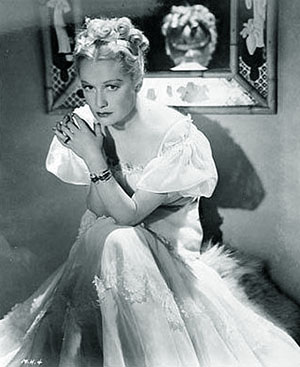
Miriam Hopkins
Gilbert's wives and girlfriends were many, and his master bath and bedroom were redecorated as women came and went, according to Grieve. For example, when Greta Garbo came into the picture, Grieve installed walls and a sunken tub of black marble in the master bath. John Gilbert died in January 1936 and, soon after, actress Miriam Hopkins purchased the home and hired Grieve to redecorate it once more. The house was redone in the emerging Art Moderne style. The newly contemporary walls of Miss Hopkins’ living room provided a showcase for works from her art collection, paintings by artists such as Picasso, Renoir and Matisse. 

David O. Selznick and Jennifer Jones

The Tower Grove Road property's legend was enhanced with the arrival of its next resident, producer David O. Selznick, in 1945.
Selznick rented the house when he separated from his wife Irene (L. B. Mayer’s daughter) after he'd become involved with actress Jennifer Jones. Selznick purchased the property from Hopkins just before marrying Jones in 1949.
With this sale, the home was substantially remodeled.
Selznick/Jones grounds
 Plate-glass windows were installed to dramatize the views and bring indoors the lush beauty of the foliage surrounding the house. Another notable change, the addition of a first floor bedroom/dressing room for Jennifer Jones, featured a striking waterfall just outside her window that could be turned on and off with a switch.

Selznick/Jones home
The Selznicks hosted dinner parties, screened movies and lived a grand life on Tower Grove Road for twenty years, until David O. Selznick’s death in 1965.  Selznick's obituary in the New York Times reported that he had "lived in an elegantly rustic home on an estate atop a hill overlooking Beverly Hills." Jennifer Jones and their daughter remained there until 1969. The house was then sold to Ted Ashley, Chairman of the Board of Warner Bros., the man credited with overseeing one of the studio's most successful eras, 1969 - 1980. It was during Ashley’s residence that Leatrice Gilbert Fountain was invited into the home her father built, a place she had not visited since childhood. 
Ted Ashley, Jack Warner & Jack Valenti in 1969
 
Eight years later, in 1977, hit-maker Elton John bought the house. John’s style was more flamboyant and his taste included Art Deco and Art Moderne (echoes of Miriam Hopkins!). His master bedroom featured a wall covered in mirrors and another covered in ultrasuede. Not too unexpected for a rock star of the '70s, especially one famous for appearing on stage in outrageously over-the-top costumes.


Elton John in the 1970s
 In 1981 the house was sold to its first non-entertainment industry resident. The businessman who purchased it had apparently planned only to remodel, but structural problems were uncovered and the building was demolished to make way for an enormous mansion.

When John Gilbert lived on Tower Grove Road, other major stars like Harold Lloyd and Jean Harlow lived not far away. Today Jay Leno, Halle Berry and other 21st Century A-listers reside in the area.


Selznick/Jones study