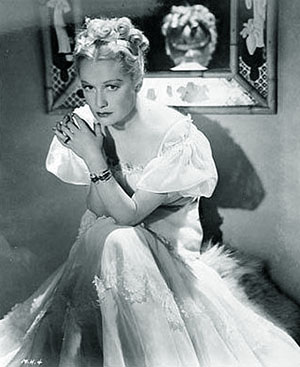
Showing posts with label Miriam Hopkins. Show all posts

Thursday, March 22, 2012

Gary Cooper, Miriam Hopkins and Fredric March

Fredric March was already an Oscar winner and a newly minted Hollywood star when he co-starred with Miriam Hopkins and Gary Cooper in Ernst Lubitsch’s 1933 adaptation of the Noel Coward play Design for Living. In 1929, when all the major studios were scouring the Broadway stage for photogenic leading men with trained and mellifluous voices, March had been recruited and signed by Paramount Pictures.  He received his first Best Actor Oscar nomination for his 1930 portrayal of ‘Tony Cavendish’ in The Royal Family of Broadway, but it was his split-personality tour-de-force as Dr. Jekyll and Mr. Hyde in 1931 that brought Fredric March his first Academy Award and movie stardom.


Dr. Jekyll and Mr. Hyde (1931)
Playwright/actor Noel Coward wrote Design for Living, a comedy in three acts, in 1932; it debuted on Broadway in 1933 at the Ethyl Barrymore Theatre starring legends of the stage Alfred Lunt, Lynn Fontanne and Coward himself. Because of its censoriously risqué plot, the play was not produced in London, Coward’s home ground, until 1939. His story of Gilda, Otto and Leo, a sophisticated trio involved in a romantic triangle (not to say threesome), was inspired by the personal lives and relationships of Lunt and Fontanne who were his close friends; Noel Coward would remark that Design for Living was about three people who love each other very much and that, though the play was a solid hit when it opened, no one loved it more than its three leading actors.
The play: Alfred Lunt, Noel Coward, Lynn Fontanne in Design for Living

When Ernst Lubitsch set out to film Coward’s play, he had a particular cast and screenwriter in mind. Miriam Hopkins, who had starred for him in The Smiling Lieutenant (1931) and Trouble in Paradise (1932), was his first choice for the female lead.  He was interested in Ronald Colman and Leslie Howard for the two male leads, but couldn’t afford Colman or persuade Howard. He next turned to Paramount leading man Fredric March for the role that was Coward’s Leo but became Lubitsch’s Tom, and approached Douglas Fairbanks, Jr., to portray the character that had been called Otto but would soon be George.  But Fairbanks came down with pneumonia and the director eventually settled on popular Paramount matinee idol Gary Cooper. Of the three leads, Hopkins had the least experience on-screen, but the most experience with Lubitsch.  She had also co-starred with March in Dr. Jekyll and Mr. Hyde and her film associations with both men helped advance her career.

Lubitsch (standing), Cooper, Hopkins and March on the set
Lubitsch, a writer himself, had hoped to collaborate once again with screenwriter Samson Raphaelson (The Smiling Lieutenant, Trouble in Paradise, The Merry Widow, The Shop Around the Corner) on Design for Living. But Raphaelson was not interested in working on “another damned sophisticated triangle” (referring to The Smiling Lieutenant and Trouble in Paradise) or in rewriting Noel Coward, and declined. Ben Hecht, an esteemed screenwriter and script doctor (Nothing Sacred, Wuthering Heights, Notorious) with a cynical view of the status quo, was Lubitsch’s next choice.  But it was not an easy partnership. Lubitsch, who commented that the two “weren’t used to each other,” was most at home working closely with his writers and Hecht was comfortable writing on his own. But they managed.

In the end, the plot was re-engineered and the triangular situation at the heart of Coward’s play was retained.

As Leo became Tom and Otto became George, all three characters became struggling American creative types rather than the play’s free-spirited British socialites. And the situation between the three was toned down; at the beginning of the play Gilda is living with Otto and has just resumed an affair with ex-beau Leo. Lubitsch’s film would follow the amorous adventures of three young, attractive Americans in Paris, London and New York: playwright Tom Chambers (March), painter George Curtis (Cooper) and commercial artist Gilda Farrell (Hopkins). Tom and George are buddy/roommates who meet and fall in love with Gilda.  
Miriam Hopkins, pre-Code siren
Miriam Hopkins is in her element as passionate, independent Gilda (pronounced ‘Jilda’).  She commands the screen – and her co-stars – with easy charm and confidence. Hopkins was at the height of her delectable pre-Code heyday in 1933; the steamy and controversial The Story of Temple Drake was released just months before Design for Living.

In his early films, Gary Cooper is always handsome and appealing, but he does not always convince as an actor. Cast against type in Design for Living he seems awkward spouting Hecht’s snappy dialogue at times and it isn’t hard to understand why Lubitsch had first turned to Douglas Fairbanks, Jr. But the director was satisfied with Cooper’s performance and believed movie-goers would “…be happy to see that he is an accomplished light comedian.”

Fredric March, experienced in talky roles like this one, is a better fit. In a departure from the more somber roles he was better known for, he shines as dapper, jovial Tom, a character partially informed by Ben Hecht’s own background as a playwright.

Had it been released just six months later, in 1934 when the Production Code was in force, Design for Living would not have gotten past the censors. Not only do Tom and George love Gilda – but Gilda loves Tom and George.  She cannot and will not choose between them, and so the three decide to live together platonically – for a while…

Gilda is able to take what was then considered the entirely male prerogative without having to pay the on-screen price – usually death – that would soon be ordained by the Code:

Gilda: “A thing happened to me that usually happens to men…a man can meet two, three or even four women and fall in love with all of them and then, by a process of interesting elimination, he is able to decide which one he prefers. But a woman must decide purely on instinct, guesswork, if she wants to be considered nice. Oh, it’s alright for her to try on a hundred hats before she picks one out, but…”

Tom: “That’s very fine, but which chapeau do you want, madam?”

Gilda: “Both”


Click here to go to Sittin' on a Backyard Fence where Jill is hosting March-in-March, a blogathon honoring the work of two-time Oscar winner (and five time nominee) Fredric March. This piece is my entry for the blogathon and also appears on Jill's blog.

Monday, October 18, 2010


John Gilbert
  Estate was Home to Hollywood Notables for 55 Years

In the mid-1920s, when he was a top star at MGM, leading man John Gilbert built a house at 1400 Tower Grove Road in the Benedict Canyon area of Beverly Hills. A two-story Spanish-colonial with tennis court and swimming pool, the estate was on a narrow road that curled up a hill behind the Beverly Hills Hotel.

Gilbert’s daughter, Leatrice, then a young girl, remembered her father greeting her from the top of a long, red-tiled stairway when she arrived for her first visit to his home in the early 1930s. She recalled soft light filtering through high, leaded windowpanes as she climbed the steps.

During one of her visits, he showed her a secret panel in an alcove adjacent to the living room and a button hidden under one of the bookshelves. The button opened a door to a stairway that led to the basement. He told her there had been a bar in the basement before Prohibition was repealed.
1400 Tower Grove Rd., early '30s (click picture for larger view)
She recalled that one evening at sunset, while they walked up the hillside in back, her father warned her to keep an eye out for rattlesnakes... and Leatrice remembered that from the top of the hill you could see "all Los Angeles out to the ocean" and Santa Catalina Island on the horizon.  Leatrice later wrote that it was clear to her even as a child that her father loved the place.

When it was built, the first floor of the main house featured an entry area and a large space for entertaining. Blessed with stunning panoramic views, the second floor held the living room, dining room, kitchen, master bedroom and bath. Most rooms were furnished in 17th-Century Spanish reproductions, a style popular in Hollywood at the time.

Harold Grieve, a silent-era art and set decorator (Ben-Hur, The Thief of Bagdad, The Sea Wolf) who was a founder of AMPAS and later became an interior designer, worked on the home several times over several years.
Miriam Hopkins
Gilbert's wives and girlfriends were many, and his master bath and bedroom were redecorated as women came and went, according to Grieve. For example, when Greta Garbo came into the picture, Grieve installed walls and a sunken tub of black marble in the master bath. John Gilbert died in January 1936 and, soon after, actress Miriam Hopkins purchased the home and hired Grieve to redecorate it once more. The house was redone in the emerging Art Moderne style. The newly contemporary walls of Miss Hopkins’ living room provided a showcase for works from her art collection, paintings by artists such as Picasso, Renoir and Matisse. 

David O. Selznick and Jennifer Jones

The Tower Grove Road property's legend was enhanced with the arrival of its next resident, producer David O. Selznick, in 1945.
Selznick rented the house when he separated from his wife Irene (L. B. Mayer’s daughter) after he'd become involved with actress Jennifer Jones. Selznick purchased the property from Hopkins just before marrying Jones in 1949.
With this sale, the home was substantially remodeled.
Selznick/Jones grounds
 Plate-glass windows were installed to dramatize the views and bring indoors the lush beauty of the foliage surrounding the house. Another notable change, the addition of a first floor bedroom/dressing room for Jennifer Jones, featured a striking waterfall just outside her window that could be turned on and off with a switch.

Selznick/Jones home
The Selznicks hosted dinner parties, screened movies and lived a grand life on Tower Grove Road for twenty years, until David O. Selznick’s death in 1965.  Selznick's obituary in the New York Times reported that he had "lived in an elegantly rustic home on an estate atop a hill overlooking Beverly Hills." Jennifer Jones and their daughter remained there until 1969. The house was then sold to Ted Ashley, Chairman of the Board of Warner Bros., the man credited with overseeing one of the studio's most successful eras, 1969 - 1980. It was during Ashley’s residence that Leatrice Gilbert Fountain was invited into the home her father built, a place she had not visited since childhood. 
Ted Ashley, Jack Warner & Jack Valenti in 1969
 
Eight years later, in 1977, hit-maker Elton John bought the house. John’s style was more flamboyant and his taste included Art Deco and Art Moderne (echoes of Miriam Hopkins!). His master bedroom featured a wall covered in mirrors and another covered in ultrasuede. Not too unexpected for a rock star of the '70s, especially one famous for appearing on stage in outrageously over-the-top costumes.


Elton John in the 1970s
 In 1981 the house was sold to its first non-entertainment industry resident. The businessman who purchased it had apparently planned only to remodel, but structural problems were uncovered and the building was demolished to make way for an enormous mansion.

When John Gilbert lived on Tower Grove Road, other major stars like Harold Lloyd and Jean Harlow lived not far away. Today Jay Leno, Halle Berry and other 21st Century A-listers reside in the area.


Selznick/Jones study