|
| Francois Truffaut |
Friday nights in July are going to be hot, and I’m not talking about the weather where I live. Beginning tonight and on the 12th, 19th and 26th, Turner Classic Movies will feature hour after hour of the films of one of the pioneers and masters of the French New Wave, Francois Truffaut (1932 – 1984). Film Critic David Edelstein of New York Magazine and NPR’s Fresh Air, hosts the series.
Coincidentally, I’ve been catching up with and revisiting Truffaut on my own lately. It started when I was putting together a birthday tribute to the French actress Francois Dorleac in March. Dorleac worked with several legendary European filmmakers in her brief but notable career – Philippe de Broca, Jacques Demy, Roman Polanski, Ken Russell - and Truffaut. I'd seen Polanski's Cul-de-sac (1966), Demy's The Young Girls of Rochefort (1967), and set out to find de Broca's That Man from Rio (1964), Russell's Billion Dollar Brain (1967) and Truffaut's The Soft Skin (1964). I’m still looking for That Man from Rio, but did manage to get my hands on Billion Dollar Brain and The Soft Skin.
 |
| Jean Desailly and Francoise Dorleac, The Soft Skin (1964) |
The Soft Skin has never been one of Truffaut’s better known films. When it screened at Cannes in 1964, the crowd booed and, in its time, the film was generally dismissed as conventional and disappointing. Following as it did on the heels of his innovative and much-admired earlier works - The 400 Blows (1959), Shoot the Piano Player (1960) and Jules and Jim (1962) - The Soft Skin was derided by some as Truffaut’s bid for mainstream acceptance. Stuffy New York Times film critic Bosley Crowther, who famously fell badly out of step with the times in the ‘60s, called it “a curiously crude and hackneyed drama.” However, as so often happens, with the passage of years came reassessment and The Soft Skin, though still relatively obscure among Truffaut’s films, has gained a reputation among film buffs as one of his stronger efforts. A deceptively straightforward but suspenseful modern domestic drama, it deals with the sudden and ardent extramarital affair of a celebrated literary scholar, and features affecting performances by its two stars - Jean Desailly as the besotted intellectual and Francois Dorleac as the beautiful young thing of a flight attendant who turns his well-ordered life upside down. Georges Delerue, the award-winning composer who scored 11 Truffaut films, composed a striking score evocative of the frantic pace and emotional disconnect that marked the Space Age.
 |
| Alfred Hitchcock and Francois Truffaut |
The Soft Skin was the first of four films in what is known as Truffaut’s “Hitchcock cycle,” a group of films he was working on at the time he conducted and published his now-famous interviews with the Master of Suspense, each of which reflects Hitchcock's influence. The Soft Skin was followed in the cycle by Fahrenheit 451 (1966), The Bride Wore Black (1968) and Mississippi Mermaid (1969). All but Fahrenheit 451 will be screened on TCM this month.
In June, when it aired as part of another TCM Friday Night Spotlight series, I recorded Shoot the Piano Player, Truffaut’s inventive and completely charming New Wave classic. Unpredictable, by turns comic and tragic, its special charms are accentuated by a charismatic and perfectly cast star, Charles Aznavour, and Delerue’s infectious, jazzy score. I found it irresistible and watched it twice in a sitting. This put me in the mood for yet more Truffaut, and I very soon revisited one of his early ‘70s classics, Oscar winner for Best Foreign Language Film, Day for Night (1973), a delightful celluloid homage to filmmaking, the great love of Truffaut's life.
In June, when it aired as part of another TCM Friday Night Spotlight series, I recorded Shoot the Piano Player, Truffaut’s inventive and completely charming New Wave classic. Unpredictable, by turns comic and tragic, its special charms are accentuated by a charismatic and perfectly cast star, Charles Aznavour, and Delerue’s infectious, jazzy score. I found it irresistible and watched it twice in a sitting. This put me in the mood for yet more Truffaut, and I very soon revisited one of his early ‘70s classics, Oscar winner for Best Foreign Language Film, Day for Night (1973), a delightful celluloid homage to filmmaking, the great love of Truffaut's life.
 |
| Jacqueline Bisset and Jean-Pierre Léaud, Day for Night (1973) |
TCM's Friday night series includes 21 Truffaut films, from The 400 Blows, his first feature, to his very last, Confidentially Yours (1983). See full program schedule below.
Click here to read Martin Scorsese’s moving tribute to Francois Truffaut for TCM in his current “Scorsese Screens” column.
Click here to read Martin Scorsese’s moving tribute to Francois Truffaut for TCM in his current “Scorsese Screens” column.
Friday Night Spotlight: Francois Truffaut
(begins 8pm Eastern/5 pm Pacific)
(begins 8pm Eastern/5 pm Pacific)
July 5
The 400 Blows(1959) stars young Jean-Pierre Léaud as Truffaut’s alter-ego Antoine Doinel in his troubled adolescence
Antoine and Colette(1962), a film short with Léaud as Antoine Doinel; Marie-France Pisier co-stars as the woman with whom he becomes obsessed
Stolen Kisses(1968), Truffaut’s second feature-length film, with Léaud again as Doinel who, by this time, is leaving military service and adapting to civilian life; with Delphine Seyrig and Claude Jade
Bed & Board(1970), the third installment in “the Doinel cycle,” stars Léaud, with Claude Jade as his wife
Love on the Run(1979), the last in the Doinel series, with Léaud as Doinel, Jade as his ex-wife, and flashbacks to footage from the earlier films
The Green Room aka/Vanishing Fiancee (1978), the story of a man unable to stop grieving the death of his wife, starring Francois Truffaut, Nathalie Baye and Jean Daste
July 12
The Bride Wore Black(1968) with Jeanne Moreau in a Hitchcockian tale of a new bride’s single-minded vengeance, with Jean-Claude Brialy; based on a novel by Cornell Woolrich
Confidentially Yours(1983) - Jean-Louis Trintignant and Fanny Ardant star in the story of a wrong man accused
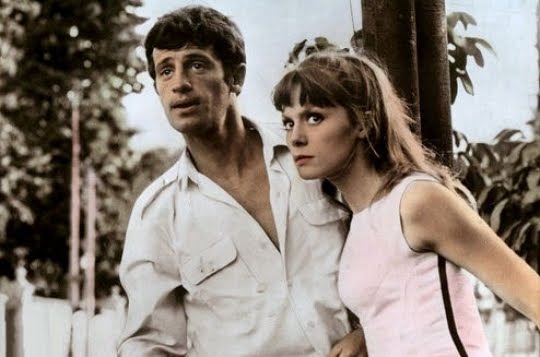
Mississippi Mermaid(1969), starring Catherine Deneauve as Jean-Paul Belmondo’s mail order bride; adapted from a Cornell Woolrich novel
Such a Gorgeous Kid Like Me (1972), a black comedy with Bernadette Lafont as a beautiful woman in prison who recounts her life story to a sociologist
Shoot the Piano Player(1960) stars Charles Aznavour as a one-time concert pianist who seeks anonymity but can’t escape his past
July 19
The Soft Skin(1964), This story of a literary highbrow who falls madly for a beautiful young woman was allegedly inspired by true stories of adultery and mayhem; starring Jean Desailly, Francoise Dorleac and Nelly Benedetti
Jules and Jim(1962) with Jeanne Moreau, Oskar Werner and Henri Serre in the tale of an ill-fated love triangle
Two English Girls(1971) stars Jean-Pierre Léaud as a young French writer who has romantic involvements with two sisters
A Story of Water(1961), co-directed with Jean-Luc Goddard, is a short film about a young woman determined to leave her village and go to Paris; with Jean-Claude Brialy and Caroline Dim
The Woman Next Door(1981) is Fanny Ardant, who unwittingly becomes the new neighbor of happily married Gerard Depardieu, her former lover
The Man Who Loved Women (1977) stars Charles Denner as Bertrand, a compulsive womanizer whose skirt-chasing has fateful consequences, with Brigitte Fossey and Leslie Caron.
July 26
Day for Night(1973) with Jacqueline Bisset, Jean-Pierre Léaud, Jean-Pierre Aumont, Francois Truffaut and Nathalie Baye – Truffaut’s timeless paean to moviemaking
The Last Metro(1980), set in Paris during the Nazi occupation, stars Catherine Deneuve as an actress whose director-husband is Jewish and must go into hiding
The Wild Child(1970), about a boy literally raised by wolves, starring Francois Truffaut and Jean-Pierre Cargol
The Story of Adele H(1975) with Isabelle Adjani as Adele, the high-strung daughter of renowned 19thcentury poet/novelist/dramatist Victor Hugo, who becomes romantically obsessed with a military officer
 |
| Jeanne Moreau, The Bride Wore Black (1968), poster art |