|
| Clive Brook and Marlene Dietrich |
Between 1930 and 1935, Josef von Sternberg filmed six wondrous and surreal flights of imagination for Paramount starring Marlene Dietrich with costumes by Travis Banton. The director and Dietrich had already made their first film together, The Blue Angel (1930), for UFA in Germany and, on the heels of that film's sensational premiere in Berlin, departed for Hollywood. Von Sternberg, who was born in Austria but mostly raised in America, had worked previously with Banton in the U.S. on Underworld (1927), a groundbreaking silent crime drama.
 |
| Evelyn Brent as Feathers McCoy in Underworld |
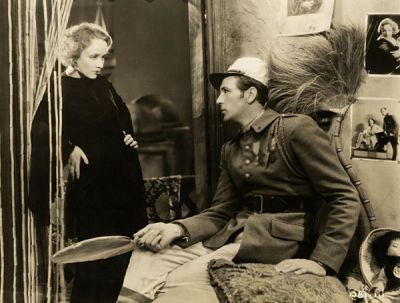 |
| Marlene Dietrich and Gary Cooper, Morocco |
Shanghai Express (1932), the third of the collaborations with Dietrich and Banton, was, according to its director, "loosely based on a single page by Harry Hervey." Hervey actually provided more pages than that and from those pages Jules Furthman crafted a clever script. Von Sternberg constructed a China made of "papier-mache" and, borrowing a locomotive and railway cars from the Santa Fe Railroad, set the scene for the tale of a train hijacked en route from Peking to Shanghai by Chinese revolutionaries.
 |
| imagining China, Shanghai Express |
Crowded on board with a clutter of cargo is a disparate group of passengers, several of whom harbor secrets. Among these travelers is dry-as-dust British military officer Donald ‘Doc’ Harvey (Clive Brook). Early in the journey he encounters the great lost love of his life, Magdalen, now known as “Shanghai Lily” and an infamous ‘coaster’ living by her wiles – played to the hilt by Marlene Dietrich at her most ravishing. As the trip unfolds and the train makes its way down the exotic and dangerous coast of China, Doc and Lily wrestle with reignited desire for each other. The hijacking triggers a crisis in their reunion.
Dietrich first appears onscreen more blonde than ever before, veiled and swathed in crepe and feathers, wearing crystal beads and kid gloves, carrying an Art Deco handbag. She is the quintessential femme fatale. Sleek and mysterious, Lily’s cynicism and insolence are tempered by her profound femininity. Dietrich skirts the edges of parody as the soft-spoken, worldly-wise heartbreaker. Brook is mostly sulky and long-suffering in his role; what attracts such a sensual woman to the repressed doctor is neither easy nor difficult to fathom.
 |
| veil, feathers, crystal, kidskin |
This ensemble was concocted, according to Dietrich’s daughter Maria Riva, by her mother and Travis Banton. She writes of Dietrich going to the studio and running into Banton’s private office shouting, “Feathers! Travis - feathers! What do you think…Black feathers! Now, what bird has black feathers that will photograph?” The black-green tail feathers of Mexican fighting cocks were eventually chosen. Selecting the proper veil fabric took as long. Riva reports that when Dietrich finally held up a swatch of “black 41” with its horizontal lines, “Travis let out a wild whoop.” Finally, von Sternberg came to take a look at the completed outfit. There had been concern about his reaction – the elaborate costume would be very difficult to photograph. In German he said to Dietrich, “If you believe I am skilled enough to know how to photograph this, then all I can offer you is – to do the impossible.” In English he said to Banton, “A superb execution of an impossible design, I congratulate you all.” After the director left, Banton broke out a bottle of champagne.
 |
| fur, feathers and lace |
David Chierichetti has written that Travis Banton worked to give Dietrich, with her perfect posture and slender figure, a softened quality. "Her clothes would usually be fussier than any others he designed, with drapings of fabric and much use of fur and velvet that would be unflattering to a heavier figure." Banton understood that few but Dietrich could successfully wear a busy mix of textures and patterns.
 |
| feathers and lace |
~
Cinematic virtuoso and visionary Josef von Sternberg didn't hesitate to claim that he not only directed his films but was also responsible for every facet of every one of them, from lighting and photography to set design, costuming and, sometimes, music. Though the director freely admitted that Lee Garmes excelled behind the camera, he also maintained that Garmes did exactly as he was told, "to the extent that I would always be beside the camera. No picture of mine has been independently photographed." Dietrich, for her part, supported these assertions. As for costumes, von Sternberg's involvement in designing Dietrich's wardrobe was, as David Chierichetti has noted, "as hard a question to answer as how much he photographed the films." What is evident in the films von Sternberg made for Paramount with Dietrich and Banton is that costume was as much an element of narrative and theme as every other meticulously designed visual and aural detail.  |
| Shanghai Lily's introduction - her attire and bearing suggest different possibilities: seasoned seductress, dark angel and more. |
 |
| Lily is regally bundled in fur when she toys with her former lover. Teasing, she puts his military cap on her own head - at a jaunty angle. This is a woman who knows how to take command. |
 |
| By the time Dietrich utters the line, "Shanghai Lily has reformed," Magdalen has begun to resurface. |
 |
| In the final scene, Dietrich is again bedecked in Shanghai Lily's black-feathered vamp ensemble - but Magdalen can be seen and heard in her expression, her voice and her words. Doc, who she now calls by his given name, Donald, surrenders to her completely. She tosses away his riding crop and glove as they embrace. |
Josef von Sternberg, in a 1966 interview with Oscar-winning film preservationist Kevin Brownlow, acknowledged that he had no interest in ‘authenticity’, “…on the contrary, the illusion of reality is what I look for, not reality itself.” Of the six von Sternberg/Dietrich/Banton films, film critic/historian David Thomson has written, “They are sublime, radiant and utterly undated, where earnestness, noble intentions, showing real life with pained sincerity (all plausible in the difficult times of the 1930s), have perished by the wayside.”
Shanghai Express was the most financially successful of the six Paramount productions, though its critical reception was mixed. Von Sternberg was flattered when novelist/philosopher Ayn Rand told him that the film had impressed her as other films rarely had. Naturally he asked what it was that captivated her so. He remembered, with some irony, that she told him it was “the way the wind blows through the fur-piece around Marlene’s shoulder when she sits on the back platform of the train.”

Shanghai Express was Oscar-nominated for Best Picture, Josef von Sternberg was nominated for Best Director and Lee Garmes won the Academy Award for Best Cinematography.
~
Travis Banton was Paramount's Chief Designer from 1929 until 1938. Before coming to Hollywood to design Leatrice Joy’s costumes for The Dressmaker of Paris (1924), he worked at various design houses including his own in New York. His reputation got a major boost in 1920 when he designed Mary Pickford’s wedding dress for her marriage to Douglas Fairbanks.
 |
| Mary Pickford in wedding gown, 1920 |
 |
| Rita Hayworth, Cover Girl (1944) |
Banton’s eventual decline has been attributed to overwork and overindulgence. Evelyn Brent, the first actress to star in a von Sternberg/Banton film, recalled Banton's work ethic: “He was the kind of designer who read the script and would find out who was going to play the part, and worked out the clothes that way.” The feather and velvet hat he designed for her in Underworld started a fashion trend. “He was a genius and, boy, did he drink! That’s what ruined him…” said Louise Brooks, a woman who knew firsthand about drinking and ruination.
Maria Riva knew Banton when he designed for the Dietrich/von Sternberg films. Of him she said that he “had the Ronald Colman look long before Ronald Colman had a look” – cashmere blazer, white flannels, paisley ascot and silk shirt with French cuffs. Dietrich’s long-time photographer John Engstead recalled that the actress didn’t listen to many but would always take advice from von Sternberg and Banton. David Chierichetti has written that it was his work for Dietrich that made Banton’s designs immortal. And costume designer Walter Plunkett (Gone with the Wind, An American in Paris) remembered, “The rest of us always watched Banton because he was always ahead of the fashion trend.” In fact, Banton's use of the strapless bodice pre-dated by four years Christian Dior's celebrated use of it as part of his "New Look" of the late 1940s.
 |
| Travis Banton and Marlene Dietrich |
~
Marlene Dietrich forever attributed her initial success in film to Josef von Sternberg, insisting "I was nothing but pliable material on the infinitely rich palette of his ideas and imaginative faculties." She learned everything about filmmaking, most especially lighting and photography, from him. The director would be unusually modest when it came to taking credit for 'inventing' Marlene Dietrich. "I did not endow her with a personality that was not her own...I gave her nothing she did not already have. What I did was to dramatize her attributes and make them visible for all to see."
The Paramount films Dietrich made with von Sternberg and Travis Banton were Morocco, Dishonored (1931), Shanghai Express, Blonde Venus (1932), The Scarlet Empress (1934) and The Devil is a Woman (1935). She and von Sternberg parted ways afterward. When her career foundered he advised her to make Destry Rides Again with James Stewart for Universal in 1939; it was a hit and revived her reputation. She went on to reinvent herself again and again.
Dietrich would work with Travis Banton on two more Paramount films, Frank Borzage's Desire (1936) and Ernst Lubitsch's Angel (1937). With or without von Sternberg's input, Banton's gowns for the great star were breathtaking.
Marlene Dietrich in scenes from all six films directed by Josef von Sternberg with costume design by Travis Banton
Notes:
Fun in a Chinese Laundry by Josef von Sternberg, MacMillan Co. (1965)
Marlene Dietrich by Maria Riva, Alfred A. Knopf (1993)
Hollywood Costume Design by David Chierichetti, Harmony Books (1976)
The Parade's Gone By by Kevin Brownlow, Bonanza Books (1968)
People Will Talk by John Kobal, Alfred A. Knopf (1985)
The Big Screen: The History of Hollywood by David Thomson, Farrar Strauss and Giroux (2012)