Friday, January 13, 2012

By guest contributor Michael Nazarewycz


It’s easy to take for granted a film’s location.

Some settings, of course, are mandatory to support the historical accuracy of a film; consider the importance of location in a war picture or biopic.  Other settings might not be important for historical accuracy per se, but are critical to the believability of a film.  For example, Oliver Stone’s Wall Street (1987), title aside, never would have worked anywhere else but in New York City, given the high-finance, decade-of-decadence aspects of the story.  Beyond instances like these, though, it’s easy for filmmakers to pigeonhole movie locations into high-level descriptions like big city, sprawling country, hot resort, or cozy hamlet.

But where do you set your film when you need more than geography?  Where do you set your film when the location is less about sense of place and more about state of mind?

If the film is Vertigo, Alfred Hitchcock’s 1958 masterpiece about a man who might be crazy and a woman who might be possessed, then the setting can only be San Francisco.
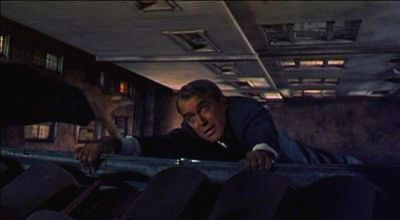
Early in the film, the fact that the setting is San Francisco is of little, if any, consequence.  The story opens with John “Scottie” Ferguson (James Stewart), a San Francisco police detective, chasing a criminal on foot across the rooftops of the city; a uniformed officer assists him in the chase.  Rooftop foot chases are nothing new in movies, so this action could have occurred in any major city.

The scene ends after Scottie slips on a slanted roof and finds himself dangling from a gutter.  The uniformed officer ends his pursuit of the criminal to help Scottie, but slips on the roof tiles and plummets past Scottie to his death.  The ordeal triggers within Scottie a case of acrophobia – the fear of heights – and he is forced into early retirement.

It’s at this point that it would be easy to look at the setting of San Francisco and say, “Of course!  San Francisco has hills, and buildings on hills.  A man suffering from acrophobia surely would be tortured by living in that city.”

Maybe, but that’s no more true than if he were living in New York with its towering skyscrapers, or in Denver with its mile-highness.  Let me make this clear now – Scottie’s acrophobia is nothing more than a plot-point.  The film is called Vertigo, not Acrophobia.

Not long after the tragic event, Scottie is contacted by an old college friend, Gavin Elster (Tom Helmore).  Gavin hires Scottie to follow his wife, Madeleine Elster (Kim Novak), spinning a tale of a woman whose recent behavior has been peculiar to the point that Gavin thinks his wife might be possessed by a ghost.  Gavin wants Scottie to get to the bottom of what his wife does with her days – things that conflict with what she tells him she has done and where she has gone, things that rack up too many miles on the odometer.

And so it begins: not just Scottie’s pursuit of the truth, and not just his descent into madness, but the revelation of the core reason why San Francisco is vital to this film; so vital, in fact, that to have shot it anywhere else would have made it one of Hitchcock’s lesser works.  The city, its places and its layout, are all physical representations of the inner-workings of Scottie’s mind.

Hitchcock’s shrewdness with setting is established immediately after the rooftop chase.  Scottie is in the apartment of old friend and former love Midge (Barbara Bel Geddes), who has three large windows that overlook San Francisco, and through these windows, we get a clear sense not just of how high Scottie and Midge are but, because of the city’s legendary hills, we get a sense of how far down other things are … how far down Scottie can fall.

I mentioned before that this film is not called Acrophobia, it’s called Vertigo.  Acrophobia is a fear of heights.  Vertigo is a dizzy, confused state of mind.  The difference is an important one.

After meeting with Gavin, Scottie begins his surveillance of Madeleine by waiting for her to leave her apartment so he can tail her car.  This is, of course, what any good detective would do, but by following her, he is, in effect, being led by her.  He doesn’t know it, but as his curiosity becomes obsession, every move he makes is not proactive by him, but reactive to her.  And where does she lead him on this first encounter?  Down a labyrinthine path, with several turns and slow weaves through traffic, coming to a stop in an alley.

Of course, streets and turns and traffic and alleys aren’t unique to San Francisco, but its hills are.  San Francisco, with heights ranging from sea level to 900+ feet (that’s 90+ stories) above sea level, has a unique combination of population density and radical height differences – a combination you won’t find in another city.

With that, the most important word in the description of Scottie’s first surveillance of Madeleine is “down.”  Scottie’s first physical trip down the steep, hilled streets of San Francisco in pursuit of the truth about Madeleine is his first psychological step down the steep, perilous path of obsession with (and madness over) this beautiful and mysterious woman.

After purchasing flowers, Madeleine continues to lead Scottie, and her next stop is the cemetery at Mission Delores.  This location is critical, too.  It isn’t just a cemetery, nor is it just a cemetery adjacent to a church.  It’s a cemetery that requires you to navigate through a church to get to it.  And the grave she visits requires a walk along a winding path through the cemetery.  And all of it – the grave at the cemetery next to the church – is a downhill drive away from the flower shop.

The further down the hills of San Francisco Scottie follows, the further down the path of obsession and madness Madeleine leads.

And continues to lead, this time to the Palace of the Legion of Honor – the art museum where she stares at the painting of the woman we later learn is Madeleine's great grandmother.  This time, the drive is relatively flat, but the walk from the car to the museum is a long one.

When it comes to visiting these places, the drives and walks aren’t short and quick.  They are twisting and turning and long and eventual, just as Scottie’s descent into madness isn’t a short and quick plummet; it, too, is twisting and turning and long and eventual.  Whether on paths though alleys (the darker side of Scottie’s soul?) or churches (Scottie’s own shot at redemption?), every physical step brings him closer to Madeleine – a closeness that only feeds his obsession. 

Madeleine’s last stop is the McKittrick Hotel.  Again, the ride is flat, but something different happens.  Scottie watches Madeleine enter the hotel and pass by a second-story window.  But to enter the hotel, he must climb a steep flight of stairs (which he does), and to get to the second floor, he must climb another steep flight of stairs (which he does again).  Yes, these climbs lend to the ongoing effort and Scottie’s willingness to surrender to Madeleine, but when he gets to the second story room, she’s not there.  And that’s because she’s not up … she’s down.  Climbing won’t get Scottie closer to Madeleine – only descending (into madness) will.

The next day, Madeleine leads Scottie from her apartment straight to the museum (which is still a downward drive, representing Scottie’s ever-growing psychological descent), and from the museum, she leads him to Fort Point, which sits at the base of the Golden Gate Bridge at San Francisco Bay.  Down, down, down Scottie continues to go, both physically and mentally.

Fort Point is at sea-level, and there is no going lower than that in San Francisco … unless you go into the Bay itself, which Madeleine does, with a jump that appears to be a suicide attempt.  Of course, Scottie follows to rescue her.  Short of donning scuba gear, Scottie has reached the end his descent – he can go no lower physically, nor can he go any lower mentally.  He appears to be Madeleine’s, lock, stock, and sea-level barrel, but Hitchcock makes sure to prove that to us the next day.

After saving Madeleine, Scottie brings her to his townhouse (the exterior of which is always shot by Hitchcock at a downward angle), but she soon slips out while he is on the phone.  The next day, Scottie resumes his surveillance, and Madeleine leads him on the longest journey yet through the heart of the city, with more turns and steeper hills, only to end up back at his place.  This is Hitchcock at his best in this film; this is Hitchcock telling us that Scottie, in order to find himself, must travel long and winding and down.  And then Hitch gets even better.

When Scottie meets Madeleine at his place, neither have specific plans, so they decide to “wander” together, but before they go, when she is in her car and he is on the outside talking to her, she mentions to Scottie that he left his home door open.  This seems so random and meaningless on the surface, but that door represents the last chance Scottie has of reclaiming himself.  If he runs to the door and runs inside the house and closes the door behind him, never to see Madeleine again, he can begin his psychological ascent back to normal.

Instead, he rushes to close the door; and as the viewer you know, right there, that he has pushed all of his chips into the center of the high-stakes Madeleine table, closing the door to his past self and going all-in with her, no matter how far down all-in might be.

Their next destination is another long and winding drive, this time to see the Big Basin Redwoods.  And while these mighty, centuries-old trees might suggest something to do with height, I’m more intrigued by the fact that she drove the car; Scottie is no longer in control of his own destiny at this point.  By giving into his obsession to her, he is merely along for the ride … her ride.  It’s also on this trip when they kiss for the first time.  Deal sealed.

The rest of the film is cinematic history.  If you have seen it, you know.  If you haven’t, I hope I haven’t spoiled anything for you.

In three short days, Scottie not only fell in love with Madeleine, he became obsessed with her to the point of sacrificing his own sanity to be with her.  And therein lies the key to the importance of San Francisco to Vertigo.  Where other cities in other films might represent cookie-cutter locations or easily-recognizable landmarks in otherwise two-dimensional stories, San Francisco offers something no other city could for this story or this film: a sprawling and beautifully architectured representation of one man’s soul.


~

Michael Nazarewycz is a film buff and writer who spent his childhood watching old black-and-whites and cheesy horrors on UHF.  He's been hooked ever since, and readily admits that he'll watch anything anyone would consider a motion picture, from a nickelodeon silent to a digital epic.  Michael is an Editorial Contributor for US-based ManILoveFilms, a Writer for UK-based Filmoria, and he has just launched a new blog, ScribeHard on Film, where he will share more personal thoughts on movies, as well as perform in-depth analysis of the classics.  Michael invites you to follow him on Twitter @ScribeHard, where he Tweets mostly about ... what else? ... movies.

Tuesday, January 10, 2012

by guest contributor Brandie Ashe


Scratch the surface of the prototypical “Hitchcock blonde”—a cool, reserved exterior masking a fiery and determinedly passionate woman—and the subtle differences in their characterizations become more evident.  In her three films for the director, Grace Kelly’s characters are paragons of dignity, displaying a patrician façade that eventually gives way to a sizzling sexuality. Tippi Hedren’s two characters for Hitchcock have an overt veneer of sophistication that nonetheless belies an innate playfulness at the heart of each woman.  And in her three films for Hitch, Ingrid Bergman is the foreign exotic who smolders with a hint of endearing uncertainty.


But when it comes to the star of Hitchcock’s 1958 ode to obsession, Vertigo, the director carefully crafts yet another embodiment of flawed femininity: the duplicitous double—caught in a web of her own making—whose love for an equally flawed man will ultimately be her undoing. And to embody this complex creature, he turns (for the first and only time in his career) to a twenty-five year old relative newcomer, Kim Novak.

By the time she starred in Vertigo, Novak had appeared in only a handful of films over the previous five years. Her breakthrough came in 1955’s Picnic, in which she played a small-town Kansas beauty who falls for William Holden. That same year, Novak played Frank Sinatra’s love interest in the controversial Otto Preminger film about heroin addiction, The Man with the Golden Arm. She played early Broadway and screen star Jeanne Eagels in the same-titled biopic in 1957, and reteamed with Sinatra in the film version of the successful musical Pal Joey.

In just a matter of three years, her small body of work, along with her stunning all-American blonde looks, garnered Novak a great deal of attention. But some film critics at the time were dismissive of Novak’s acting ability. A.H. Weiler’s New York Times review of Pal Joey called her performance merely “decorative,” and the same paper’s review of her performance in Jeanne Eagels wondered what “possessed Columbia to cast this comparative fledgling … as one of Broadway’s immortals” (though the reviewer did, in all fairness, go on to ultimately blame the film’s many problems on the lackluster script and direction).

Still, despite critics’ opinions of her talent, it is undeniable that in some of her roles, there is an almost hypnotic quality to Novak’s presence on the screen. Watch, for example, her sensual dance with William Holden in Picnic. As the strains of “Moonglow” play in the background, Novak begins to dance, her movements slow and deliberate, her eyes focused solely on her partner as they circle one another. She draws him—and us—in with a mere smoldering glance, a twitch of her hips, a slight swaying movement. The sexual tension is palpable, and it’s hard to take your eyes off Novak in the moment.

Of all of the directors with whom the actress worked during her career, only Hitchcock was fully able to exploit this stirring hypnotic quality and use it to full advantage on the screen. In the process, the prolific director ultimately drew out of Novak what is arguably the greatest performance of her career.

Vera Miles
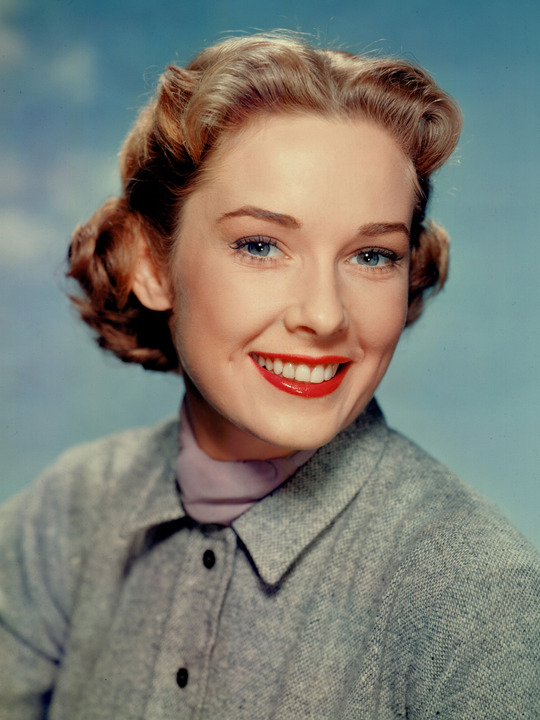
Novak was not the original choice to play Madeleine/Judy. Hitchcock had initially cast Vera Miles, with whom he had a heavy-handed personal contract. Hitchcock had adopted a Svengali-like attitude with Miles, trying to craft her into “his” type of actress by dictating her appearance and building her into a kind of Grace Kelly clone (as Hitch had recently lost his favorite star to Monaco’s Prince Rainier). But Miles was forced to drop out of the project due to pregnancy, and as a result, Hitchcock lost interest in the actress (though he would still go on to cast her as Janet Leigh’s sister in 1960’s Psycho). Years later, he would tell Francois Truffaut, “She became pregnant just before the part that was going to turn her into a star.”

It’s interesting to consider how closely Scottie’s attempts to “make over” Judy into “lost” love Madeleine mirror Hitchcock’s own attempts to craft Miles into the “perfect” cinematic star. More than any other film in his oeuvre, Vertigo represents Hitchcock’s cinematic quest to “build” the perfect woman, one made over in precisely the image he desires. To put it bluntly, Novak’s Madeleine/Judy most clearly embodies the old idiom (fully embraced by Hitchcock) that men want a lady in the drawing room and a whore in the bedroom. To that end, the character is a subtly sexy blonde whose deceptively icy, composed, and chic appearance hides a shrewd mind and a leashed, but potentially voracious sexuality.

And yet, despite her flaws and her deceptive behavior, Madeleine/Judy is one of the more sympathetic Hitchcock blondes in that her struggle to reconcile her love for Scottie with her guilt over deceiving him about her role in the real Madeleine’s death forces the audience to feel some sense of compassion for her. We witness her dilemma; we understand intrinsically that her acquiescence to Scottie’s mad desire to recreate the “real” Madeleine comes from a place of desperate love. She agrees to let him clothe her in Madeleine’s sophisticated style, to have her makeup done and her nails shaped as Madeleine’s, and even gives in when Scottie insists she color her now-brown hair blonde. Her plaintive response to his pleas to dye her hair is heartbreaking in its eagerness to earn his love: “If I let you change it, will that do it? If I do what you tell me, will you love me?”

There are those who claim that Novak is too stiff in her performance in Vertigo, that there is something unnaturally wooden about her interpretation of Madeleine/Judy. But I tend to agree with film critic Roger Ebert, whose reflection on Vertigo praises Novak’s presentation of the character: “Ask yourself how you would move and speak if you were in unbearable pain, and then look again at Judy.” Every element of Novak’s performance, particularly in the wake of the real Madeleine’s death, is carefully constructed to convey the character’s inner turmoil. She has broken the rules—she has fallen in love with her mark. And her punishment is that he cannot love her as herself, as Judy: he needs “Madeleine.” She knows nothing she does short of donning the mantle of “Madeleine” once more will earn her what she needs from him. It’s the last thing she wants to do … and yet, because she loves Scottie, she cannot—will not—deny him his desire.

The entire film comes down to that single five-minute sequence in which Judy “becomes” Madeleine again. Scottie waits impatiently for Judy to return from her makeover, and is displeased that her newly blonde hair has not been pulled back from her face in Madeleine’s signature updo. He sends her into the bathroom to complete the transformation and waits anxiously for her to emerge. When she does, she is bathed in a hypnotic, strange green light (ostensibly reflected from the neon sign hanging outside the hotel room window), a dreamlike effect that makes it appear as though Madeleine is moving back from the murky past into the solid present. This sense is highlighted through Hitchcock’s brilliant composition of the scene, as Scottie kisses Madeleine and is swept back into a memory of their time together in San Juan Batista while the camera rotates around the embracing couple in a smooth 360 turn.


The uncertain, yearning expressions on her face, the stilted movements of her body as she walks in that gray suit once more—everything Novak does is masterfully composed in order to show us just how miserable Judy’s situation really is in that moment. “Judy” is now the one who is dead and Madeleine—the double, the false identity—is her new reality, and must remain so if she wishes to keep Scottie’s love and attention. And the utter hopelessness that comes from that realization is written all over Novak’s face in this scene, effectively foreshadowing Madeleine’s second (and permanent) demise.

It is fitting that Vertigo has, in retrospect, turned out to be the defining role of Kim Novak’s career, because the film features what is undoubtedly the best performance she ever gave on-screen. Her role as Madeleine/Judy remains one of the most intriguing Hitchcock blondes, a mesmerizingly intense woman brought to blazing, impressive life by a truly talented young performer in the capable hands of a truly talented director in his prime. I can’t help but imagine what more Hitchcock and Novak could have done, had they been paired in another film together at some point. What other depths could he have uncovered in her, and what other cinematic brilliance could they have created, had they just been given the opportunity?


~

Brandie Ashe is a freelance writer and editor from Alabama. An inveterate classic movie fan since discovering the films of Shirley Temple and the Marx Brothers as a child, she indulges her obsession at her blog, True Classics. In 2011 True Classics was honored with two CiMBA Awards from the Classic Movie Blog Assn., one for Best Classic Movie Blog Event and another for Best Profile of a Filmmaker. In addition, her blog was nominated for a 2011 Lammy  Award  from the Large Assn. of Movie Blogs in the Best Classic Movie Blog category. 


Saturday, January 7, 2012

by guest contributor Christian Esquevin


“I don’t wear suits, and I don’t wear gray. Another thing, I don’t wear black pumps,” said Kim Novak to Edith Head, the costume designer for Vertigo. “I don’t care what she wears as long as it’s a gray suit," Hitchcock retorted when Edith reported this conversation to him. Thus began the creative tension over the costuming of Vertigo. But in a clash of opinion over the visual aspects of a Hitchcock film, Hitch always prevailed. Indeed, he had the colors already in mind along with the costume types he wanted even before pre-production for Vertigo began. Kim Novak wore the gray suit with the black pumps - her iconic look in Vertigo. “I had never had a director who was particular about the costumes, the way they were designed, the specific colors,” said Novak about Hitchcock later.


The story theme within Vertigo is based on obsession, and the costume looks for the Madeleine/Judy character are a key symbol of that dysfunction. The “clash” that Kim Novak had with Hitch and Edith Head over her costumes was nothing new in Hollywood, but Alfred Hitchcock’s very specific clothing demands in type and color speaks volumes about Vertigo being for him a very personal film. The combination of the costumes and look of Kim’s Madeleine, the psychological tension caused by the character Scottie’s clash of opposite impulses towards Madeleine/Judy, and the ultimate futility of his possession of her, were all deeply embedded in Hitchcock’s psyche. As far as the costumes being good fashion, it didn’t matter that Kim’s pumps were black. They would have looked better in gray or brown, or as she wanted, in tan to match her nude-toned hose. Wearing flesh-toned pumps was an old trick she’d learned from Marlene Dietrich, a device to make your legs look longer. The gray suit was in a neutral and sedate color. Hitch believed it revealed how the Madeleine character felt about herself. Edith Head often designed gray suits for her film costumes, and wore them regularly believing that it gave her a non-competitive look when working with the stars. But Marlene Dietrich had worn a gray suit for Hitch in Stage Fright, as had Doris Day in The Man Who Knew Too Much, and as Tippi Hedren would wear in The Birds. So the gray suit and black pumps touched something within Hitchcock, and along with the blonde hair of his leading actresses, denoted for Hitchcock the “woman of mystery,” the cool and subtle beauty with a blazing inside.

The color of the costumes and the sets had a symbolic meaning for Hitch as well. The gray represented modesty. When Jimmy Stewart as Scottie first sees Kim playing Madeleine, she wears a black gown but is covered in a green opera coat at Ernie’s Restaurant. The wallpaper of the restaurant forms a red background that vibrates with the green in these color opposites. For some reason green represented death for Hitchcock. Madeleine’s car is also green. It’s in the following scene where Scottie begins tailing Madeleine that she first wears the gray suit.  Scottie’s former love interest Midge is dressed in warm colors and soft fabrics – symbols of her nurturing proclivities towards Scottie. After Scottie saves Madeleine from drowning, she is dressed, albeit in his robe, in a vibrant red. Here the color evokes life and full-bloodedness. Then in a later scene when Scottie and Madeleine drive to the shore, she is dressed in black and white – a black dress with black gloves and a white coat. The black and white in this costume denotes not the un-ambiguous nature of her character, but rather the duality of her persona. As an added fillip, her black chiffon scarf blows freely with the ocean wind, perhaps a symbol of mystery, or one of doom.


As the character Judy, Kim Novak is costumed by Edith Head to appear dowdy. She wears green – a green sweater made bulky by being worn over a blouse. The blouse is green with white polka-dots and with a peter-pan collar turned over the sweater. The look is accentuated by an unflattering hair style. The total look is purposefully unappealing. This look has several purposes: to define the character of Judy in contrast to Madeleine’s; to appear that she is “hiding” her identity; and to provide a stark difference with Madeleine in order to dramatize her make-over. When they go on a date and later go shopping for her clothes, she is dressed better but still very simply. The make-over itself is a key dramatic moment in the film, Judy’s reluctance, Scottie’s obsession in turning her visually into Madeleine, complete with gray suit and blonde hair, provide dramatic tension and then release at the conclusion of the scene. This scene is accomplished through various film techniques that dramatize her unveiling as the re-incarnated Madeleine – making her entrance bathed in a pale and ethereal green light and leading to a climactic kiss. Her gray suit, here as before, tightly accentuates her curves. In its contradictory fashion, it is sedate but seductive.


The nature of the costumes, and the make-over, reverberated not only with the character’s roles, but with the actor’s and the director’s deep psychology. Hitch exercised his darker side in molding an actress into his own obsession, while directing Jimmy Stewart to do the same. Kim Novak as Judy wondered why Scottie couldn’t love her as she was, just as Kim Novak really felt about Hollywood in general. But the gray suit worn with the black pumps allowed Kim Novak to not only be in character, but by taking her out of her comfort zone in dress enabled her to more effectively be an actress that plays a part of a character that is pretending to be someone else.


Hitchcock must have recognized his own dilemma in creating Vertigo. At the climactic end, Scottie demonstrated his tragic disappointment with Judy, “He made you over just like I made you over,” he says accusingly to Judy. Only he (Elster) had made her over first, and thus Scottie was only re-creating another man’s fantasy. And perhaps worse, he accused her of being “an apt pupil,” which she hadn’t been for him. That demonstrated to Scottie, and served the film’s underlying theme, that the pursuit of an empty ideal is futile. For Hitchcock, it was a deeply ingrained motif, one that would keep repeating itself as he tried to mold one Hitchcock blonde after another into his fantasy, only to have her leave him. With the character Scottie, this creation fantasy was played out not as a means of domination, but rather one where once his fantasy woman was created, he could surrender and succumb to her. But we know that that too would have been another fantasy - another twirling and spiraling movement creating a feeling of vertigo.


Vertigo received several Oscar nominations, including Best Art Direction. Edith Head was not nominated for Best Costume Design, which was won by Cecil Beaton’s florid Gigi. And she had just been snubbed for her outstanding costumes for Grace Kelly in Hitchcock’s To Catch a Thief. It seems that a fabulous gray suit as character-delineating costume was too subtle to pick up awards. No matter, she had already won five of her eight Oscars by then. Worse, Hitch wasn’t nominated either for this iconic classic.


~

Christian Esquevin is the author of Adrian: Silver Screen to Custom Label, published by the Monacelli Press in 2008. The book is about the life and career of MGM’s famed Golden Age costume designer Gilbert Adrian and his subsequent fashion business. Christian also produces the Silver Screen Modiste blog covering classic film fashion.

Christian was born in Marseille, France, and moved with his French parents to Los Angeles when he was four. Los Angeles had a small but close-knit French community at the time that provided the social context for his youth in 1950s and 1960s L.A. One of his great-aunts was the vendeuse for lingerie at the art-deco palace Bullock’s Wilshire. Another one of Christian’s great-aunts had been the Head Cutter-Fitter for the old RKO Studio Wardrobe Department in the 1930s, where she worked under Walter Plunkett and supervised the fabrication of the costumes for Ginger Rogers, Katharine Hepburn, Lucille Ball, Anne Miller, and the other RKO stars. Her knowledge and skill in making period costumes was an influence on Plunkett’s specialty in that area. While she had retired by the time Christian arrived in L.A., she used to dress him and his mother and other French-heritage participants in traditional French folk costumes for the Disneyland holiday parades and other ceremonial occasions. She bequeathed him her collection of costume sketches and photographs that started his interest in classic film costume design.

Christian has a Master’s degree in Library Science from USC and is the Director of the Coronado, California, Public Library. Christian’s book on Adrian was the result of several years of research and collecting. The lack of an “Adrian archive” and the disposal of much of the early film studios’ material heritage has fueled his efforts to preserve at least one aspect of film history. He is currently working on a combined biography of the costume and fashion designers Walter Plunkett, Irene (Lentz Gibbons) and Helen Rose. He is a collector of original costume design sketches and has organized several exhibits featuring film costume design based on his collection. Christian launched Silver Screen Modiste in 2009 in order to cover the history, heritage, and fashion influence of classic Hollywood costume design. He has written about Edith Head in several posts and considers her work with Alfred Hitchcock to be among her finest.

Wednesday, January 4, 2012

by guest contributor Whistlingypsy


Just as my fingers on these keys
Make music, so the self-same sounds
On my spirit make a music, too.
~ excerpt from Peter Quince at the Clavier by Wallace Stevens

"I don’t think Mozart’s going to help at all."
~ Midge in Vertigo

British composer Ralph Vaughn Williams, who greatly influenced young Bernard Herrmann and for whom he had a great admiration, took the subject of film score composition seriously and in encouraging his contemporaries to do the same said, “I believe that the film contains potentialities for the combination of all the arts such as Wagner never dreamed of, and I would therefore urge those distinguished musicians who have entered the world of the cinema to realize their responsibility in helping to take the film out of the realm of hack work and make it a subject of a real composer.” Music constitutes an essential part of the film experience, yet we often fail to acknowledge its importance to the way we perceive film. This is not to say that music is comprehensible only to those who have formal training; to the contrary the ability to appreciate music is a capacity we all share. The often overlooked genius of composing for film in general, and of Bernard Herrmann specifically, is an ability to work within the parameters of music theory while exploiting the viewer's instinctive knowledge of musical conventions, creating a lush musical landscape perfectly suited to the emotional content of the image captured on film.

Composer and conductor Bernard Herrmann was born on June 29, 1911 at New York City’s Lying In Hospital, the eldest of three children born to Abraham and Ida Herrmann. Benny, as he was known to his family, suffered a major health crisis at an early age in the form of St. Vitus’s Dance, which he barely survived. He spent much of his time as a boy and a young man reading biographies of artists and composers, learning musical works through his father’s collection of 78rpm recordings and attending live performances of the New York Philharmonic at Carnegie Hall. His literary discoveries through the New York Public Library included the Treatise on Orchestration by Hector Beriloz (he was familiar with the composer’s Symphonie Fantastique and later claimed the book convinced him to become a composer). Herrmann wrote many small-scale works as a teenager, most of which remain unpublished. He studied music at the Juilliard Graduate School, and at the age of twenty he formed the New Chamber Orchestra of New York.

He joined the Columbia Broadcasting System in 1934 where David Ross, CBS’s top announcer, asked Herrmann to compose music for his poetry reading series. Herrmann’s setting for La Belle Dame Sans Merci (a favorite poem at the time) so impressed CBS executives that he was given a job conducting and six years later became Chief Conductor of the CBS Symphony Orchestra. Through his many and diverse projects for CBS, in 1938 Herrmann was selected composer-conductor for The Mercury Theatre on the Air, which brought him to the attention of Orson Welles. The young director left no room for negotiation in his meetings with RKO executives concerning his choice to score his film, and he insisted Herrmann should receive a competitive salary despite his inexperience, “If he’s good enough to do my score, he’s good enough to get the best price.”

Herrmann was no snob about cinema, he was familiar not only with American films and composers but also with their European counterparts, but he was well aware of the obstacles in composing for film. A film composer often completed scores in as little as two or three weeks, rarely had time to do his own orchestration, and once the music was written and conducted had little to say about the sound levels or dynamics of the score in the finished film. Herrmann was confident, however, that working with Welles would be different and it was with no small excitement that he announced his leave of absence to go to Hollywood. His career as a composer for film was demanding and rewarding, in addition to his outstanding scores for Citizen Kane (1941) and The Magnificent Ambersons (1942), he earned his reputation for glorious music on films such as Jane Eyre (1943), Hangover Square (1945) and The Ghost and Mrs. Muir (1947), all of which were about to bring him to the attention of another Hollywood genius, Alfred Hitchcock.

The sometimes variable nature of film composition often left the composer without work and Herrmann wrote the score, the first of two "television operas," for a 1954 television adaption of Dickens's classic holiday story. His original compositions for television also included The Twilight Zone from 1959 through 1964, for which he composed the original theme as well as scores for seven episodes (at least three of which were included as part of the Syfy Channel's New Year's Day marathon). His work for The Alfred Hitchcock Hour from 1963 through 1965 included original compositions for seventeen episodes.

Bernard Herrmann's "Concerto Macabre," Hangover Square

Much has been written regarding the turbulent end to the collaboration between Bernard Herrmann and Alfred Hitchcock, both from the composer’s and the director’s perspective. Herrmann and Hitchcock were, for most of their eleven years of collaboration, friends as well as associates and Steven C. Smith, author of A Heart At Fire’s Center, observes, “The rapport between the two was strong from the start.” The Hitchcocks often played host to the Herrmanns; Benny and Lucy were invited to spend the weekend at Hitchcock’s secluded Bel Air home, where days were spent in leisurely conversation and evenings spent enjoying Alma’s superb cooking.

Jack Sullivan, author of Hitchcock’s Music, suggests the director’s relationships with his composers were often passionate, and as often troubled, in part because the director was "intoxicated by and knowledgeable about music.” Hitchcock's music and sound notes for Vertigo were more specific than on past projects, but what finally emerged as Herrmann’s film score is very different from what Hitchcock had planned. The film’s original title, From Among The Dead, was a reference to the French novel on which the story is based, and Herrmann’s composition was to be supplemented by passages from a lost score that had haunted the director for decades.

Hitchcock had seen Mary Rose, a dramatic tale of lost love regained written by J. M. Barrie, during the play’s London run in 1920 and became enthralled by the music of Norman O'Neill.

The Musical Times and Singing Class Circular, Volume 62 dated March 1, 1921, described the composer and his work for Mary Rose as follows: “A dreamer of dreams and a mystic, Norman O’Neill has the power of expressing in his music the ethereal world in which he dwells. His flights of fancy, intangible though they are, touch a responsive chord in the hearts of the imaginative. . . .The ‘Mary Rose’ call continued to haunt the ear with gentle insistence long after it had reached echo-land.” Hitchcock was especially struck by 'the Call' connected with the heroine's disappearance, he later remembered the sensation as "celestial voices, like Debussy's Sirenes nocturne." Hitchcock twice failed to uncover the music, which he had also intended to use as part of the Rebecca film score, and as usual he deferred to Herrmann with memos and notes reflecting his confidence in the composer, "Mr. Herrmann may have something to say here" and "All of this will naturally depend upon what music Mr. Herrmann puts over this sequence."

Esa-Pekka Salonen and the Los Angeles Philharmonic, Debussy's "Sirenes nocturne"

If there is truth in the notion that music is the language of the inexpressible; Bernard Herrmann’s film score for Vertigo has given a voice to an ordinary man who finds himself in extraordinary circumstances. Herrmann’s main title sequence intentionally avoids an identifiable melody, exploits unpredictable rhythmic changes and flirts with tonal ambiguity. Kathryn Kalinak, author of Settling The Score observed, "The combination of violins and tubas played in alternately ascending and descending arpeggiated chords (played in succession rather than simultaneously)" and moving in contrary motion creates an asymmetry (if you will) of sound keeping the viewer continually off guard musically. Herrmann's main title music is heard first, but the musical effect in combination with Saul Bass's visual imagery in the opening credits reinforces the feeling of vertigo. The visual acts as counterpoint to the music; the spiraling images create a visual vortex in the same manner the music creates a spatial vortex and the viewer enters the world of the film suspended between two possibilities. Film criticism often invites the amateur “to see into” the life of a film, which results in as many interpretations of dramatic themes and visual cues as there are viewers. Film music makes a distinction between the life experienced by the characters and the life viewed by the audience.


The classical film score can often combine nondiegetic music, music heard by the audience but not experienced by the characters, and diegetic music, music heard as part of the world in which the characters move and live. The two instances in which diegetic or “live” music occur in Vertigo are scenes of emotional significance for Midge and Scottie. The first occurs after a bit of magical thinking on the part of Hitchcock, when Scottie is inexplicably delivered from hanging precariously between life and death. The scene opens on a cozy domestic setting, the man and woman could be husband and wife, could be brother and sister. We learn about both through their comfortable exchanges and through the use of music. John-O, as she calls him, and Midge share a past but appear uncomfortable in their present relationship. Her choice of music, an Overture by J. C. Bach, and her taste in contemporary furniture slyly hint that she is comfortable making brief visits to the past while living very much in the present. He is uncomfortable sitting in her Eames style chair and tells her the music is the cause of his vertigo (all important cues in the events that will soon engulf Scottie). The second, and perhaps more significant, occurs in the use of Mozart’s 34th Symphony as “a rope from heaven” to draw Scottie from his abyss of acute melancholia with guilt complex.

Musical therapy was first used after World War I in an attempt to reach veterans suffering from profound mental trauma, and Scottie's musical therapist has told Midge that Mozart is the boy for him (Author and physician Oliver Sacks relates in Musicophilia: Tales of Music and the Brain not only is music haunting, irresistible and unforgettable, but "music occupies more areas of our brain than language does and humans are essentially a musical species"). Scottie responds to Midge, following her with his eyes and turning his head in her direction, but we can't help but agree with Midge that Mozart isn't going to help at all.

James Stewart’s Scottie is half enthralled to possibility, but remains half captive to reality. A man no longer content with his passivity in the face of life’s acting on him; he is trapped in a sort of tenacious, immaterial fantasy rendering him incapable of action. In his ability to capture the ineffable quality of this character’s waking nightmare, Herrmann essentially created a film score that can be heard on two levels simultaneously. His use of leitmotifs reminiscent of both Wagner’s Tristan and Isolde and Berlioz’s Symphonie Fantastique, share thematic similarities but are by no means derivative. Herrmann is here demonstrating his comprehension that some members of his audience will recognize the reference to these musical passages, while all will understand the emotional content of his music (an equivalent can be found in the screenwriter who includes lines of poetry by John Keats which reference the Romantic era against which the film is set. Those familiar with Keats’s life will understand the specific reference; those unfamiliar with Keats’s life will hear the beauty of the poet’s words).

Bernard Herrmann has been called "Hitchcock's Maestro," and while he might have been uniquely suited to capture the spirit of the dark and troubling tales the director brought to the screen, his work before the famed collaboration would establish his reputation. His affinity for the Romantic era, equally the composers as the poets, his "pastoral poetic gloom" and artful mourning of that which is irrevocably lost can all be heard in the hauntingly similar Portrait of Jennie (1948) for which he composed the theme song but was not credited. An observation regarding Vertigo highlights the intrinsic nature of Herrmann's score in the film's storytelling: close your eyes and listen to any passage and be immediately transported to locations and scenes in the film. The true power of Herrmann's score is in the music's ability to be heard independently from Hitchcock's images (the dream fades, the music lingers). Esa-Pekka Salonen, conductor of the Los Angeles Philharmonic Orchestra, recognized the art of Bernard Herrmann's film music, performing and recording many of Herrmann's compositions. Scene D’Amour is the moving heart of a poignant film portrayal of a man suspended between action and despair, death and life, love and obsession, themes worthy of any Romantic era composer.

In spite of myself, the insidious mastery of song
Betrays me back, till the heart of me weeps to belong.
~ excerpt from Piano by D. H. Lawrence.

Esa-Pekka Salonen and the Los Angeles Philharmonic, "Scene D'Amour" from Vertigo

~


Whistlingypsy/aka/Karin of Distant Voices and Flickering Shadows is a technical writer working on a contract/freelance basis who lives in the beautiful Hill Country of Texas. She was inspired by The Lady Eve (the blogger not the movie) to begin a blog and share her fascination for Jazz Age music and Silent Era films. She considers herself an enthusiastic amateur with an interest in films, music and writing.

Sunday, January 1, 2012

by guest contributor R.D. Finch


"What's that old Oscar Wilde thing? 'Each man kills the thing he loves...' That I think is a very natural phenomenon, really."
Alfred Hitchcock, in a 1963 interview

In his fifty-five year long career in films, Alfred Hitchcock directed sixty-seven movies. At least a dozen of these are bona fide masterpieces, and about an equal number are excellent movies that fall just short of the masterpiece mark. By any measure that's an impressive record, one unequaled by any other filmmaker I can think of. Even more impressive is that Hitchcock's pictures are not rarefied works of art of interest mainly to aesthetes and film scholars, but full-blooded movies that appeal equally to ordinary filmgoers looking for accomplished entertainments and to cinephiles looking for an intellectually and artistically stimulating film-viewing experience. Of all Hitchcock's pictures, none managed to combine these two modes—entertainment and art—so skillfully, so intriguingly, and so pleasingly as his 1958 film Vertigo.

 Most people are familiar with the plot of Vertigo. A retired San Francisco police detective, John "Scottie" Ferguson (James Stewart), psychologically traumatized after a rooftop chase to apprehend a criminal ends badly, is targeted as a dupe by his old college friend Gavin Elster, who exploits Scottie's crippling fear of heights to bring off an intricate scheme to murder his wife Madeleine (Kim Novak). The film's plot is a clever one and since this is a mystery thriller with hints of the supernatural (can Madeleine really be the reincarnation of her ancestor, as she believes?), neither the audience nor Scottie realizes what is really happening until quite far into the film. This allows the viewer's understanding of the situation to be manipulated, just as Scottie's is, to create a mood of suspense and, after the truth is revealed to the viewer about three-quarters of the way through the film, for that suspense to be prolonged as the film proceeds in a completely unexpected direction right up to its shock ending.

Such a narrative strategy requires that the viewer's reactions be precisely guided at every turn, and nobody was more expert at this than Hitchcock. Well known for his need for absolute control over all aspects of his films from conception to release, Hitchcock was by temperament the epitome of the film auteur, the director who puts his stamp on every element of his work. The way he accomplished this was by meticulous attention to detail. Because each shot was storyboarded in advance, the final film essentially needed no editing and thus was immune to tampering with by producers and studio executives. Like most filmmakers who began by directing silents, Hitchcock viewed cinema storytelling as essentially a visual process, with dialogue, music, and sound used to augment the film's imagery. Because the way he chose to show the action—placement and movement of the camera, the use of visual effects that formed his famous set pieces, the exact way images succeeded one another to form a spatial and narrative continuum—was the product of his own imagination, his films always seem expressions of a personal and very distinctive vision. Many directors have made movies in the Hitchcock style, but I can't think of a single one of these films that on close viewing could actually be mistaken for the work of the master himself.

Because of the convoluted and deceptive nature of its plot, Vertigo is even more dependent on Hitchcock's almost obsessive attention to detail as a means of controlling audience response than any other film he made. But in Vertigo he uses his working methods as much more than merely a practical means of telling a story in his own way. He amplifies his control-freak approach to directing until it becomes an all-encompassing aesthetic used to suggest a great deal more than is apparent in what at first seems little more than a deftly contrived suspense melodrama. It is this effect of using every device in his vast panoply of cinematic tricks to evince the complex psychological and thematic undertones of the film that makes Vertigo Hitchcock's greatest achievement. It's a haunting film that can be watched again and again and still continue to entertain and thrill and deliver new revelations.

Perhaps the most powerful and resonant thing about the film is the way Hitchcock uses repetition to emphasize the idea of doubling. Elements in the first part of the film recur later in the film, and elements in the later part of the film mirror those in the first part, giving the film a strange pattern of symmetrical associations. Scottie seeks out places where he saw Madeleine in the beginning of the film and revisits them later in the film: the missions, the florist's shop, the museum, Ernie's restaurant. He watches Judy at her hotel window the same way he watched Madeleine at her hotel window earlier. His transformation of Judy into Madeleine exactly duplicates Elster's transformation of Judy to pass her off as his wife.

Near the end of the picture Hitchcock expresses the complete fusion of Madeleine and Judy, of past and present, of Scottie's memories and his dreams, in the most striking of several memorable set pieces in the film—a long, passionate kiss between Scottie and Judy after he sees her for the first time as the fully re-created Madeleine. The camera swirls, Scottie and Judy swirl, and the room appears to revolve around them. The background fades from Judy's room to the stable where Scottie and Madeleine kissed for the last time and finally back to Judy's room again, while Bernard Herrmann's glorious music—clearly inspired by Wagner's Tristan und Isolde—surges and pulses in unison with the intense emotions of the passage. It's the most rapturously erotic scene in a Hitchcock movie since the kiss in Notorious.


Hitchcock was famous for his lack of interest in the acting of his performers, and for saying that actors should be treated like cattle, that is, prodded into doing what he needed for the shot he was working on. This was perhaps a holdover from his silent days, when facial expressions, body language, and movement were more important than character development and line delivery because the director essentially created the performance visually, through the staging and editing of the film. This is one reason experienced theater actors often found working with Hitchcock such a frustrating experience. Yet for all this, in Vertigo he gets two remarkable performances from his stars.

It is well documented that Kim Novak was not Hitchcock's first choice to play Madeleine/Judy; Vera Miles was. But by the time he was ready to begin shooting, Miles was pregnant and so somebody else had to be cast. I have no idea how he hit on the idea of casting Kim Novak, but I did notice that just as Elster and Scottie transform Judy into the image of Madeleine, Hitchcock almost seems to transform Kim Novak into an uncanny image of Grace Kelly, right down to her hair and makeup, and her accent and diction. I can't help wondering if one of the reasons Vertigo seems to be Hitchcock's most personal film is his own understanding of the compulsion behind Scottie's Pygmalion-like behavior.

At any rate, Novak, who under the right conditions could be a much better actress than she is generally given credit for, does a tremendous job as the mysterious, spaced-out Madeleine. But her more demanding incarnation as Judy is even more impressive. If Madeleine is an enigma, Judy is a fully defined character. Hitchcock and his writer, Samuel Taylor, make a daring narrative decision that happens soon after Scottie meets Judy. The conventional thing to do would have been to conceal the truth about the murder plot from the audience until the end then reveal it to the viewer and Scottie at the same time, in the kind of twist ending typical of films of this kind. Instead Hitchcock and Taylor devise a situation in which Judy writes a letter to Scottie explaining everything to him then impetuously tears it up before he sees it.

The audience is now aware of the true nature of events even if Scottie isn't, and the entire tone of the movie has changed. Now that we know the truth, the point of view shifts much more in Judy's direction. The crux of suspense is no longer what really happened, but how long will it take Scottie to figure it out and what will be his reaction when he does. What all this means for Novak's performance is that she can no longer play her character as an enigma, but must externalize the conflict Judy feels about what she has done to Scottie and the ambivalence she feels about his controlling attitude. Novak's role immediately becomes much more demanding, and she handles the requirements of those demands admirably. If only she looked less like a caricature of a rather common shopgirl!

But the real center of the movie is James Stewart's Scottie, a character who inspires Stewart to give one of the most remarkable performances of his career. We tend to think of the screen persona of James Stewart as that of an optimistic, boyish everyman. But in truth Stewart's characters often had a dark side to them, a willfulness that threatened to cause the passion of their emotions to spill over into obsession. We tend to forget this because until Vertigo, even though that dark side might threaten to take over whatever character Stewart was playing—George Bailey or even Jefferson Smith for Frank Capra or one of the revenge-driven men in the Westerns he made with Anthony Mann, for instance—at the end of the film his character always managed to pull back from the brink before he went over the edge. Hitchcock himself perceived the latent darkness in Stewart's screen image and used it as a sort of dangerous recklessness in the characters Stewart played in Rope and Rear Window. But in Vertigo, for the first and only time I can think of, Stewart's character is completely overcome by the darkness in him and propels the film to a catastrophic conclusion.

During the course of the picture, Stewart must convincingly go through a series of changes that illustrate the stages of the disintegration of Scottie's personality. At the beginning of the movie, he seems like the familiar James Stewart. He has experienced a traumatizing event, his life has been drastically changed by it, and he must live with the handicap of disabling acrophobia. But his resilience and sense of proportion intact, he seems able to cope with the changes in his circumstances. As he reluctantly follows Madeleine, he finds his detective's curiosity about this mysterious woman aroused. Curiosity soon turns to fascination and then to passionate love. At this point he is already beginning to lose his objectivity as he desperately tries to rationalize Madeleine's delusional behavior.

After Madeleine's death, he is a broken man, a state he conveys in his scenes in the mental hospital through his dazed expression and total lack of affect. If he seems to have regained a precarious sense of balance after several months of treatment, he begins to lose it as soon as he first spots Judy. As he grows closer to her, he progressively loses control of himself until he has become an emotional juggernaut moving inexorably toward the annihilation of both himself and the object of his love. This idea that external and internal forces could collude in such a way to transform a person's ego into an unstoppable engine of destruction is a chilling one indeed.


By the film's conclusion, Hitchcock has carefully guided us to a place where he is at last able to make the point he has been aiming for all along: the fine distinction between passion and obsession, between real life and dreams, between creation and destruction. The death of Judy at the end makes real the fake suicide that was staged for Scotty's benefit earlier. What began as make-believe has taken on a terrible life of its own and become reality, a reality born of the destructive potential when love overpowers reason.

~ 

A nearly life-long cinephile, R. D. Finch lives in rural Northern California. His favorite films are the classics (roughly 1930-1980), both American and foreign. His blog,The Movie Projector, was honored with two CiMBA Awards in 2010 from the Classic Movie Blog Association: Best Film Review (Musical or Comedy) for his post Love Me Tonight (1932), and Best Classic Movie Article for his piece The Best Fred Astaire Musicals Without Ginger Rogers.