Wednesday, November 16, 2011


I'm looking forward to spending some time with one of my favorite families this Thanksgiving weekend, Hannah and Her Sisters (as well as her other relatives and friends).

Dianne Wiest, Oscar winner
Hannah and Her Sisters, Woody Allen's, by turns, clever and outright hilarious 1986 classic, has been judged by many as his best film of the 1980s, but I think it might well be the best of his best work. Allen's own Oscar-winning script is a tour de force testament to his astounding facility as a screenwriter - he has a record 14 screenplay Oscar nominations to his credit; he's won two (the first for Annie Hall in 1977). Two member's of the film's superb ensemble cast, Dianne Wiest and Michael Caine, were awarded supporting Oscars for their performances. Allen himself delivers one of his own very best and Max von Sydow (who has some of the film's best lines, which is saying something) and Lloyd Nolan are especially memorable in slightly-more-than-cameo roles.

The film begins with one family Thanksgiving dinner and ends with another. Opening credits roll as the Harry James Orchestra croons "You Made Me Love You," and the story begins to the same band's snappy version of "I've Heard That Song Before." It is Thanksgiving in Manhattan and Hannah's family comes together in her spacious, character-drenched, softly-lit Upper West Side apartment. The parents of Hannah (Mia Farrow) and her sisters, a crusty and eccentric pair of old-school show biz troupers (Lloyd Nolan and Maureen O'Sullivan) take a moment to sit down at the piano and sing a duet on "Bewitched, Bothered and Bewildered," a tune that recurs, usually by way of tinkling ivory keys, throughout the film. Meanwhile, Hannah's husband Elliott (Michael Caine) has been ruminating on his fascination with his wife's sister, Lee (Barbara Hershey).

O'Sullivan and Nolan
A tumble of interconnected episodes from the lives of family and friends flows between the two Thanksgivings. Mickey (Woody Allen), ex-husband of Hannah and future husband of her sister Holly (Dianne Wiest), goes through a health crisis that leads to a spiritual crisis; Lee is unfaithful to her long-time lover (Max von Sydow) with Elliott. Bickering between the sisters' parents gets ugly and leads to bawdy, if amusing, accusations.  Along the way, flashbacks reveal bizarre and comical past events (bad first dates are traditional fodder for hilarity, but who knew infertility could be so entertaining?). By the second Thanksgiving, life seems to be on a more harmonious course for Hannah and Her Sisters. Elliott and Hannah are once again content with each other, Lee has married an entirely new man and Holly and Mickey, who once went through a date from hell, are now wed. A maid fusses with candles on the dining table, "I'm in Love Again" can be heard in the background, on piano, and one of the couples shares a private, irony-tinged moment...fade to black.

'Holly and Mickey' in Central Park
As so often with Woody Allen's films, Manhattan's alluring presence lingers in the background...Central Park, Greenwich Village, 5th Avenue, the Chrysler Building, Columbia University, The Carlyle Hotel, CBGB's - east side, west side, all around the town - accompanied by scintillating tunes that accentuate story and setting. The soundtrack is saturated with some of the great American standards of 20th century song: "Where or When," "You Are Too Beautiful," "Isn't it Romantic," "If I Had You," a Dave Brubeck version of  "I Remember You," Count Basie's "The Trot," "The Way You Look Tonight" sung by Carrie Fisher, "I'm Old-Fashioned" sung by Dianne Wiest - not to mention Bobby Short performing "I'm in Love Again" at the Carlyle...plus interludes of Bach and even a moment of "Madame Butterfly."

Hannah and Her Sisters brims with warmth as it casts a wry gaze on the misadventures of its confused but not-difficult-to-relate-to characters. It deservedly earned three Academy Awards (Weist, Caine, Allen) and was also nominated for Best Picture, Best Director, art direction and editing.  It is a gem.

~

The gifted Mr. Allen, now 75, is the auteur director of more than 40 films over the past 45 years, a writer on nearly 60 films and actor in 40+. Along with his screenwriting Oscars, he's won a Best Director award for Annie Hall. Allen began as a comedy writer for Sid Caesar's popular Show of Shows during TV's golden age of the 1950s, became a successful stand-up comedian, had short stories published in The New Yorker and wrote two Broadway hits, Don't Drink the Water and Play it Again, Sam. Today he continues to make films and also performs as a classic New Orleans-style jazz clarinetist.

Woody Allen (center) on the set of Hannah and her Sisters
Woody Allen has had one of the most prolific, varied and celebrated careers of the 20th and 21st centuries. My own favorites of his films are Hannah and Her Sisters, Bullets Over Broadway (1994) Match Point (2005) and Midnight in Paris (2011). Also on my list are Annie Hall (1977), Broadway Danny Rose (1984), Stardust Memories (1980) and Play it Again, Sam (1972). I haven't seen every one of his films and haven't loved everything he's done (Curse of the Jade Scorpion and Interiors come to mind), but I admire his lifelong devotion to creatively exploring and expressing his own unique personal vision - and I'm deeply grateful for the decades of intelligent entertainment and long, loud laughs he has given me.

Many thanks to Chris of Movies Unlimited's MovieFanFare website and Ivan of LAMB's 'Classic Chops' for republishing this post during Thanksgiving week 2011.

Wednesday, November 9, 2011


For a few years now, Turner Classic Movies has traditionally aired The Uninvited (1944) during Halloween season. A gothic mystery/romance with a lighter heart than Rebecca (1940), The Uninvited is another of my cold night favorites.


Though lacking any gun or knife, let alone even a drop of blood or a hint of gore, The Uninvited can subtly spook the unsuspecting viewer. The action begins jauntily enough as a pair of vacationing Londoners, brother and sister, hike the cliffs of Devon and Cornwall and find, fall in love with and purchase a long-empty mansion overlooking the sea. The two later come to the realization that their new home is haunted and that their new friend, the former owner's lovely granddaughter, is a target of the malevolent apparition who inhabits the house. This is a phantom whose arrival, sometimes partially materialized, brings with it a penetrating chill that terrorizes all who encounter it...including the family pets. And there is the sudden overpowering scent of mimosa that signals an unseen presence as it fills a room. Heightening these spine-tickling proceedings is a rapturous score by Victor Young with a haunting motif that later became the popular standard, "Stella by Starlight." The film was directed by Lewis Allen and photographed by cinematographer Charles Lang (Midnight, A Foreign Affair, The Magnificent Seven, Charade) who was Oscar-nominated for The Uninvited.

The Uninvited stars Ray Milland, one of Paramount's most charming and enduring players, and Ruth Hussey as the brother and sister duo. Donald Crisp is the former owner of 'Windward House,' and Gail Russell appears in her first film role as his granddaughter, Stella. Cornelia Otis Skinner portrays one Miss Holloway, a sinister creature reminiscent of Rebecca's Mrs. Danvers - and any number of characters played by Gale Sondergaard...


Cornelia Otis Skinner as Miss Holloway

This year in tandem with watching The Uninvited, I read the book on which it was based. Irish author Dorothy Macardle's novel was first published in 1942, four years after du Maurier's smashing success, Rebecca, appeared in print and two years after the enormously popular Hitchcock/Selznick 'picturization' was released. It, too, is of the modern gothic genre with roots reaching back to Bronte's Jane Eyre.


Macardle's book is engaging, lively and, though not equal to du Maurier's classic in any sense, it entertainingly transports today's reader to a time, place and world view now several decades gone. Macardle could weave a tale and hold one's attention, telling her spooky story of warring spirits from the first person perspective of the protagonist, Roderick Fitzgerald, a London journalist whose move to the seaside brings with it hair-raising adventure, a new turn in his writing career and new love.

Dorothy Macardle
Author Dorothy Macardle, I discovered, was involved in far more than writing novels during her 69 years (1889 - 1958). Born in Ireland into a well-heeled brewing family, she taught after graduating from college but was soon involved in political and social activism. She gained an international reputation as an Irish nationalist writer and was an intimate associate of Eamon de Valera, a leader in Ireland's fight for independence and president of country from 1959 to 1973. Macardle is best known today for her historical opus, the nearly 1,000 page The Irish Republic, an account of Ireland's struggle for freedom between 1916 and 1923. Quite amazing that the woman could also write a plausible ghost story in her spare time...

The adaptation from novel to screen is largely faithful. The book is peopled by a greater variety of characters and the back story of each principal is more detailed. On screen, the haunted mansion's name changed from 'Cliff's End' to 'Windward House,' Roderick Fitzgerald is referred to as 'Rick' rather than 'Rod' and Miss Holloway's role is expanded. Fitzgerald's profession was changed from writer to composer - perhaps in order to ease giving Victor Young's "Stella by Starlight" its center-stage moment in the film.

Young's theme for The Uninvited enhances the film's romantic and mysterious story. By comparison, Franz Waxman's score for Rebecca, though also dramatic and powerful, seems to me, at times, overwhelming. I knew Bernard Herrmann had, when he was with CBS Radio, scored an earlier radio presentation of Rebecca and I found this intriguing given his later association with Hitchcock.

In December 1938 Orson Welles' Campbell Playhouse (formerly the Mercury Theatre on the Air) premiered and featured the first radio adaptation of Rebecca; it starred Margaret Sullavan as the second Mrs. de Winter, Welles as Maxim de Winter and Mildred Natwick as Mrs Danvers. Bernard Herrmann provided the score:


In the end, the music Herrmann scored for Rebecca eventually made its way to the screen; much of it was used in Jane Eyre (1943) starring Orson Welles and Joan Fontaine.

Gail Russell
19-year-old Gail Russell, in her screen debut as Stella Meredith, is another high point in The Uninvited. Fresh-faced, with dark, tousled hair and long, thick lashes, Russell projects a fetching mixture of fragility and intensity as a young girl faced with a deadly threat just as she experiences first love. Russell followed The Uninvited with a role in Our Hearts Were Young and Gay - coincidentally, she portrayed Cornelia Otis Skinner in the film (she played Skinner again in Our Hearts Were Growing Up). In 1945 Russell was cast in a quasi-sequel to The Uninvited called The Unseen (with Joel McCrea), and she made a number of films co-starring with John Wayne, who befriended her when they made Angel and the Badman in 1947. But Russell's life and career were blighted by serious personal demons. A beautiful teenager who'd been embarrassed by the nickname "The Hedy Lamarr of Santa Monica High," she had long suffered from crippling shyness. When Paramount Pictures came calling she agreed to pursue a movie career; her mother had insisted, the family needed money.  Russell developed a habit early on of drinking before she faced the cameras - it helped steady her nerves. This habit developed into a deadly addiction that shortened her life; she died in 1961 at age 36.

The characters of Stella Meredith in The Uninvited and Rebecca's second Mrs. de Winter are fairly similar - both are young, inexperienced and in need of  protection and guidance. But one character evolves more than the other. Throughout The Uninvited, Stella remains a maiden in need of rescue by older, wiser Roderick Fitzgerald. In Rebecca, the second Mrs. de Winter begins as an awkward, coltish young lady utterly intimidated by all that her new status as bride of an aristocrat brings. But when Maxim de Winter confesses his role in Rebecca's death and reveals his vulnerability, her transformation into a more confident, assured woman begins. Fontaine's portrayal of this maturing is seamless.
Joan Fontaine as the second Mrs. de Winter
Joan Fontaine, who became a star with Rebecca, enjoyed continued success. Cast again by Hitchcock in 1941's Suspicion, with Cary Grant, she won a Best Actress Oscar for her performance. Other noteworthy films include Jane Eyre in 1943 with Orson Welles and Max Ophuls' stunning Letter From an Unknown Woman (1948). She continued to work in film and on TV until the mid-1990s and just recently celebrated her 94th birthday; she and her older sister Olivia de Havilland, however, remain estranged...

My meanderings through Rebecca and The Uninvited on page and screen began as I sought enjoyable ways to spend the crisp, dark evenings that come with the late months of the year. This quest brought several cozy nights charged with chills, thrills and romance and now I'm tempted to continue...perhaps with another foray into the realm of the gothic  -  once defined as the Cinderella story gone very wrong...

In the meantime, I've been trying out different hot drink confections to help fend off the chill. My latest experiments involve a healthier cocoa mix called 'WonderCocoa' and a new twist on the hot toddy called 'The Laureate.' Click here for ideas on what to sip to stay warm on a cold, dark night...

Wednesday, November 2, 2011


Halloween has come and gone, a time change looms (“fall back”) and winter is just around the corner. Early twilight and cool evenings are here and it seems to me that when the weather starts getting nippy and night falls early, nothing satisfies like a crackling fire, something either steaming or iced to drink and a well-chosen book or movie to settle into. What I'm reading and watching as autumn deepens this year are books and the films that were made of them.

The Uninvited, 1944
I’ve been reading Dorothy Macardle’s classic ghost story, The Uninvited, a novel that made its way to film by way of Paramount Pictures in 1944. I’d seen The Uninvited again recently and became curious about its original source material.  I’ve also picked up Daphne du Maurier’s romantic thriller Rebecca once more and have happily revisited the 1940 Hitchcock-directed Selznick production.

Rebecca, 1940
I don’t know how old I was when I first read the words, “Last night I dreamt I went to Manderley again,” but do know I was young because, when I came upon du Maurier’s description of 50-foot rhododendrons I didn’t know what they were or how to pronounce the word (...if only I could remember what I called them in my imagination back then...). As I re-read Rebecca, I realized how completely Hitchcock’s Oscar-winning film had supplanted the book, erasing nearly all but the opening line and “rhododendrons” from my memory.

The film is a generally literal adaptation, barring Production Code-dictated changes (most notably, Rebecca's death is accidental in the film rather than outright murder as in the book) and a few other alterations. This is largely thanks to producer David O. Selznick, who was wary when it came to tinkering with literature.

Selznick, Fontaine & Hitchcock at Academy Awards dinner
Hitchcock and Selznick weathered a famously rocky collaboration on Rebecca, Hitchcock’s first American film and his first under contract to Selznick International Pictures. The director counted himself lucky that Selznick was still involved with Gone with the Wind - which lessened his interference on Rebecca to some extent. For his part, Selznick was flabbergasted by the director’s stubborn habit of shooting very little ‘coverage’ – or extra footage, effectively “editing in camera” (filming only what he wanted for the final cut). Once Hitchcock completed the shoot, the producer did what he could to more explicitly stamp the production as his own. In particular he supervised the film’s score, having music added to almost every scene – which accounts for intermittent intrusions of musical bombast. Selznick biographer David Thomson writes that the producer learned that no matter how involved he was, “there were secrets of craft, nuance and meaning that only a director controlled.” According to Thomson, Rebecca had been a battle between director and producer that left Selznick feeling defeated.

He should not have been so glum. Rebecca is plainly a Selznick project, a glossy and rich first rate production. The film was an unqualified success and brought the producer his second Best Picture Oscar in a row, one of the two Oscars Rebecca won out of the eleven total nominations it received. But Selznick was accustomed to dominating his directors and Hitchcock had outfoxed him…

Despite the fact that Rebecca has been called the least ‘Hitchcockian’ of the director's films and that Hitchcock later virtually disowned it, it bears unmistakable signature touches. The character interpretations of Florence Bates (Mrs. Van Hopper) and George Sanders (Jack Favell) are darkly witty comic turns - entirely in the Hitchcock tradition. And from relatively inexperienced Joan Fontaine in the central role, the director determinedly mined the performance of her young life. Judith Anderson’s iconic Mrs. Danvers, a brilliantly shaded tour de force, evolved out of a collaboration between actress and director about which she remarked, “I knew I was in the presence of a master; I had utter trust and faith in him.”

Judith Anderson and Joan Fontain in Rebecca

Rebecca's visual style also bears the recognizable imprint of its director. Hitchcock and cinematographer George Barnes concocted a persistently foreboding atmosphere that permeates the film from its first frames.  In fact, the film's opening images - of Manderley's ornate iron-gated entrance, its misty landscape and the mansion's ghostly silhouette - are often cited as an influence on Citizen Kane. Hitchcock and Barnes also notably and inventively contrived to create a character, or the presence of a character, who never once appears onscreen - the titular Rebecca. The scene above beautifully illustrates...

Daphne du Maurier and her children at Menabilly
Daphne du Maurier once described Rebecca, her most well-known and popular novel,  as a study in jealousy. Many have offered opinions on what inspired the plot - was it du Maurier's relationship with her mother and father? Was it based on the writer's insecurities about her husband's beautiful, glamorous, dark-haired former fiancee? It is known that du Maurier spent time during childhood at two grand country mansions, Milton Hall in Cambridgeshire and Menabilly (which she later owned) in Cornwall, and that the two estates were both likely models for Manderley and its grounds. Regardless of conjecture about du Maurier's inspirations, few have questioned that Rebecca is a triumph of its genre - it has been continuously in print over the eight decades since its original publication.

Daphne du Maurier
Du Maurier's Rebecca is a shrewd, seductive 20th century update on the gothic mystery/romance. Its persistent lure is dream-like imagery and a vulnerable narrator's voice throbbing with melancholy and hinting at dark secrets and heartbreak. Soon enough the reader is trapped, like the second Mrs. de Winter, in the world of psychological torment that is Manderley.

For me, du Maurier's novel and the Hitchcock/Selznick film are, taken together, an unbeatable way to greet the season's chill...

Sunday, October 23, 2011

 
The Uninvited, from Paramount Pictures in 1944, is an elegantly spooky Rebecca-esque romance with more than one haunting quality. Yes, Windward House, the sea cliff-situated home central to the story, is haunted by a malevolent woman’s ghost, but the film’s music is equally haunting (though not at all spooky).

Victor Young (who composed the film’s Rachmaninoff influenced score) and his orchestra introduced “Stella by Starlight” in The Uninvited. The melody is a thematic refrain throughout, but takes center stage in a romantic scene between Ray Milland (Roderick Fitzgerald) and Gail Russell (Stella Meredith). The pair is spending an evening together at Windward House and Rick begins to play the music, which he has written, on his grand piano:

(Jan. 2013 update: sadly this video is no longer available on YouTube)


Victor Young wasn't Academy Award-nominated for his rhapsodic score for The Uninvited, but did garner 22 Oscar nominations over his prolific career. He was nominated for as many as four films in a single year, but his only win came posthumously, for Around the World in 80 Days (1956). His scores for Golden Boy (1939) and Written on the Wind (1956) were among many nominated for the gold statuette - and he also scored The Palm Beach Story (1942), Shane (1953), Johnny Guitar (1954) and The Country Girl (1954). Young died in 1956 with hundreds of film credits to his name.

As with Laura, another notable film of 1944 with an evocative musical theme, song lyrics were composed for "Stella by Starlight" after The Uninvited was released and became a popular movie. In 1946 Oscar-winning lyricist Ned Washington (“When You Wish Upon a Star”/Pinocchio and “Do Not Forsake Me, Oh My Darlin’”/High Noon) created lyrics to accompany the music.

In 1947, two versions of "Stella by Starlight," one recorded by Frank Sinatra the other by the Harry James Orchestra, climbed the pop charts. In 1952, iconic saxophonist Charlie Parker made the first jazz recording of the tune; the song remains both a popular standard and jazz standard today.

Wednesday, October 19, 2011

Bette Davis, The Private Lives of Elizabeth and Essex  (1939)

When I received an email from Rick Armstrong the other day telling me that I'd been awarded the Classic Movie Blog Association's 2011  "Best Review/Drama" CiMBA for my post on The Private Lives of Elizabeth and Essex, I was thrilled - and also surprised. The post had originally been my entry in CMBA's "Movies of 1939 Blogathon" last spring and I'd always thought of it as something of an outlier, being about a film that isn't generally counted among the truly great films of that much-vaunted movie year.
I took another look at the post and read it with, I'll admit, a certain amount of pride (deserved or misplaced...who knows), and what came through most for me as I re-read my own words was the depth of my admiration for Bette Davis. I remembered that The Private Lives of Elizabeth and Essex, though a moneymaker for Warners and a nominee for five Academy Awards, was bereft of statuettes and plaques. And I thought with some satisfaction (and cheek), "At last, Bette, this film that you were so eager to make, that you insisted was your 'tankard of tea,' has won an award!"

Thanks to everyone who voted for my CiMBA entry - as well as those who simply liked it.  I'm honored.

Saturday, October 8, 2011


For Carole & Company's "Carole-tennial (+3)," marking the 103rd anniversary of Hollywood legend Carole Lombard's birth, I'm taking a look at my favorite Carole Lombard film, director Ernst Lubitsch's To Be or Not to Be (1942). This was Lombard's last film, released just a month after her death.

'The Lubitsch Touch' has been dissected and analyzed for decades. Billy Wilder, who had been protégé to director Ernst Lubitsch early on, put it succinctly: "The Lubitsch Touch is a light touch. But there are serious overtones in Lubitsch. He understood life..."
In 1941, Lubitsch signed a three year contract with Paramount Pictures. But first he had another commitment to fulfill with United Artists. To Be or Not to Be was part of Lubitsch's arrangement with UA.

Though the original story for the film was mostly Lubitsch's, the project that evolved was something of a departure for the director. As he later remarked, "I was tired of the two established recognized recipes, drama with comedy relief and comedy with dramatic relief. I had made up my mind to make a picture with no attempt to relieve anybody from anything at any time."

To Be or Not to Be is a comedy both black and broad; it is also a sophisticated and razor sharp satire on the Nazis.

Actors...and Nazis, To Be or Not to Be
Lubitsch chose radio superstar Jack Benny for the male lead. Benny, who later observed that it was "impossible for comedians like me and [Bob] Hope to get good directors - that's why we made lousy movies," considered Lubitsch "the greatest comedy director that ever lived" and was eager to work with him. Though Miriam Hopkins was up for the role of Benny's onscreen wife, she was only interested in taking the part if it was enlarged for her. Jack Benny was meanwhile pushing for Carole Lombard in the role. One night Benny and producer Alexander Korda went out on the town together; much drinking ensued and the upshot was that Korda wired UA and asked the studio to hire Lombard.

Lubitsch and Lombard knew each other from her early days on the Paramount lot. While the director had made pictures with the other great Paramount leading ladies, Claudette Colbert and Marlene Dietrich, he and Lombard had never managed to work together. Lombard's husband, box office king Clark Gable, was not excited about To Be or Not to Be and referred to Lubitsch as "the horny Hun." But Lombard had always wanted to work with the director and signed on; her only special request was that Irene design her wardrobe.

The production had its share of problems. To begin with, Jack Benny was jittery. According to co-star Robert Stack, he was "scared to death." Benny's source of discomfort was that while he knew how to deliver his lines on stage and on radio, he didn't know what to do when it came to a movie set. This made him very nervous.

Another problem concerned musical director Miklos Rozsa. Rozsa was set to score the film but once he saw the script and realized it was a satire on Nazism, he refused; he just didn't see the humor.

Carole Lombard and Robert Stack on the set
Regardless of these and other difficulties, the atmosphere on the set was a happy one. Lombard developed a habit of driving in from Encino, even when she wasn't scheduled, just to watch Lubitsch at work. According to Jack Benny, "Everyone was in awe of him."

To Be or Not to Be opens in Warsaw, Poland, just before the Nazi invasion. A man who appears to be Adolf Hitler is walking the streets, creating a stir.  The man, it turns out, is not Hitler but a local actor named Bronski (Tom Dugan) who is about to portray Adolf Hitler in an anti-Nazi play; he is testing his believability in public.

The plot centers on the acting troupe Bronski is part of, the Theatre Polsky, and its two stars, Josef and Maria Tura (Benny and Lombard). The troupe is rehearsing an anti-Nazi play, Gestapo, but is forced to revert to a less controversial drama, Shakespeare's Hamlet. A running gag concerns Maria, who is carrying on with a young pilot (Robert Stack). Whenever Josef begins Hamlet's "To be or not to be" soliloquy on stage, Maria's eager young man conspicuously shuffles out of his theater seat to meet her. The walk-out of an audience member in the midst of this speech completely flusters the actor (who has no idea why the man has left). Josef Tura's Hamlet is heavy on the ham and, as one Nazi character remarks, "What he did to Shakespeare we are now doing to Poland." The troupe eventually becomes involved with the Polish resistance.

Lombard is well-matched with Benny, who was never better and never had a better role. The two shared exquisite timing and much panache, and their scenes together could be shown in a master class on playing comedy. The fine ensemble cast includes venerable Felix Bressart (as an actor relegated to "spear carrier" roles but who has his moment to quote Shakespeare, eloquently) and Lionel Atwill along with Sig Ruman, Stack and Dugan.

Billy Wilder elaborated on another aspect of Lubitsch's genius, "The Lubitsch Touch is the superjoke. You have a joke, and then you don't expect the joke on top of the joke that tops the first one. The joke you didn't expect is funnier than the one you expected..."

The sequence below ends with one of Lubitsch's great "toppers." Sig Ruman's character (aka/'Concentration Camp Ehrhardt') is a Nazi colonel with a habit of blaming his own mishaps, mistakes and misunderstandings on his inept second-in-command, Captain Schulz. In this scene, the "topper" is Ehrhardt's final exclamation, a late addition to the script by Lubitsch...

Sig Ruman, Carole Lombard (and Tom Dugan) in To Be or Not to Be

The picture wrapped just before Christmas 1941, and Carole Lombard promised Jack Benny she would guest on his radio show once she returned from an upcoming war bond drive. But on the evening of January 16, 1942, the plane returning Lombard and her mother from the bond drive, along with 20 others, crashed into a mountain west of Las Vegas. All aboard were killed. Apparently the pilot had changed course, flying toward Las Vegas rather than his official destination, Boulder, Colorado. The plane had almost missed the mountain peak, crashing only 120 feet from the top.

To Be or Not to Be premiered on February 15, 1942. It was not a hit. Some critics claimed Lubitsch had suffered a lapse in taste. Churlish Bosley Crowther of the New York Times accused the director of  going for cheap laughs. Robert Stack later said that the press of the time just didn't get it. He noted that Lubitsch was "a Jew from the Old Country himself" and declared that To Be or Not to Be was the best satire on Nazism ever made.

Lubitsch was appalled that his intent and his taste were both misinterpreted and maligned. He acknowledged that he hadn't depicted Nazi terror in the typical way with outright violence, "My Nazis are different; they passed that stage long ago. Brutality, flogging and torture have become their daily routine. They talk about it the same way as a salesman referring to the sale of a handbag."

Lombard and Lubitsch
It isn't surprising that critics and audiences of early 1942 may not have warmed to or understood Lubitsch's approach. The country had suffered Japan's attack on Pearl Harbor and entered World War II just as the production of To Be or Not to Be was coming to an end. Those early days of the war were deeply patriotic times in the U.S. and the outcome of the conflict was still far from certain. Other wartime movies generally presented a more traditional portrait of our enemies and their victims - unequivocal, distinctly unfunny and in stark black and white terms.  Lubitsch's witty satire had arrived in American theaters at the wrong moment. But the passage of time has been kind to To Be or Not to Be. It long ago entered the pantheon of Lubitsch's great masterworks - that very special place where Ninotchka (1939) and The Shop Around the Corner (1940) also abide.

Carole Lombard, a natural as vain but appealing Maria Tura, was never more elegant or disarming. Though her character is clearly 'a woman of affairs,' Lombard endows her with so much warmth, humor and humanity that Maria is never less than entirely sympathetic. Such was Lombard's irreplaceable talent.


To learn more about Carole & Company's "Carole-tennial (+3)" blogathon and participating blogs, click here...
Carole Lombard, 1908 - 1942

References:
Ernst Lubitsch: Laughter in Paradise by Scott Eyman
Nobody's Perfect: Billy Wilder, A Personal Biography by Charlotte Chandler

Monday, October 3, 2011


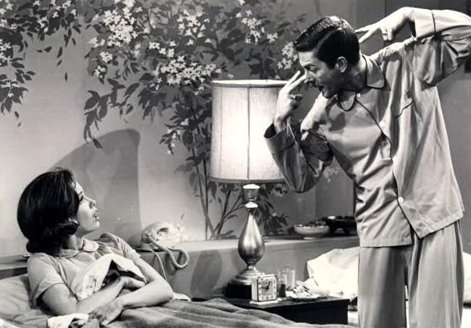
Today marks the 50th anniversary of the premiere of The Dick Van Dyke Show and this post is my contribution to the tribute blogathon hosted by Thrilling Days of Yesteryear. Click here for more on participating blogs...


In 1991, Nick at Night acquired and began airing The Dick Van Dyke Show, that sitcom über-classic originally shown on CBS from 1961 -1966. Thrilled to be able to once again watch a favorite series I hadn’t seen in 25 years, I was ready to celebrate "our television heritage” with Nick at Nite...


To hear that tune and see those faces again was uplifting. The Dick Van Dyke Show lost none of its charm over the years. It sparkled still with that trademark mix of sophistication and slapstick ingeniously created by Carl Reiner, written by Bill Persky and Sam Denoff and performed by an unparalleled cast comprised of old pros and newcomers.

TV's first lady
America's first lady
Of course, I noticed a thing or two about the show that I hadn't long, long ago. One thing that caught my eye was that Rob and Laura Petrie (Dick Van Dyke and Mary Tyler Moore) resembled nothing so much as a loosened-up, middle-class (and very funny) rendition of John F. and Jackie Kennedy, who were in the White House when Dick Van Dyke premiered and through its early years. Later I learned that on the day JFK delivered his famous inaugural address ("...ask not what your country can do for you..."),  the cast and crew of The Dick Van Dyke Show were filming the show's first episode. Who knew that two New Frontiers would open on the same day...

Laura Petrie was a perkier sort of of Jackie Kennedy. She was a cooking, cleaning, singing, dancing, housebound helpmate whereas the first lady masterminded state dinners, kept up with the arts, treasured all things French and spent weekends riding horses. But both ladies were fashion trendsetters. Beautiful Jackie popularized not just pillbox hats but an overall look of elegant simplicity. Meanwhile, New Rochelle's lovely Laura Petrie started a fashion craze of her own when she wore Capri pants...


CBS at first objected when Mary Tyler Moore began wearing pants on the show. For the most part TV housewives of that time were usually seen puttering about their homes in dresses (and, in June Cleaver's case, pearls and heels), and Laura-in-pants made the network nervous. Moore and producer Carl Reiner had agreed that since her character spent so much time at home, it made sense for her to dress casually. Within a few short years Time Magazine was proclaiming that Moore had "helped make Capri pants the biggest trend in US casual attire."

In the early '90s, as I watched Laura whip up a cake (or was she frying liver?) on Nick at Nite, I felt a sudden wave of nostalgia for the age of single-income families and stay-at-home moms.  Laura's life seemed so simple. She had most of her day to herself. While Rob was at work and Ritchie in school, all she had to do was keep the house and clothes clean, make sure there were groceries in the kitchen and food on the table. Rob probably even handled the bills! I didn't take this line of forbidden thinking very seriously for very long - but it gave me pause as I recalled my youthful scorn for the world of the housewife. A few years after The Dick Van Dyke Show ended, Mary Tyler Moore moved on to her own show. No longer a housewife on the New Frontier, she resurfaced as that beyond-iconic single working woman, Mary Richards of WJM-TV, Minneapolis. As I write this it occurs that, like Mary, I (eventually) became a single woman working for a local TV station - hadn't really thought about it before! Time to toss my hat in the air...

The first episode of The Dick Van Dyke Show aired 50 years ago tonight (2600 weeks ago tomorrow night at 8:00) - here's what viewers saw when they tuned in: